African Hawk-Eagle

Birds      AccipitriformesAccipitridae      Id. Record Geographic rangePictures
Aigle fascié

African Hawk-Eagle

Aquila spilogaster

Order  : Accipitriformes

Family : Accipitridae  ;

Biometrics :

Size : 55 à 65 cm
Wingspan : 130 à 160 cm
Weight : M: 1150 à 1300 gr - F: 1440 à 1640 gr

IUCN conservation status :

Extinct
Threatened
Least
concern
Extinc
in the Wild
Near
threatened
Not
evaluated

EX EW CR EN VU NT LC NE
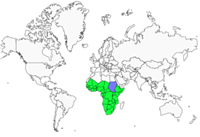
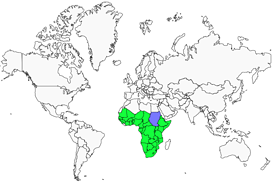
Geographic range :

Distribution sumatran.trogon

Synonyms : Águila-azor Africana (es), Aquila minore africana (it), Afrikanischer Habichtsadler (al), Afrikaanse Havikarend (nl), African Hawk-Eagle (en)

Aigle fascié Physical description :
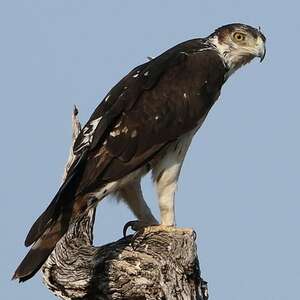
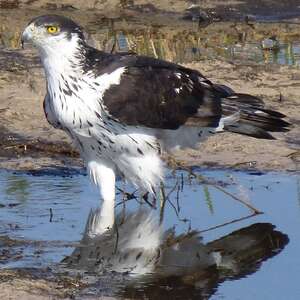
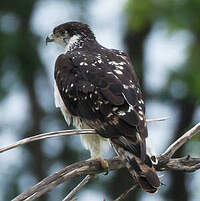
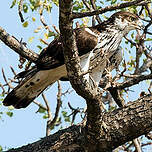
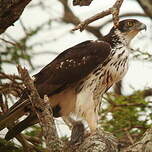
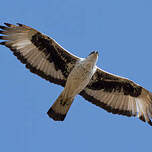
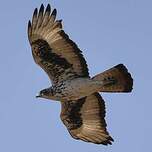
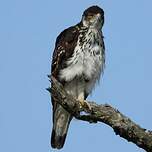
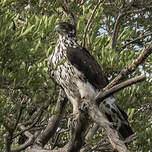
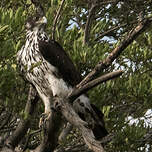
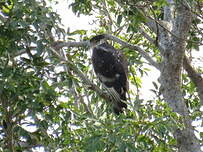
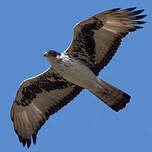
African Hawk-Eagle is a large bird of prey. Adult has black upperparts. Flight feathers are black. Primaries show broad white bases. Secondaries present narrow pale grey bars. Tail is black.
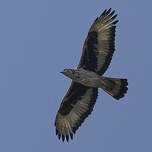
Underparts are white on throat and foreneck. We can se conspicuous black stripes on upper breast, underwing coverts and flanks. Lower belly and vent are white. Undertail is white, finely barred with dark, and with broad black terminal band. It has a broad black trailing edge.
On the head, crown and ear coverts are black. Hooked bill is black with yellowish cere. Eyes are deep yellow. Feathered legs are white. Long bare feet are greenish yellow.
Both adults are similar in plumage, but female is larger than male, and she is more heavily Aigle fascié streaked on underparts than male.
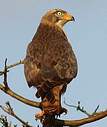
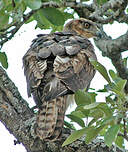
Juvenile has dark brown upperparts with pale rufous and white bars on wing coverts and scapular bases.
Underparts are rufous, with brown streaks on breast and coverts. Underwing is rufous.
Juvenile has duller wing and tail patterns than adults. It lacks the broad black trailing edges of adults.
Juvenile has rufous eyebrows, ears and throat. Eyes are brown. Cere is paler than in adults.

Voice : African Hawk-Eagle's call is a whistle sometimes musical 'kluu-kluu-kluu'. We can also hear an explosive 'kwee-oo' fading away. It is silent while flying.

Habitat : African Hawk-Eagle lives in open woodlands and scrubs, where it can find rocky cliffs and wooded streams. It may be found mainly up to 1500 metres of elevation, but sometimes up to 3000 metres. It avoids arid regions, preferring dry countries and savannah bushveld.
GEOGRAPHIC RANGE: African Hawk-Eagle breeds and is widespread in tropical sub-Saharan Aigle fascié Africa.

Behaviour : African Hawk-Eagle is a secretive bird of prey, often seen alone, but also sometimes in pairs, mainly when perched on exposed dead branch, or soaring high in the sky, or flying low over the ground, searching for prey.
African Hawk-Eagle searches for prey while flying, but also from a perch. It may catch preys taking them from the ground, or performing a dashing aerial pursuit. It hunts mainly birds as francolins, and small mammals.
It may hunt as a giant eagle with combined surprise and dash technique.

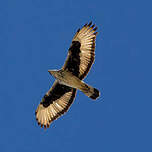
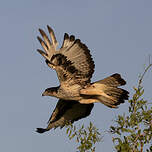
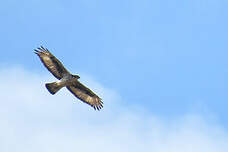
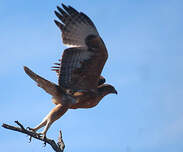
Flight : African Hawk-Eagle performs a fast flight with rapid and deep wing beats, as a large bird of prey. It often soars very high in the sky.

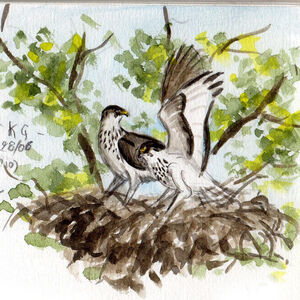
Reproduction-nesting : African Hawk-Eagle breeds in wooded hills, usually from May to July. It builds a large bowl-shaped nest of about one metre in diameter. Nest is located in a fork, in a tall tree, along wooded river banks. It is made with sticks.
Female lays one or two eggs. Incubation lasts about 43 to 44 days, shared by both parents. Only the strongest chick is reared if there is more of one egg.

Food habits : African Hawk-Eagle feeds mainly on birds (as francolin), small mammals and reptiles.

Protection / threats : African Hawk-Eagle is widespread in its range. It is less numerous during latter part of the rain season. It is locally common resident.  

Other links :
Iucn
Birdlife


Specification sheet created by Nicole Bouglouan


Qui sommes-nous ? L'association | Mentions légales | Sources | Contacts | Print version
Updated on 2008/04/29 05:36:33 - © 1996-2008 Oiseaux.net

L'aigle royal

Aigle fascié

Aigle fascié

Aigle fascié

African Hawk-Eagle