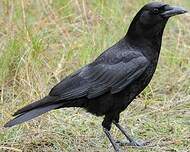
American Crow

Birds      PasseriformesCorvidae      Id. Record Geographic rangePictures

Corneille d'Amérique Physical description :
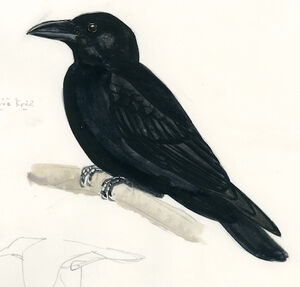
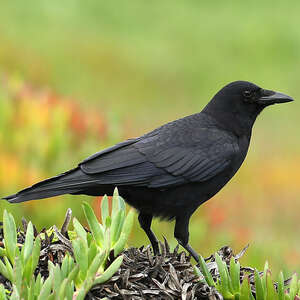
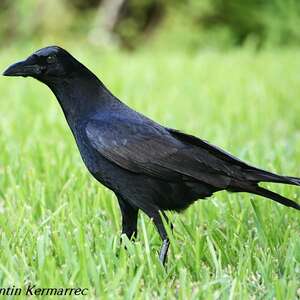
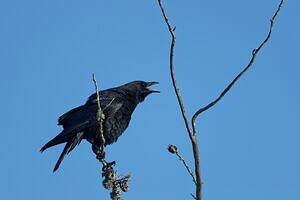
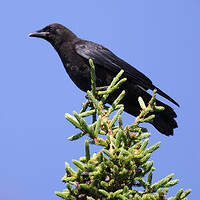
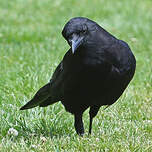
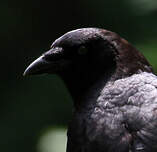
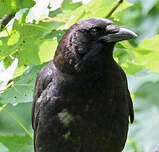
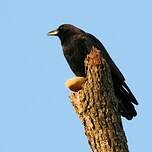
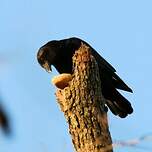
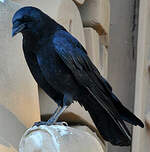
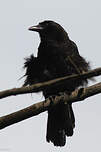
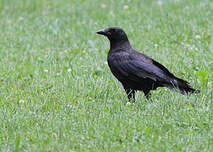
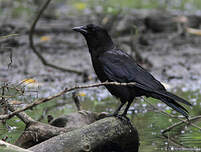
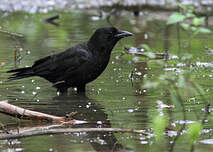
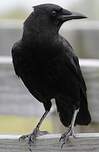
American crow has completely black plumage, but we can se purplish gleam in beautiful light. It has fan-shaped tail.
It has long, heavy black bill, slightly hooked at the tip. Eyes are dark brown. Legs and feet are strong and black.
Both sexes are similar, with male slightly larger than female.
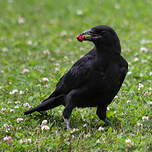
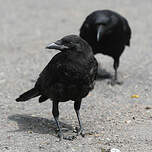
Juvenile resembles to adult, but it lacks glossy feathers. Wing and tail feathers become brownish during the first year. They have blue eyes.

Voice : American Crow utters a familiar harsh 'caw' call. Juvenile has higher pitched voice, a nasal 'cah' begging call.
Adults also utter rattles, coos and clear notes, sometimes given in chorus or duets, used as alarm calls.

Habitat : American Crow lives in a wide variety of Corneille d'Amérique habitats, but it prefers open areas with nearby trees. It needs cultivated areas and grasslands to forage for food. They roost and breed at the edges of forests. But they also may live in suburban areas and urban parks, or in coastal habitats.
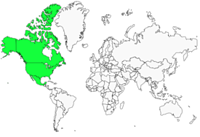
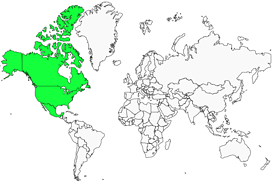
GEOGRAPHIC RANGE: American Crow is found in lower part of Canada, and throughout United States. It avoids desert regions.
It may winter from southern Canada southwards, but most of them are resident or perform short distance flights or dispersions.

Behaviour : American Crow mainly forages on the ground, by walking, and picking up items. It may also Corneille d'Amérique walk on tree branches. They can feed in small area when there are only few birds, but they also forage in larger groups in larger areas.
American Crow opens nuts with the bill, but another walnut or clam will be broken by dropping it from high elevation on hard surface. American Crow stores food in several places for later, in crevices or on the ground, covering it with leaves or other materials.
American Crows have a social system, living in family groups. They stay near the place where they were born, helping to raise young, and defending territories. They harass and chase predators, while calling strongly.
Family members often practice mutual preening.
American Crow Corneille d'Amérique roost in flocks, from tens to hundreds of thousands. They gather at the end of the day in areas with large trees, and then, they move to a final roosting at nightfall.
American Crow may join a third social group named 'floater group', including up to 50 birds. These birds lack mates, and they spend time on their natal areas, helping family groups. These 'floater groups' allow them roaming areas or vacant territories, with group protection.
American Crow is fond of anting. Bird lies on anthill, allowing ants to insert into its plumage to clean it and remove scales from feathers.
Courtship displays include dry rattling calls uttered in spring. It also performs diving flight Corneille d'Amérique displays, chasing females.

Flight : American Crow will fly as far as 50 miles to forage, returning to the roost each evening. Its flight is swift and performed at high elevation.

Reproduction-nesting : American Crow pair builds a nest mostly in conifer if available. Nest is usually located near the top, at about 20 to 60 feet above the ground. It is made with sticks and filled with mud and grasses. It is lined with bark, hair and soft materials. It is a large construction.
Female lays 4 to 5 eggs, pale blue green marked with brown. Corneille d'Amérique Incubation lasts about 18 days, by female. She is fed by the male, begging for food as a young bird.
Chicks hatch altricial. Both parents feed them with regurgitated food, and helpers join them. Young fledge at about 35 days after hatching. Parents and family members feed and protect them during summer.
Young reach their sexual maturity at two years.
This species produces one single brood per year.

Food habits : American Crow are omnivorous. In spring Corneille d'Amérique and summer, they eat insects and larvae, worms, fruits, grains and nuts. They may hunt and prey on frogs, mice, and even young rabbits. They are nest predators, eating eggs and nestlings.
They feed on nuts, walnuts and acorns, in autumn and winter. They take advantage of human garbage, and scavenge carrion on roadsides.

Protection / threats : Large roosts of American Crows are considered to be nuisances, when they are situated close to human activity areas.
Populations are increasing when associated with suburban areas.
American Crow is protected, but there is a hunting season in many states, and some permission when depredating agriculture.  

Other links :
Iucn
Birdlife


Specification sheet created by Nicole Bouglouan


Qui sommes-nous ? L'association | Mentions légales | Sources | Contacts | Print version
Updated on 2008/05/01 05:35:05 - © 1996-2008 Oiseaux.net

Le guide ornitho : Les 848 espèces d'Europe en 4000 dessins

Corneille d'Amérique

Corneille d'Amérique

Corneille d'Amérique

Corneille d'Amérique

Corneille d'Amérique

Corneille d'Amérique

Corneille d'Amérique

Corneille d'Amérique

American Crow