American Goldfinch

Birds      PasseriformesFringillidae      Id. Record Geographic rangePictures
Chardonneret jaune

American Goldfinch

Carduelis tristis

Order  : Passeriformes

Family : Fringillidae  ;

Biometrics :

Size : 11 à 13 cm
Wingspan : 19 à 22 cm
Weight : 11 à 20 gr

Longevity : 11 years

IUCN conservation status :

Extinct
Threatened
Least
concern
Extinc
in the Wild
Near
threatened
Not
evaluated

EX EW CR EN VU NT LC NE
Geographic range :

Distribution sumatran.trogon

Synonyms : Guldsiska (sv), Dominiquito Canario (es), Lucherino americano (it), Goldzeisig (al), Treursijs (nl), American Goldfinch (en)

Chardonneret jaune Physical description :
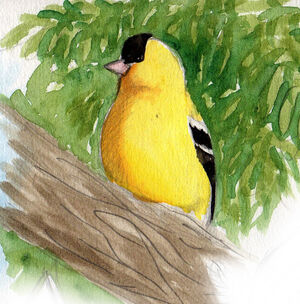
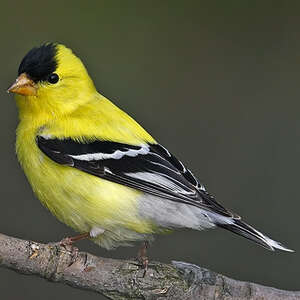
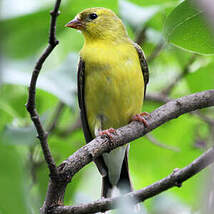
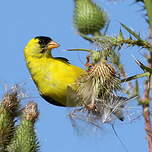
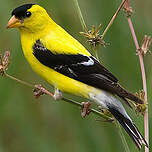
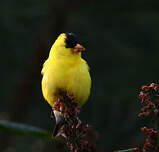
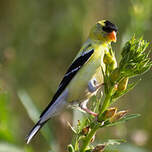
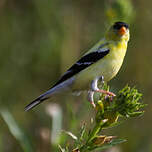
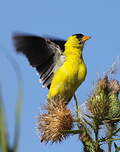
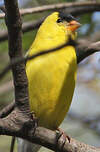
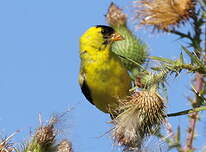
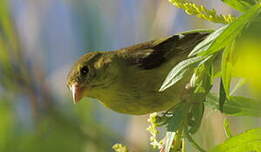
American Goldfinch male in breeding plumage is bright yellow with black cap. Wings are black, with white bars, and yellow patch on shoulders. Rump and vent are white. Tail is black and white.
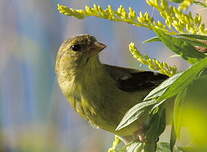
Bill is small, conical and pink. Eyes are black. Legs and feet are pink.
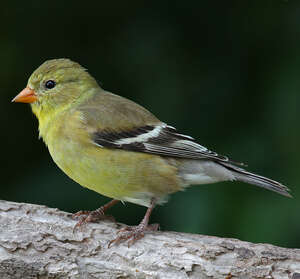
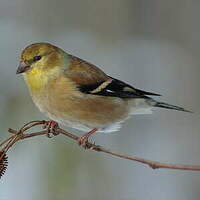
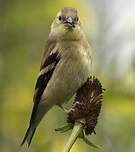
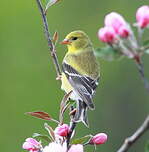
American Goldfinch female is duller than male. Upperparts are olive, including head which lacks black patch. Underparts are dull yellow.
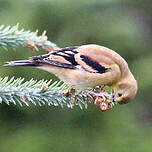
Winter adults and immature are either brownish or greyish above. Male shows some black on forehead. Bill is dark greyish brown.
Juvenile has brown upperparts with cinnamon-buff wing markings and rump. Underparts are pale yellow. Wings and tail are blackish.

Voice : American Goldfinch's song is a lively series of Chardonneret jaune trills, twitters and 'swee' notes. Song is high-pitched and long. Contact call is given in flight 'tsee-tsi-tsi-tsit'.
In flight, they utter 'perchicoree-perchicoree'. Alarm call is a soft whistle 'sweet', or a call 'bearbee-bearbee-bee-bearbee'.

Habitat : American Goldfinch breeds in weedy fields and flood plains, including open second growth woodlands, cultivated areas, orchards and gardens, roadsides.
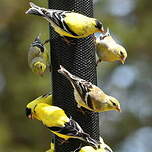
Winter habitats vary, and birds move near human feeders, into urban areas.
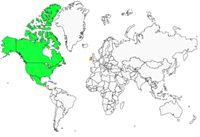
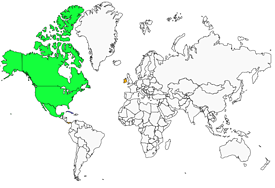
GEOGRAPHIC RANGE: American Goldfinch breeds from Chardonneret jaune Central Canada, and southwards to northern Nevada, Oklahoma and Central Georgia.
It winters from Canadian borders, and southwards to southern United States and into Mexico.

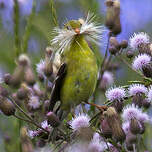
Behaviour : American Goldfinch is gregarious at all time of the year. It is a daytime feeder. It is well adapted to hanging on seed heads, but sometimes, it feeds on the ground. It is fond for thistles, eating its seeds, and using the down to line its nest.
In winter, it feeds in flocks, and during breeding season, in small groups.
If female is disturbed at nest, she goes to another nearly tree, and calls for the male. It passes and passes again on the wing, at some distance from intruder, in deeper curves than usual, and calling. When intruder is departed, male flies with joy to the nest with female.
Male establishes and marks its territory by warbling and flitting from perch to perch around its domain. As well, it circles and performs flying displays. Chardonneret jaune First, it is a low flat flight, and the other is an exaggerated undulation and series of loops.
American Goldfinch is the only bird of its type that gets its breeding plumage by moulting. In spring, birds shed and bills of both sexes turn orange. Male gains its bright yellow plumage and black cap. After a complete moult in autumn, both sexes get almost identical plumage in colour.
Male contributes to nest building, accompanying female for materials, and Chardonneret jaune while is perched nearby, singing and calling to female.
Courtship display shows the male chasing a single female, while she is flying in zigzagging manner. Pair may circle about, while male is warbling during its flight.
American Goldfinch is monogamous.

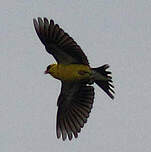
Flight : American Goldfinch has an undulating fly, beating its wings a few time to ascend, and closing wings to descend. When they fly in flocks, they appear as a light and dancing flock.

Reproduction-nesting : American Goldfinch is one of the latest breeders, because nestling food depends on the seeds of the thistles.
Female builds the nest in tree or in dense shrub. It is made with plant fibres and down. Lichens are woven and fastened by saliva. She builds a rim around the nest with bark, bound with spider webs and caterpillar silk. Nest is lined with soft materials. It is generally fixed on a Chardonneret jaune branch, and sometimes secured to one side of a twig only.
Female lays 4 to 6 pale blue eggs. Incubation lasts about 12 to 14 days, by female, fed by male during this period. Both parents feed the young with regurgitated seeds. Young are altricial. They fledge at about 17 days of age, and they follow their parents, but they are independent within a month's time.
This species produces one clutch per season, occasionally two. If female starts a second brood, male feeds the young of first clutch.

Food habits : American Goldfinch feeds on weed seeds, such as seeds from grasses, trees, and wildflowers. Its diet includes few insects, such as caterpillars and fly or wasp larvae.

Protection / threats : American Goldfinch has some predators, such as snakes, squirrels, Blue Jays, Hawks and cats. Brown-headed Cowbirds parasite American Goldfinches nests, but young die because they don't get enough food.
American Goldfinch helps control weeds by eating seeds, and people enjoy observing them in their gardens and feeders.
American Goldfinches populations are not decreasing. Introduction of agriculture and clearance of forests have benefited these birds. It is common and widespread.
It is widely known as 'thistle-bird' and 'wild-canary'.  

Other links :
Iucn
Birdlife


Chardonneret jaune

Chardonneret jaune

Chardonneret jaune

Chardonneret jaune

Chardonneret jaune

Chardonneret jaune


Specification sheet created by Nicole Bouglouan


Qui sommes-nous ? L'association | Mentions légales | Sources | Contacts | Print version
Updated on 2008/05/04 05:30:55 - © 1996-2008 Oiseaux.net

American Goldfinch

Chardonneret jaune

Chardonneret jaune

Chardonneret jaune

Chardonneret jaune

Chardonneret jaune

Chardonneret jaune

Chardonneret jaune

Chardonneret jaune

Chardonneret jaune

American Goldfinch