
American Kestrel
Falco sparverius - Crécerelle d'Amérique
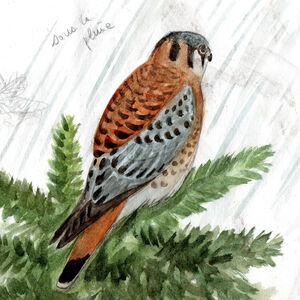
Systematics
-
Order:
Falconiformes
-
Family:
Falconidés
-
Genus:
Falco
-
Species:
sparverius
Descriptor
Biometrics
- Size: 31 cm
- Wingspan: 51 à 61 cm.
- Weight: 84 à 165 g
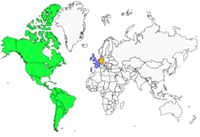
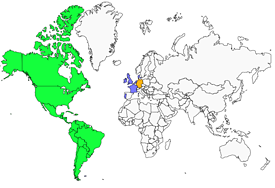
Geographic range
Identification
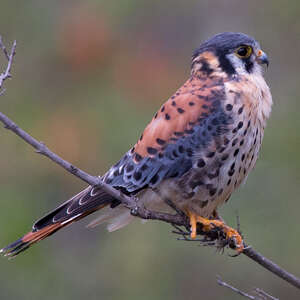
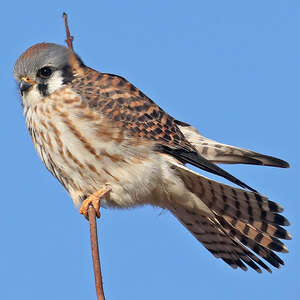
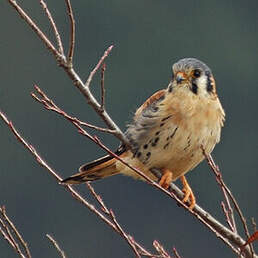
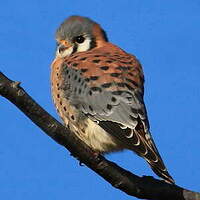
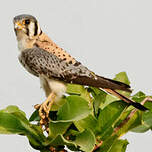
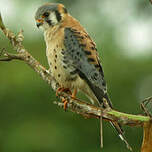
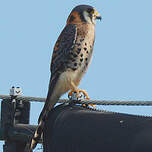
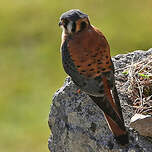
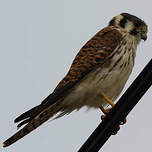
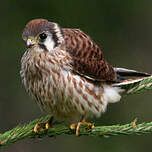
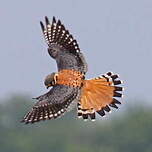
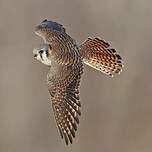
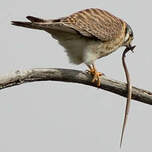
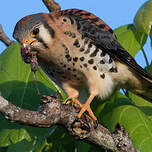
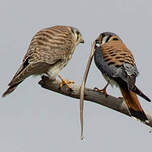
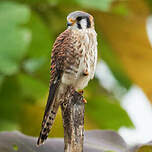
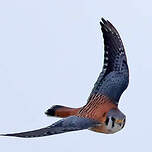
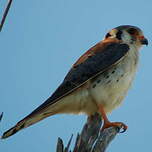
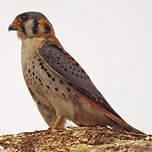
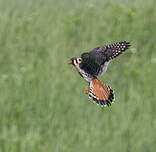
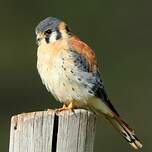
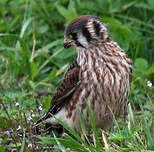
American Kestrel (Falco sparverius) is a species of bird in the Falconidae family.
Subspecific information 17 subspecies
- Falco sparverius sparverius (Alaska and Canada through the USA to w Mexico)
- Falco sparverius paulus (se USA)
- Falco sparverius peninsularis (nw Mexico)
- Falco sparverius tropicalis (s Mexico to n Honduras)
- Falco sparverius nicaraguensis (nw Honduras, Nicaragua)
- Falco sparverius sparverioides (Bahamas, Cuba)
- Falco sparverius dominicensis (Hispaniola)
- Falco sparverius caribaearum (Puerto Rico to Grenada. West Indies.)
- Falco sparverius brevipennis (Aruba, Curaçao, Bonaire. Netherlands Antilles.)
- Falco sparverius isabellinus (e Venezuela, the Guianas, n Brazil)
- Falco sparverius ochraceus (e Colombia, nw Venezuela)
- Falco sparverius caucae (w Colombia)
- Falco sparverius aequatorialis (n Ecuador)
- Falco sparverius peruvianus (sw Ecuador, Peru, n Chile)
- Falco sparverius cinnamominus (se Peru to Paraguay and Tierra del Fuego)
- Falco sparverius fernandensis (Alejandro Selkirk and Juan Fernandez Is.. Chile.)
- Falco sparverius cearae (s Brazil)
Foreign names
- Crécerelle d'Amérique,
- Cernícalo americano,
- peneireiro-americano,
- Buntfalke,
- tarka vércse,
- Amerikaanse Torenvalk,
- Gheppio americano,
- sparvfalk,
- Spurvefalk,
- sokol pestrý,
- poštolka pestrá,
- Amerikansk Tårnfalk,
- amerikantuulihaukka,
- xoriguer americà,
- Skrúðfálki,
- pustułka amerykańska,
- raibais piekūns,
- ameriška postovka,
- Воробьиная пустельга,
- アメリカチョウゲンボウ,
- 美洲隼,
- 美洲隼,
Habitat
Forest : Subtropical/Tropical Dry, Subtropical/Tropical Moist Lowland ; Savanna : Dry ; Shrubland : Temperate, Subtropical/Tropical Dry ; Grassland : Temperate, Subtropical/Tropical High Altitude ; Wetlands (inland) : Bogs, Marshes, Swamps, Fens, Peatlands ; Desert : Hot ; Artificial/Terrestrial : Pastureland, Urban Areas
Threats - protection
IUCN conservation status
Extinct
Threatened
Least
concern
concern
Extinc
in the Wild
in the Wild
Near
threatened
threatened
Not
evaluated
evaluated
EX
EW
CR
EN
VU
NT
LC
NE
Sources of information
- All About Birds, Cornell Lab of Ornithology
- Animal Diversity Web, University of Michigan Museum of Zoology
- Avibase, Lepage Denis
- Hawks, Eagles and Falcons of North America, Paul A. Johnsgard
- Vol. 2 - Handbook of the Birds of the World, Josep del Hoyo-Andrew Elliot--Jordi Sargatal
- Wikipédia, Wikipedia, The Free Encyclopedia
- IOC World Bird List (v14.1), Gill, F and D Donsker (Eds). 2024-04-18.
Other sources of interest

- Accipitriformes
- Aegotheliformes
- Anseriformes
- Apodiformes
- Apterygiformes
- Bucerotiformes
- Caprimulgiformes
- Cariamiformes
- Casuariiformes
- Charadriiformes
- Ciconiiformes
- Coliiformes
- Columbiformes
- Coraciiformes
- Cuculiformes
- Eurypygiformes
- Falconiformes
- Galliformes
- Gaviiformes
- Gruiformes
- Leptosomiformes
- Mesitornithiformes
- Musophagiformes
- Nyctibiiformes
- Opisthocomiformes
- Otidiformes
- Passeriformes
- Pelecaniformes
- Phaethontiformes
- Phoenicopteriformes
- Piciformes
- Podargiformes
- Podicipediformes
- Procellariiformes
- Psittaciformes
- Pterocliformes
- Rheiformes
- Sphenisciformes
- Steatornithiformes
- Strigiformes
- Struthioniformes
- Suliformes
- Tinamiformes
- Trogoniformes