American Tree Sparrow

Birds      PasseriformesEmberizidae      Id. Record Geographic rangePictures
Bruant hudsonien

American Tree Sparrow

Spizella arborea

Order  : Passeriformes

Family : Emberizidae  ;

Biometrics :

Size : 14 à 16 cm
Wingspan : 21 à 24 cm
Weight : 18 à 28 gr

Longevity : 10 years

IUCN conservation status :

Extinct
Threatened
Least
concern
Extinc
in the Wild
Near
threatened
Not
evaluated

EX EW CR EN VU NT LC NE
Geographic range :

Distribution sumatran.trogon

Synonyms : Tundrasparv (sv), Chimbito Arbóreo (es), Passero arboricolo americano (it), Baumammer (al), Amerikaanse Boomgors (nl), American Tree Sparrow (en)

Bruant hudsonien Physical description :
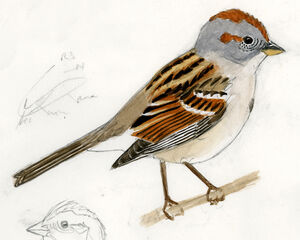
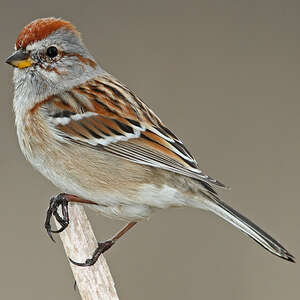
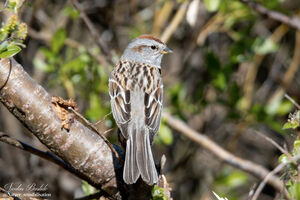
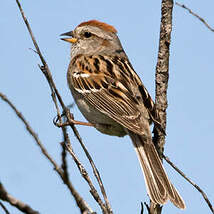
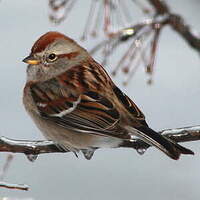
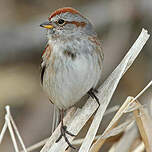
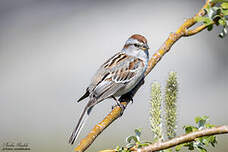
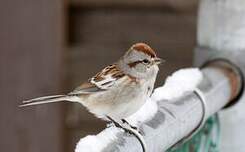
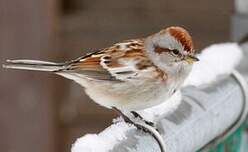
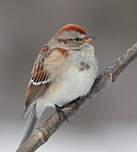
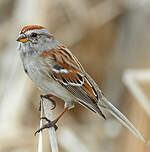
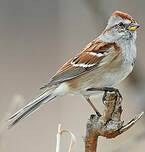
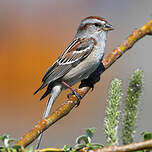
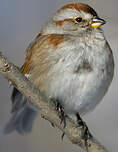
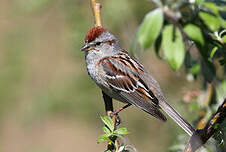
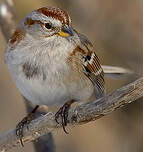
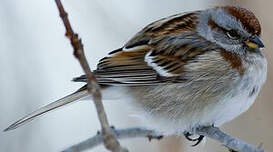
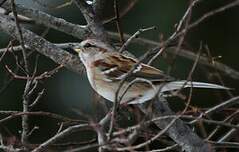
American Tree Sparrow has grey head and nape, and rufous crown. We can see rufous eyeline behind eye. Throat and breast are grey, with dark central spot on breast. It has rufous patches on breast sides. Back and scapulars are streaked black and rufous. Tail in notched, with outer feathers slightly edged in white. Underparts are greyish-white with buffy sides.
In winter plumage, American Tree Sparrow is buffer, with rufous colour on crown, forming a central stripe.
Bill is two tones, with black upper mandible and yellow lower mandible. Eyes are black. Legs and feet are black too.
Both sexes are alike.
Juvenile is streaked on head and underparts.
There are two subspecies, western subspecies is paler and slightly larger Bruant hudsonien than eastern.

Voice : American Tree Sparrow's call is a musical 'teedle-eet'. It also utters a thin 'seet'. Song begins with several clear notes, followed by a variable and rapid warbler. Both sexes use calls, but male sings only one song. In flight, call is a high and sharp 'tsiiw'.

Habitat : American Tree Sparrow breeds along edge of tundra, above treeline in the far North, in open areas with scattered trees.
It winters in fields, marshes, Bruant hudsonien gardens, open forests and residential areas.
GEOGRAPHIC RANGE: American Tree Sparrow breeds from western Alaska to Labrador, and southwards to northern British Columbia and Quebec.
It winters from southern Canada, southwards to northern Arizona, northern Texas and South Carolina.

Behaviour : American Tree Sparrow is migratory, and migrates during the night.
To feed, it is a diurnal bird. American tree Sparrow is omnivorous, eating insects in summer and vegetal food in winter. It forages by scratching on the ground, but also along branches Bruant hudsonien and twigs of trees and shrubs. It frequents bird feeders, often in flocks. It needs to drink 30% of its weight each day, or during winter, by eating snow. In snowy fields, it may beat tall weeds with their wings and collects the seeds on the ground.
American Tree Sparrow uses sounds and physical displays to communicate. Songs are used to defend territory, and to attract mates. Males and females sing when are feeding or alarmed. Bruant hudsonien
Birds are territorial in breeding season. Male sings and defends territory, while female sometimes chases intruders. They don't actively defend their winter territories, and form flocks where hierarchies develop.
American Tree Sparrow hops on the ground and on the branches. It bathes frequently. It roosts solitary hidden into vegetation, but may shelter in flocks with snowy weather.
American Tree Sparrows are monogamous. Pairs form around mid-June. Both sexes sing to show their interest. Female becomes excited when male sings close to her. She utters 'wehy' to attract the male to her. Male also spreads its wings and flutters, and darts to the ground in front of the female. Then, it flies back to its perch, and repeat it several times. But breeding may occur without any display, while they feed or at nest.

Flight : American Bruant hudsonien Tree Sparrow is often seen flitting among thickets. It has an agile flight.

Reproduction-nesting : American Tree Sparrow's nest is situated on the ground, in shallow depression, often in tussock of grass, at base of shrub. Female builds a neatly-woven open cup nest, with moth, grasses, sedges, bark and twigs. It is lined with fine grass, sedges and feathers. She needs about one week to make it.
Female lays 4 to 6 eggs, one per day. Eggs are creamy-white, pale blue or green, speckled reddish. Incubation lasts about 10 to 14 days, by female. Chicks hatch altricial, with sparse tufts of brownish grey down. She broods the chicks after hatching for a few days.
Young are fed by both parents and they fledge at about 8 to 10 days. They are fed for 2 to 3 weeks more by adults.
This species produces only one clutch per season.

Food habits : American Tree Sparrow feeds on insects and spiders during summer, and grass and weed seeds and berries in winter.

Protection / threats : American Tree Sparrow has some predators, such as hawks, owls, weasels, foxes and red squirrels. This species is abundant and widespread throughout its range.  

Other links :
Iucn
Birdlife


Bruant hudsonien

Bruant hudsonien

Bruant hudsonien

Bruant hudsonien

Bruant hudsonien

Bruant hudsonien


Specification sheet created by Nicole Bouglouan


Qui sommes-nous ? L'association | Mentions légales | Sources | Contacts | Print version
Updated on 2008/05/04 05:30:55 - © 1996-2008 Oiseaux.net

Providence of a Sparrow: Lessons from a Life Gone to the Birds

Bruant hudsonien

Bruant hudsonien

Bruant hudsonien

Bruant hudsonien

Bruant hudsonien

Bruant hudsonien

Bruant hudsonien

Bruant hudsonien

Bruant hudsonien

Bruant hudsonien

Bruant hudsonien

Bruant hudsonien

American Tree Sparrow