Anhinga
Anhinga anhinga
Order : Pelecaniformes
Family :
Biometrics :
Size : 75 à 95 cm
Wingspan : 109 cm
Weight : 1350 gr
Longevity : 12 years
IUCN conservation status :

EX EW CR EN VU NT LC NE
Geographic range :
Synonyms : Amerikansk ormhalsfagel (sv), Anhinga Americana (es), Aninga americana (it), Amerikanischer Schlangenhalsvogel (al), Amerikaanse Slangenhalsvogel (nl), Anhinga (en)
Physical description :
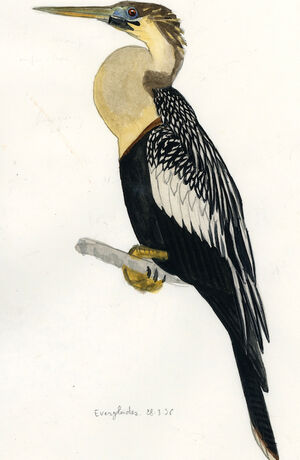
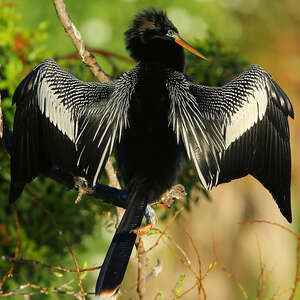
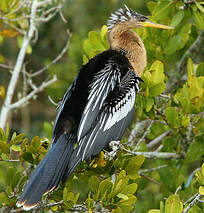
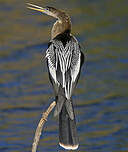
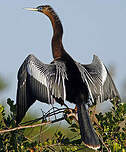
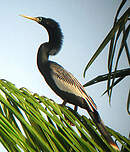
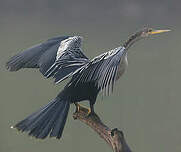
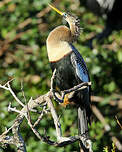
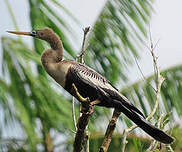
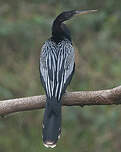
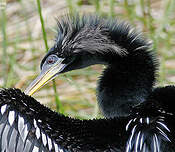
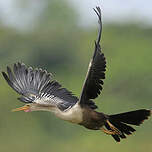
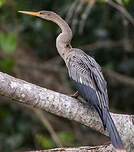
Anhinga male has dark plumage with green iridescence, with glossy pale grey feathers on upper back and half part of wings. Those are bordered with long white feathers. It has relatively small black head spotted and streaked, as an extension of its very long neck. As other Anhingas, its neck has some vertebrae forming a kind of hinged-mechanism, allowing dashing suddenly its head forwards to jab its prey, with its long sharp bill. It has a small black crest. It has broad wings with white spotting and streaks, long tail often spread in flight, with a white edge on the tip. Legs and webbed feet are pale yellow.
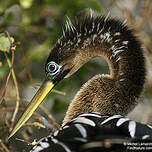
Bill is pale orange yellow, with dark tip and orange base. Lores are greenish blue. Eyes are reddish. Anhingas in breeding plumage
have a blue ring around their eyes.
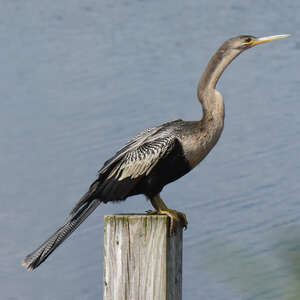
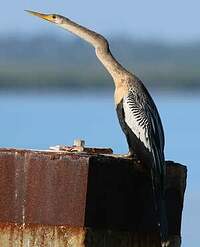
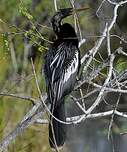
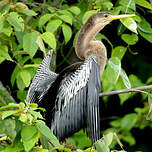
Female is duller than male, with buff brown neck and upper breast, and has not silver patches on wings.
Juvenile has uniform brown plumage.
Voice : Anhinga's call is a raspy croaking. Its calls consist of clicks, croaks and grunts.
It usually calls near or on the nest, or during the flight or while perching. Usually, Anhinga is a quiet bird.
Habitat : Anhinga prefers fresh or brackish waters, and we can see it sometimes on coasts. It lives near lakes, marches, mangroves stamps with thick vegetation and tall trees, and in shallow bays and lagoons.
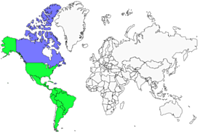
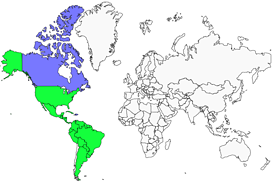
GEOGRAPHIC RANGE: Anhinga occurs all year in coastal areas of southwest of United States, from North Carolina to Texas.
But we can find it also in Mexico, Central America, Panama and Cuba. In South America, it is found from Colombia to Ecuador, and from east of Andes to Argentina.
Anhingas occur worldwide in tropical and subtropical regions.
Behaviour : Anhinga often swims with only head and neck out from water, giving it the name of 'snake-bird', looking as swimming
snake. It is found along rivers where it searches for preys, jabbing them with its long and pointed bill. It is not a rapid swimmer, so, it targets slow-moving fishes and catches them. Then, it brings up fish above water, turning it with the bill before swallow it head first.
During courtship displays, Anhingas perform flight displays, soaring towards the nest from great height. Mexican birds perform particular display when at nest, vocalizing to one another, stretching neck towards the mate. Then, birds interweave their necks, one passing nesting material to the other. They copulate on the nest and they are monogamous, using same nest from
year to year.
Anhinga is highly territorial, performing exaggerated displays to defend the nest site. It spreads the wings and snaps the beak, to threat an intruder, and if necessary, they may fight, pecking each other on neck and head.
Anhingas are solitary birds, but it may gather with herons, cormorants, ibises and storks. It nests in loose colonies with its species and others, but it is not found with other Anhingas out of nesting colonies.
Anhinga
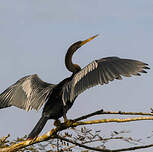
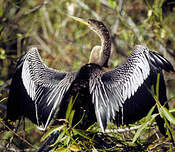
spends much of its time in the water to fish. But after to swim, it has to perch to dry its feathers. It has to spread out its wings to dry its plumage and get heat from the sun. It is necessary for this bird, to maintain its body temperature. Anhinga does not have oil glands to protect its feathers, like most water birds. This helps it to dive and chase fish underwater. It can fly with wet plumage, but it is not easy.
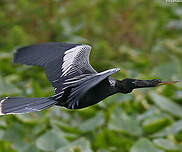
Flight : Anhingas have large and broad wings that allow them to soar very well, and flying in horizontal flight, alternating wing beats and glides. To take off, Anhinga may run on the water surface, or dive from a tree.It may be seen soaring
very high in flocks.
Reproduction-nesting : Anhinga's nest is built by both adults. Male brings nesting material and female builds the platform, situated on a branch above water, or in top of tree in open land, at about 4 to 20 feet high. Female weaves sticks together, and pads them with fresh twigs and leaves.
Female lays 2 to 5 bluish-white or pale green eggs. Incubation lasts about 25 to 30 days, by both parents. Chicks hatch naked and helpless. They may have some white and dark down on the sides of their body, and they are brooded by both parents for 12 days.
First, parents feed chicks by dripping fluid and regurgitation of fish directly into their open throats. When chicks become older, they put the head into parent's bills to get food.
They stay at nest three weeks, and then, they climb on a branch near the nest, and they fledge at about six weeks. They remain with parents for several weeks.
If young are threatened at nest, they are able, at about three weeks, to drop into water and swim to escape.
Young reach their sexual maturity at about 2 years old.
Food habits : Anhinga feeds mainly on fish, but also aquatic invertebrates, insects, reptiles and amphibians.
Protection / threats : Anhingas are abundant species in the Americas, but their habitat is threatened. Pesticides poisoning is another threat for them.
Other links :
Iucn
Birdlife
Specification sheet created by Nicole Bouglouan
Qui sommes-nous ?
L'association |
Mentions légales |
Sources |
Contacts |
Print version
Updated on 2008/05/04 05:30:55 - © 1996-2008 Oiseaux.net
Anhinga