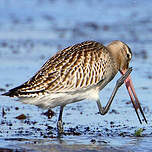
Bar-tailed Godwit

Birds      CharadriiformesScolopacidae      Id. Record Geographic rangePictures
Barge rousse

Bar-tailed Godwit

Limosa lapponica

Order  : Charadriiformes

Family : Scolopacidae  ;

Biometrics :

Size : 33 à 42 cm
Wingspan : 70 à 80 cm
Weight : Femelle : 400 à 450 g ; Mâle : 280 à 380 g

Longevity : 18 years

IUCN conservation status :

Extinct
Threatened
Least
concern
Extinc
in the Wild
Near
threatened
Not
evaluated

EX EW CR EN VU NT LC NE
Geographic range :

Distribution sumatran.trogon

Synonyms : Maly Veretennik (ru), Myrspov (sv), Aguja colipinta (es), Pittima minore (it), Pfuhlschnepfe (al), Rosse Grutto (nl), Bar-tailed Godwit (en)

Barge rousse Physical description :
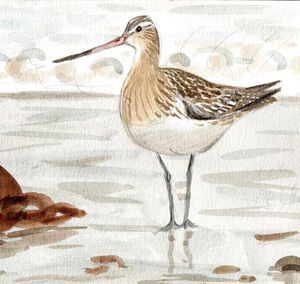
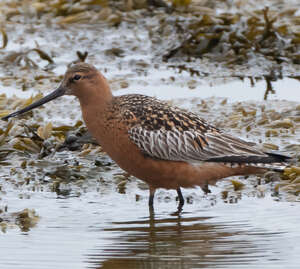
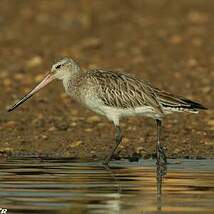
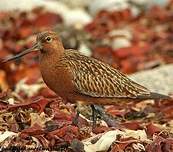
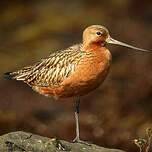
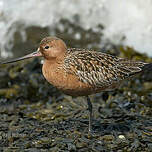
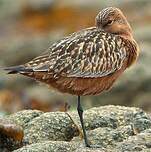
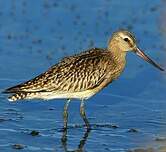
Bar-tailed Godwit adult male in summer plumage has unbarred brick-red underparts and whitish undertail. Upperparts are reddish-brown mottled with grey. Tail is barred with dark.
Head is reddish-brown with pale eyebrow. Long, slender upturned bill is dark, with pinkish base of lower mandible. Eyes are dark brown. Legs and feet are grey.
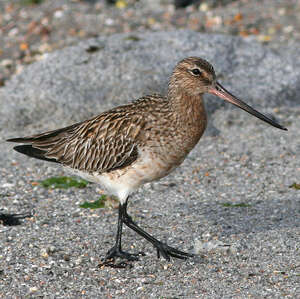
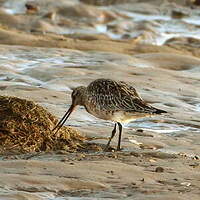
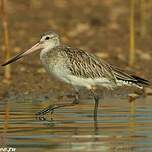
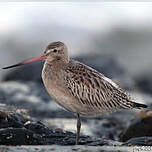
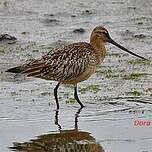
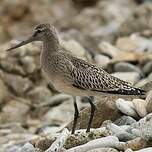
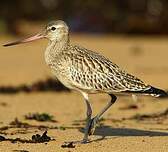
Bar-tailed Godwit adult male in winter lacks reddish tones, and it is grey with white edges on upperparts, and white on underparts.
Head is greyish with white supercilium and dark eyeline. Bill is pink at the base with black tip.
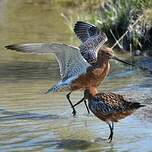
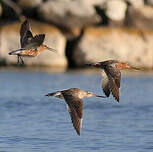
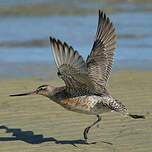
In flight, we can see a white patch from rump to the back, extending in a point.
Both sexes are similar, but female is larger than male with longer bill. Barge rousse In summer plumage, she is paler than male and may lack reddish colours.
Juvenile is similar to adult in winter, with heavy black and white markings on wing coverts, and browner or grey upperparts.
Bar-tailed Godwit is difficult to distinguish from the Black-tailed Godwit (limosa limosa). This one lacks white underwing and has black tail, larger bill and white wing bars.

There are three Barge rousse subspecies:
L.l. baueri, larger, with heavily barred rump and lower back. It breeds in eastern Russia and western Alaska, and it winters in eastern Australia and mainly New Zealand.
L.l. menzbieri, slightly smaller with less extensive barring. Male appears relatively small, with shorter bill and very deep dark red on underparts. It breeds in northern Siberia, and it winters in southeast China, Thailand, Barge rousse Indonesia and northwest Australia.
L.l. lapponica breeds in Scandinavia and western Russia, and winters in north western Europe, south to Spain and Portugal.

Voice :
Sound from CD 'Tous les Oiseaux d'Europe' by Jean C. Roché by courtesy of Sittelle and CEBA.
Bar-tailed Godwit's call in flight is a high-pitched 'kik' or 'kiv-ik' repeated when bird is excited or alarmed. We can also hear a nasal 'ke-wuh'.
In flight displays and on breeding areas, they utter various calls such as 'a-wik..., Barge rousse a-wik..., a-wik' soft and rapid, and a 'ku-wew, ku-wew'.

Habitat : Bar-tailed Godwit breeds in wet grassy open tundra, with trees at the edges. Outside breeding season, it lives in sandy estuaries, shallow bays, but also estuaries with firm mud. We can find them in adjacent brackish meadows.
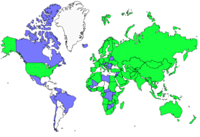
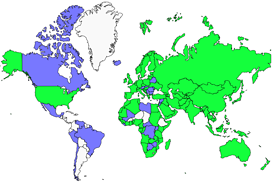
GEOGRAPHIC RANGE: Bar-tailed Godwit breeds in arctic Asia and western Alaska. They migrate to coastal western Europe, Africa, South Asia, Australia and New Zealand. Some birds from Europe and Asia may appear on North American coasts.
Bar-tailed Godwit is the holder Barge rousse of the longest non-stop flight known, with about 11000 km from Alaska to New Zealand. It may cover at least 25000 km per year.

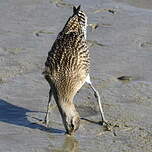
Behaviour : Bar-tailed Godwit feeds in shallow water, walking slowly and wading through the water, probing by quick jabbing into the mud with its long sensitive bill to find its food. They may feed in flocks of up to 30 or more birds, including migrants (non breeding) and young birds. This species is gregarious, often found in large flocks with other waders. They may Barge rousse also feed in short vegetation where they pick up insects by sight.
Within typical groups along beaches, females feed in deeper water than male. They have longer bills and they are larger. Flocks are often at the tide edge, where food resources are most available.
During courtship displays, male performs flight displays, circling high above the tundra and the nest site. During these flights, it calls loudly. It also performs territorial displays.
Bar-tailed Godwits are very long distance Barge rousse migrants, with a long migration unrivalled by even Arctic Tern. They have fat reserves that may double their weight, because they can't land on the ocean, and they can't feed during this period above water.

Flight : Bar-tailed Godwit performs direct flight with strong steady wing beats.

Reproduction-nesting : Bar-tailed Godwit's nest is located on the ground, on raised hummock among grass. It is a shallow cup in the moss, and sometimes lined with vegetation such as grass, moss and lichens. They breed on tundra hillsides with short shrubby growth.
Female lays 2 to 4 olive or Barge rousse pale brown eggs, spotted with dark brown. Incubation lasts about 20 to 21 days, shared by both adults. Short time after hatching, chicks follow their parents to marshy areas, and they are able to find their own food. Both parents tend and protect them until they fledge, at about one month of age.
Young reach their sexual maturity at two years. This species produces only one brood per season, in May-June.

Food habits : Bar-tailed Godwit feeds on crustaceans, molluscs, insects and annelid worms. According to the habitat, birds may feed heavily on aquatic insects, and sometimes on seeds and berries.

Protection / threats : Bar-tailed Godwits are vulnerable to the severity of the weather, habitat loss in coastal places, and hunting in some parts of their migration.  

Other links :
Iucn
Birdlife


Barge rousse

Barge rousse

Barge rousse

Barge rousse

Barge rousse

Barge rousse


Specification sheet created by Nicole Bouglouan


Qui sommes-nous ? L'association | Mentions légales | Sources | Contacts | Print version
Updated on 2008/05/04 05:30:55 - © 1996-2008 Oiseaux.net

Guide des oiseaux de mer

Barge rousse

Barge rousse

Barge rousse

Barge rousse

Barge rousse

Barge rousse

Barge rousse

Barge rousse

Barge rousse

Barge rousse

Barge rousse

Barge rousse

Barge rousse

Barge rousse

Barge rousse

Barge rousse

Barge rousse

Bar-tailed Godwit