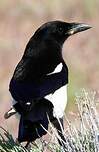
Black-billed Magpie

Birds      PasseriformesCorvidae      Id. Record Geographic rangePictures

Physical description :
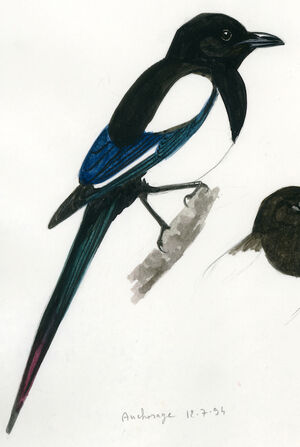
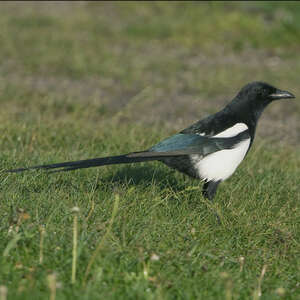
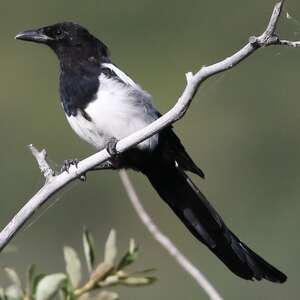
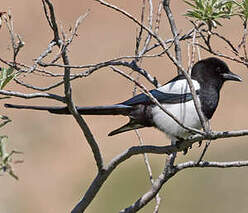
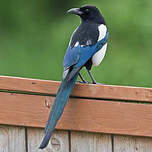
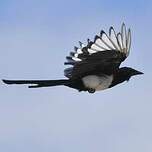
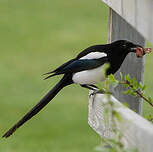
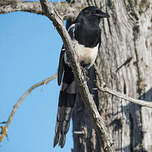
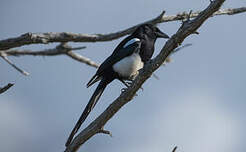
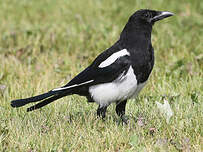
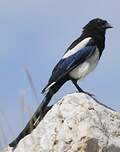
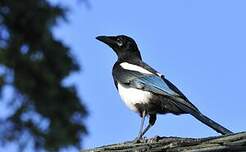
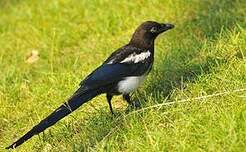
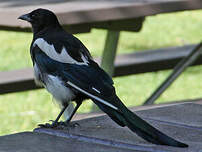
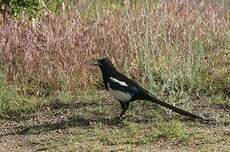
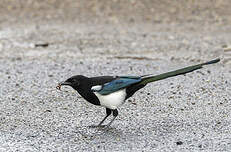
Black-billed Magpie is a black and white bird, with long tail. Adult has black head, chest, back and vent, with iridescent metallic blue-green wings and tail. It has large white patches on scapulars and white markings on primaries visible on extended wings. Belly is pure white. Tail is long, graduated, with a glossy purple band near the tip.
Strong bill is black. Eyes are dark brown. Legs and feet are blacks.
Both sexes are similar in plumage, but male is larger than female.
Juvenile resembles adults with duller plumage, less glossy feathers and shorter tail.

Voice :
Sound from CD 'Tous les Oiseaux d'Europe' by Jean C. Roché by courtesy of Sittelle and CEBA.
Black-billed Magpie's common call is a harsh chattering 'chack-chack-chack-chack-chack'. It is very noisy when in groups, uttering rapid, nasal 'mag? mag? mag?' or 'yak-yak-yak'.

Habitat : Black-billed Magpie lives in farmlands, thickets, open or lightly wooded areas, meadows and mountainsides, parks and gardens, even in town.
GEOGRAPHIC RANGE: Black-billed Magpie lives in Eurasia, from Western Europe to Japan, Northern Africa, and temperate regions of North America.

Behaviour : Black-billed Magpie is often associated with cattle, perching on their backs, picking off ticks. It usually forages on the ground, searching for insects. It often stores food, making a small hole with the bill in the ground, and regurgitating food in it. Then, it covers the hole for one or two days, and later use.
Black-billed Magpie is sometimes comical on the ground. It walks with high steps, and often hops sideways when excited. On the ground, tail is held elevated, rarely spread.
Black-billed Magp Pie bavarde ie forms long-term bonds. Courtship displays include courtship feeding to female by male. They are monogamous, and they generally nest solitary, but they may be found in loose colonies. They are gregarious outside breeding season. Noisy groups gather in winter, chasing around the branches, and performing displays while calling. They follow predators and may steal food from other species.
Black-billed Magpie is resident all year round in its range, but some birds may move southwards or to lower elevations in winter.

Flight : Black-billed Magpie performs direct flight with slow steady wing beats. Its flight is weaker than other corvidae, and rather unsteady because the long tail.

Reproduction-nesting : Both adults build the nest during five or six weeks. Nest is a mud bowl lined with grass, rootlets and hair, within a large and bulky domed structure, made with strong twigs, sometimes thorny twigs. Nest has two entrances and is located in trees or bushes, at about a few feet to 25 feet above the ground.
Female lays 4 to 9 green grey eggs, with dark brown speckles. Incubation lasts about 16 to 21 days, by female. She is fed by the male during Pie bavarde this period. Both parents feed the altricial chicks, and male protects the nest.
Young fledge at about 25 to 29 days of age; they have a weak flight, and they quickly hide into the foliage. Family groups remain together until autumn.
This species produces one brood per season.

Food habits : Black-billed magpie is omnivorous, feeding mainly on insects. But it also consumes conifer seeds after breeding period. It may eat berries, nuts and other seeds in winter. They also eat carrion, chicks and eggs in other species nests, and small rodents.

Protection / threats : Black-billed magpie is still considered as a pest, and may be killed in some areas. They also are vulnerable to pesticides. However, populations are common and widespread.  

Other links :
Iucn
Birdlife


Pie bavarde

Pie bavarde

Pie bavarde

Pie bavarde

Pie bavarde

Pie bavarde


Specification sheet created by Nicole Bouglouan


Qui sommes-nous ? L'association | Mentions légales | Sources | Contacts | Print version
Updated on 2008/04/29 05:36:33 - © 1996-2008 Oiseaux.net

Les passereaux d'Europe, tome 1

Pie bavarde

Pie bavarde

Pie bavarde

Pie bavarde

Pie bavarde

Pie bavarde

Pie bavarde

Pie bavarde

Pie bavarde

Pie bavarde

Pie bavarde

Pie bavarde

Pie bavarde

Black-billed Magpie