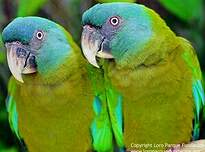
Blue-headed Macaw

Birds      PsittaciformesPsittacidae      Id. Record Geographic rangePictures
Ara de Coulon

Blue-headed Macaw

Ara couloni

Order  : Psittaciformes

Family : Psittacidae  ;

Biometrics :

Size : 41 cm
Wingspan :
Weight : 205 à 295 gr

IUCN conservation status :

Extinct
Threatened
Least
concern
Extinc
in the Wild
Near
threatened
Not
evaluated

EX EW CR EN VU NT LC NE

Geographic range :

Distribution sumatran.trogon

Synonyms : Guacamayo Cabeciazul (es), Ara testablu (it), Blaukopfara (al), Blauwkopara (nl), Blue-headed Macaw (en)

Family description :
Psittacidae is a large family, including several races of parrots of different sizes and colours, but with almost similar behaviour throughout their wide range. We find two main kinds of birds, the Cockatoos and the Parrots. The Cockatoos are large to medium-sized, with strong bill and conspicuo... to be continued

Physical description :
A medium-sized lowland Amazonian macaw, which was classified as endangered, but recent research indicates that its situation is much more favourable and recommends a re-classification.
It breeds very well in the Loro Parque Fundación breeding centre, from two pairs sent to the LPF by the CITES authorities of the Czech Republic. (Introduction from the Loro Parque Fundación)

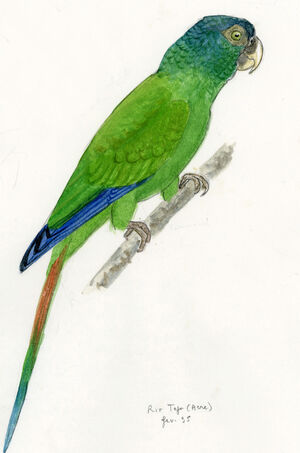
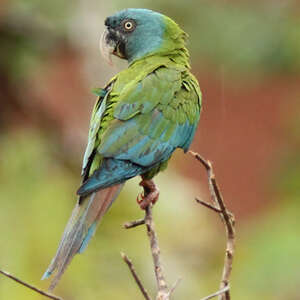
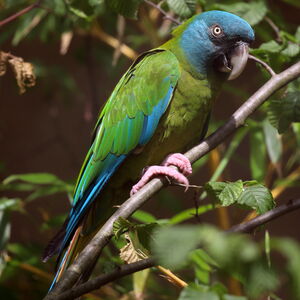
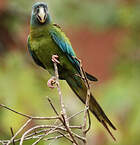
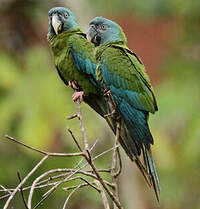
Blue-headed Macaw has bright green mantel. On the upperwing, primary coverts, flight feathers and trailing edge are blue. Uppertail feathers are reddish, becoming duller before the blue tip.
On the underparts, body is green. Underwing and undertail feathers are yellowish-olive.
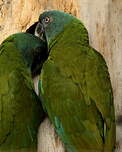
Head is blue. Lores and eye-ring of bare skin are greyish. Strong bill is blackish, paler at tip. Eyes are yellow. Legs and feet are flesh-coloured.
Both sexes are similar.
Juvenile resembles adults.

Voice : Blue-headed Macaw utters raucous 'purrr' and 'raaah' in flight. These sounds are soft and often not heard. But it also gives high-pitched shrieks.

Habitat : Blue-headed Macaw is often found along watercourses, at the edges of humid lowland forests, in clearing and opening in wet forest. It may be seen from 150 up to 1500 metres of elevation.
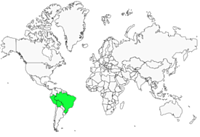
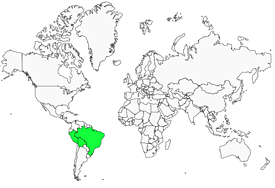
GEOGRAPHIC RANGE: Blue-headed Macaw lives in eastern Peru, westernmost Brazil and northern Bolivia.

Behaviour : Blue-headed Macaw is resident in its restricted range, only performing local movements.
This species is usually secretive and quiet. It is seen in pairs or small family groups, but not in large flocks as other species.
However, it can be seen sometimes perched on exposed branches of tall dead trees.
Blue-headed Macaw, as numerous Psittacidae, visits the 'clay-licks' where it takes clay, in order to detoxify the poisonous substances included in its diet. They are found at higher places in the clay-wall, where the trees provide some shade.

Flight : Blue-headed Macaw performs swift, direct flight.

Reproduction-nesting : Breeding season occurs from October to April.
Blue-headed Macaw probably uses natural cavities for nesting. As it is living near forests, its nest could be a hole in tree.
Female lays 3 to 4 eggs. Incubation lasts about one month. Young fledge three months after hatching.
This species has low reproductive rate.

Food habits : Unknown in the wild. Blue-headed Macaw probably feeds on seeds and fruits, as the most of Macaws' species.

Protection / threats : Endangered species. Blue-headed Macaw is threatened by illegal pet-trade which is increasing. In Bolivia, the range is threatened by habitat loss, but in other way, the species has benefited from the clearance of several areas.  

Other links :
Iucn
Birdlife


Specification sheet created by Nicole Bouglouan


Qui sommes-nous ? L'association | Mentions légales | Sources | Contacts | Print version
Updated on 2008/05/05 05:34:55 - © 1996-2008 Oiseaux.net

Le Marais Breton-Vendéen

Blue-headed Macaw