Blue-throated Macaw
Ara glaucogularis
Order : Psittaciformes
Family :
Biometrics :
Size : 85 cm
Wingspan : 90 à 100 cm
Weight : 600 à 800 gr
Longevity : 80 years
IUCN conservation status :

EX EW CR EN VU NT LC NE
Geographic range :
Synonyms : Guacamayo Barbazul (es), Ara di Wagler (it), Blaukehlara (al), Blauwkeelara (nl), Blue-throated Macaw (en)
Family description :
Psittacidae is a large family, including several races of parrots of different sizes and colours, but with almost similar behaviour throughout their wide range.
We find two main kinds of birds, the Cockatoos and the Parrots.
The Cockatoos are large to medium-sized, with strong bill and conspicuo... to be continued
Physical description :
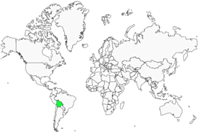
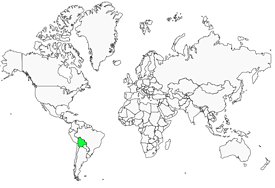
Blue-throated Macaw is endemic to a small region named Llanos de Moxos, in north-centre Bolivia. This species is endangered.
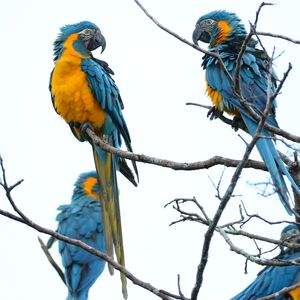
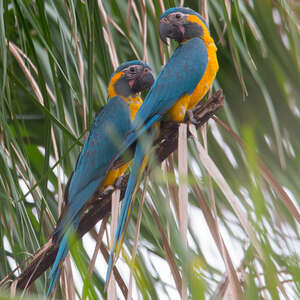
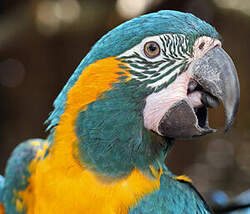
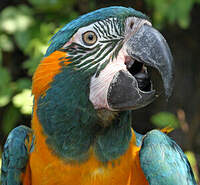
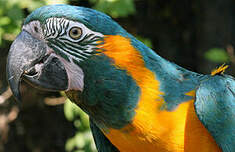
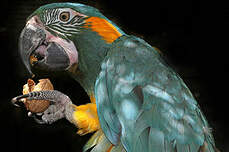
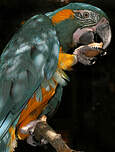
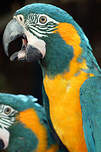
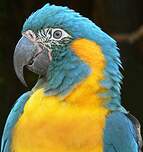
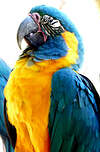
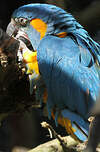
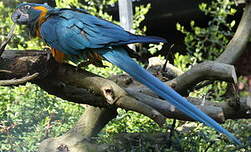
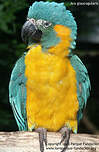
Blue-throated Macaw has blue upper parts, lighter than in the Blue and Yellow Macaw (Ara ararauna). Wings are slightly darker blue.
Underparts are bright yellow, except undertail coverts which are blue. Under tail feathers are rather orange.
Under wing is yellow with darker flight feathers.
On the head, forehead, crown, nape, chin and throat are greenish-blue. We can see a yellow band between nape and throat, coming from ear-coverts and joining the yellow breast.
Bare face is white with greenish-blue feathered lines. Cere is white too.
Strong bill is blackish. Eyes are pale yellow. Legs and feet are dark grey.
Both sexes are similar.
Juvenile resembles adults, with darker blue throat, grey eyes and shorter tail. It reaches its sexual maturity at 2-4 years.
Voice : Blue-throated Macaw utters similar calls to those
of the Blue and Yellow Macaw, such as 'rraa-aaar', loud and guttural, but these sounds are softer and higher-pitched. It gives loud, raucous calls when alarmed.
Habitat : Blue-throated Macaw lives mainly in elevated, dry thickets of palm trees (Attalea phalerata), located in seasonally flooded lowlands. It also can be found in savannahs and gallery woodlands along streams. It is visible up to 300 metres of elevation.
GEOGRAPHIC RANGE: Blue-throated Macaw is found in Bolivia, in a small area named El Beni, in the Centre-north.
Behaviour : Blue-throated Macaw is usually seen
in pairs or in small groups, and it can be seen with other species such as Blue and Yellow Macaws. Both are very similar and can frequent the same nightime roosts.
Blue-throated Macaw is an arboreal parrot. It feeds mainly on fruits of Attalea and Acronomia palms. It may open unripe nuts, in order to reach the liquid within.
As other parrots, it needs to clean its beak, and for that, it regularly comes to Tabebuia trees where it causes some damages to the branches with its hard beak.
Blue-throated Macaws breed easily in captivity, but in the wild, they often compete over nesting cavities with other species,
and its smaller size makes it often disadvantaged.
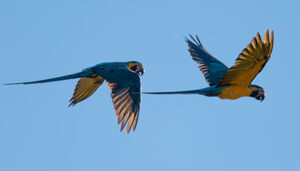
Blue-throated Macaws are monogamous and mate for life. When the pair flies within a flock, both mates fly close to each other, with wings nearly touching.
Flight : Blue-throated Macaw has direct flight with shallow wing beats, and it can reach speeds of up to 55 km per hour.
Reproduction-nesting : Breeding season occurs from October-November to March.
Blue-throated Macaw nests in holes in large trees, mainly in palm
trees.
In captivity, they can become aggressive during the nesting period.
Female lays 2 to 3 eggs. Incubation lasts about 4 weeks. Chicks remain with adults for about three months before to fledge.
This species can breed twice in a year.
Food habits : Blue-throated Macaw feeds on the fruits of palms (Attalea and Acromonia).
Protection / threats : Blue-throated Macaw is heavily threatened by cage-bird trade and loss of nest-sites and food resources.
'Scientists only discovered where it lived in 1992, and it was immediately classified as Critically Endangered. Since 1995, the Armonía - Loro Parque Foundation Blue-throated Macaw Conservation Programme has been active in the seasonally flooded plains of Beni, Bolivia. From perhaps less than 50 birds in 2000, the population has increased to reach up to 350 by the end of 2007.' (Text by Loro Parque Foundation)
Other links :
Iucn
Birdlife
Specification sheet created by Nicole Bouglouan
Qui sommes-nous ?
L'association |
Mentions légales |
Sources |
Contacts |
Print version
Updated on 2008/05/05 05:34:55 - © 1996-2008 Oiseaux.net
Blue-throated Macaw