Blue-winged Macaw

Birds      PsittaciformesPsittacidae      Id. Record Geographic rangePictures
Ara d'Illiger

Blue-winged Macaw

Ara maracana

Order  : Psittaciformes

Family : Psittacidae  ;

Biometrics :

Size : 36 à 43 cm
Wingspan :
Weight : 245 à 265 gr

Longevity : 60 years

IUCN conservation status :

Extinct
Threatened
Least
concern
Extinc
in the Wild
Near
threatened
Not
evaluated

EX EW CR EN VU NT LC NE

Geographic range :

Distribution sumatran.trogon

Synonyms : Guacamayo Maracaná (es), Ara di Illiger (it), Maracana (al), Illiger-ara (nl), Blue-winged Macaw (en)

Family description :
Psittacidae is a large family, including several races of parrots of different sizes and colours, but with almost similar behaviour throughout their wide range. We find two main kinds of birds, the Cockatoos and the Parrots. The Cockatoos are large to medium-sized, with strong bill and conspicuo... to be continued

Physical description :
This macaw is famous for living in the same area as the Spix's Macaw (Cyanopsitta spixii), and that the last wild male Spix's Macaw was paired with a female of this species. The Loro Parque Foundation breeds this species very well, and some birds from its breeding centre have been released in Brazil as a pilot release for Spix's Macaws. (Text by Loro Parque Fundación - Tenerife).

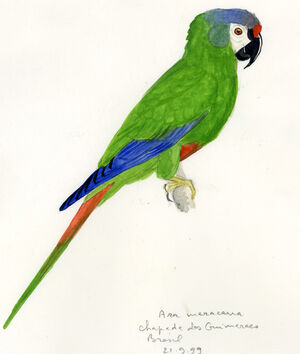
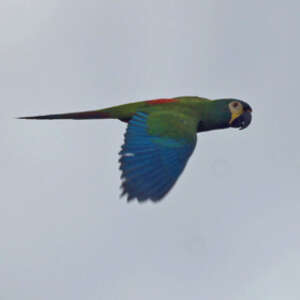
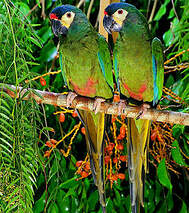
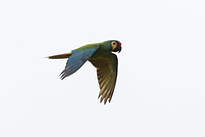
Blue-winged macaw adult has green mantle and rump, with red patch on lower back. Wings show blue flight feathers, giving the bird its name. The graduated tail is blue, with broad reddish base.
On the underparts, throat, breast and upper belly are green, as under tail and under wings coverts. Lower belly shows red patch. Flight feathers and under tail feathers are bronze-green.
On the head, the forehead is red, whereas crown, nape and lower cheeks are greenish-blue.
Heavy, hooked bill is black. Eyes are reddish-orange, surrounded with bare yellowish skin on cere, lores, eye-ring and upper cheeks, extending to ear-coverts area. Legs and feet are yellowish.
Both sexes are similar.
Juvenile has paler forehead and brown eyes. The patches in belly and lower back are rather yellowish than red as in adults. Tail is shorter. It reaches its sexual maturity at 2 to 4 years.

Voice : Blue-winged Macaw utters sharp, shrill 'krek...krek...krek' in flight.

Habitat : Blue-winged Macaw lives in the margins of evergreen and deciduous forests along water or bordering savannahs, and in gallery forests along streams, in 'caatinga' vegetation (thorny vegetation). It can also be found at forest edges up to 1,000 metres of elevation, and in palm groves.
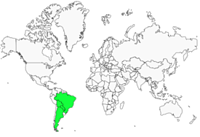
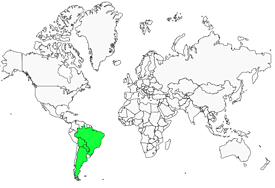
GEOGRAPHIC RANGE: Blue-winged Macaw has wide range in Brazil (north-east, centre and south-east). It is also found in Paraguay and in north-eastern Argentina.

Behaviour : Blue-winged Macaw is resident in its range. It is more secretive than other large macaws, and less noisy.
This macaw is usually seen in pairs or in small family groups.
Blue-winged Macaw feeds on seeds of native and introduced plants, and also takes fruits and nuts.
They gather at night at communal roosts in trees in large flocks.
These macaws can be extremely active, flying over landscapes at mid-height and landing into vegetation or isolated trees, mainly in the morning. These isolated trees provide them good visibility for security.

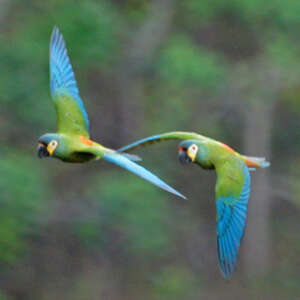
Flight : Blue-winged Macaw is an artistic flier performing aerobatics. It flies with strange jerky upwards movements.
This macaw prefers to fly along tree-lined streams, rather than across open areas.

Reproduction-nesting : Breeding season in north-eastern Brazil occurs from December to February, but mainly in December.
As other Psittacidae, Blue-winged Macaw nests in cavities or holes in trees, often in Caraibeira tree (Tabebuia caraiba)
Female lays two eggs. Incubation lasts about one month.
Young start to fly about 11 weeks after hatching.
They remain within the family group for about one year after fledging.

Food habits : Blue-winged Macaw feeds on seeds, fruits and nuts. They feed on coffee bushes (Coffea arabica), and exotic fruits from Melia azedarach. Seeds are provided by native and introduced plants species.

Protection / threats : Blue-winged Macaw is classified as Vulnerable. This species is heavily threatened by habitat loss due to deforestation, and illegal cage bird trade. Numbers are rapidly declining.
However, Blue-winged Macaw breeds well in captivity, and allows some hope for reintroduction in its native range.  

Other links :
Iucn
Birdlife


Specification sheet created by Nicole Bouglouan


Qui sommes-nous ? L'association | Mentions légales | Sources | Contacts | Print version
Updated on 2008/05/05 05:34:55 - © 1996-2008 Oiseaux.net

Le Marais Breton-Vendéen

Blue-winged Macaw