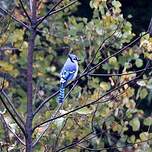
Blue Jay
Cyanocitta cristata
Order : Passeriformes
Family :
Biometrics :
Size : 25 à 30 cm
Wingspan : 34 à 43 cm
Weight : 70 à 100 gr
Longevity : 18 years
IUCN conservation status :

EX EW CR EN VU NT LC NE
Geographic range :
Synonyms : Urraca Azul (es), Ghiandaia azzurra americana (it), Blauhäher (al), Blue Jay (en)
Physical description :
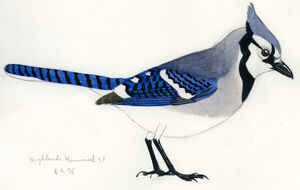
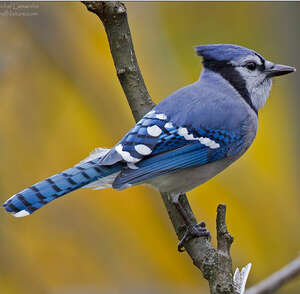
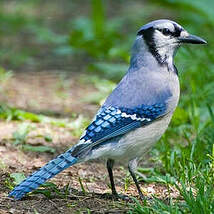
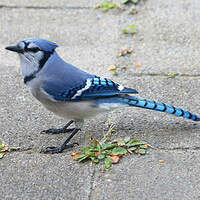
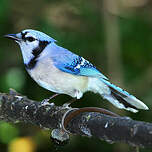
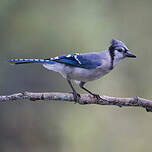
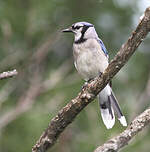
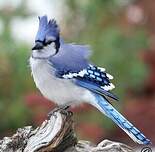
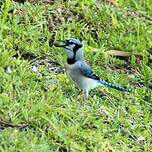
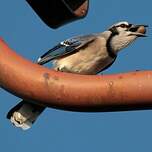
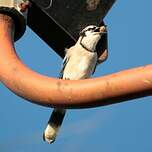
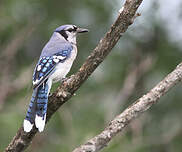
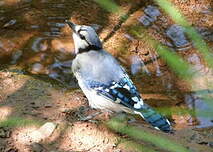
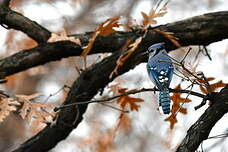
Blue jay is a crested jay, showing black stripes and white patches on blue wings and long tail.
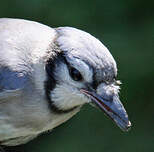
Upperparts are bright blue, with a grey-blue crest on head. Underparts are whitish grey. Throat presents black collar, extending around the head, joining a black eye line.
They have black bill, legs and feet. Eyes are black with white eye ring.
Both sexes are similar.
Juvenile is similar to adults, but duller, with blue becoming greyer, and black becoming browner.
Voice : Blue jay has varied calls. The most common is a harsh 'jay-jay-jay', but it gives also a musical 'weedle-eedle', clear whistles and gurgling notes. There is also a high-pitched call, 'jayer-jayer' increasing in speed as the bird becomes excited.
Blue jay utters also a mellow whistle 'kloo-loo-loo', very musical, and a softly sweet warbling during courtship.
Blue jay can mimic the calls of other birds, reproducing the Red-shouldered hawk's calls.
Habitat : Blue jay lives in varied forests and woodlands, most on the edges. It is common in urban parks with large oaks.
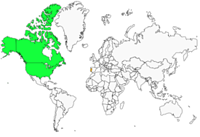
GEOGRAPHIC RANGE: Blue jay is resident in eastern of North America, from south Canada to Gulf Coast.
It is partially migratory, and some birds migrate out of North, but most of them remain in their range. They migrate during the day.
Behaviour : When they live in parks, Blue jays gather in flocks, offering beautiful and typical show. They hide seeds, nuts and acorns under the ground.
To feed, they glean insects from trees and shrubs, but also from the ground. When they eat some nuts, they hold them with their feet and crack them with the bill.
Blue jay doesn't share. It chases other birds away from its food resources. It carries nuts and acorns, and hides them, but it is not able to find them later. So, nuts and acorns give life to new plants.
Blue jay doesn't like birds of prey, such as hawks and owls, and it makes a big racket when it sees one. It may chase these large
birds.
Blue jays are aggressive birds. They may attack human came too close their nests. When an owl is roosting near the nest during the daytime, Blue jay dives bomb and pecks it to force it to find a new roost. Blue jay is cautious and silent near the nest, but it is bold and noisy away from it.
Young jays are known to collect brightly coloured objects, like bottle caps or pieces of aluminium foil, and they carry them for a moment.
Blue jays are monogamous, mating for life. During courtship display, the male feeds the female constantly and also while she incubates.
Blue jay is known to be a raider of other bird's nests. They may steal eggs and chicks, and nests. They prefer robin nests, and can appropriate them for nesting.
During the moult period, Blue jays practise the 'anting', using ants or other materials on their bodies, for preening or tidying their feathers. Reason of this behaviour is not quite known, and many questions still exist.
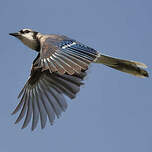
Flight : Blue jay is a slow flier and an easy prey for hawks and owls, when it flies in open lands. It flies apparently effortless, with body and tail held level, with slow wing beats.
Reproduction-nesting : Blue jay's nest is located in trees or large bushes. They prefer pine trees. It is built by both adults, in branches close to trunk. Nest is situated at 3 to 10 metres above the ground.
Bulky nest is made
with barks, twigs, leaves, grasses, lichens, moss and paper. It is an open cup, shaped with mud, and lined with fine rootlets and feathers.
Female lays 3 to 6 eggs, with varied colours, blue, green or yellow, spotted with brown or grey. Incubation lasts about 17 to 18 days, by female. Male feeds female while she incubates, or share incubation sometimes.
Chicks hatch altricial, and they are fed by both parents. They fledge at about three weeks old. They begin feeding themselves three weeks later,
but they continue to follow their parents during one or two months, sometimes four.
This species produces one single brood in North, and two or three in South.
Food habits : Blue jays are omnivorous, they eat plants and animals. They are fond of acorn from oaks trees, but they also eat fruits, nuts, seeds, insects, mice, frogs, small birds and eggs, caterpillars.
Protection / threats : Blue jay is an easy prey for medium-sized raptors. Owls pluck jays from nest at night.
Blue jay plays a role in keeping bird populations, as well as some insect's pests. Blue jay can be important in the local control of caterpillars. Adults extract larvae from cocoons, and carry several in the bill to their chicks. Destruction of cocoons is important, helping the pest control.
Other links :
Iucn
Birdlife
Specification sheet created by Nicole Bouglouan
Qui sommes-nous ?
L'association |
Mentions légales |
Sources |
Contacts |
Print version
Updated on 2008/05/04 05:30:55 - © 1996-2008 Oiseaux.net
Blue Jay