Bolivian Blackbird
Oreopsar bolivianus
Order : Passeriformes
Family :
Biometrics :
Size : cm
Wingspan :
Weight :
IUCN conservation status :

EX EW CR EN VU NT LC NE
Geographic range :
Synonyms : Turpial Boliviano (es), Gracchio della Bolivia (it), Andenstärling (al), Andestroepiaal (nl), Bolivian Blackbird (en)
Physical description :
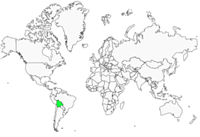
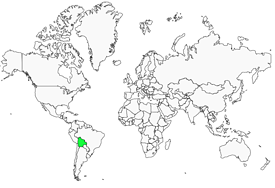
Bolivian Blackbird is endemic to Bolivia, living in restricted range.
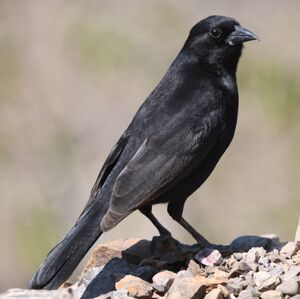
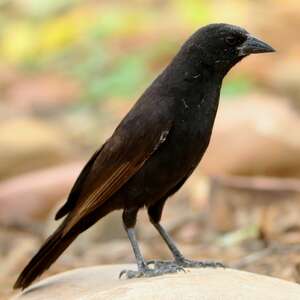
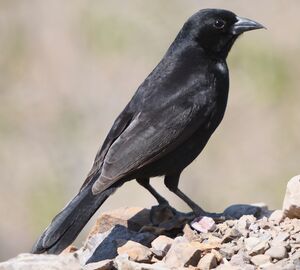
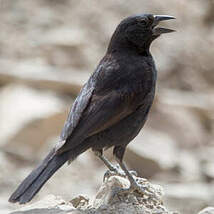
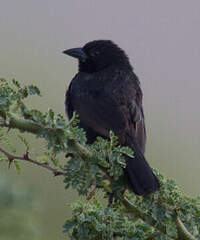
Adult male has black plumage on entire body, with dull blue gloss. Primary and secondary flight feathers are browner. Rest of upper wing is black. Tail is black too.
Underparts are black with velvet-like chin and forehead.
When in flight, its black body contrasts with browner flight feathers.
Head is entirely black. Strong, pointed, down curved bill is black. Eyes are dark brown. Legs and feet are black.
Both sexes are similar. Female is smaller and duller than male.
Juvenile resembles adults, with brown tinge on underparts and wing coverts, and less glossy plumage.
Voice : Bolivian Blackbird utters series of 'chip' interspersed with 'chu-pit' giving this kind of song 'chip chip chip chip chu-pit chu-pit chu-pit chip chip'.
When in flight, it gives some 'chu-pee' or 'chu-pee-pit', and also series of 3 to 4 'churr'.
Perched bird utters several clear whistles 'tew'.
When bird takes off, it utters loud 'cheep-cheep' given in bursts of two or more.
Female gives long flight call when leaving the nest, including several different notes.
Alarm call is a short, sharp 'chip', given by bird while it flicks its tail.
Habitat : Bolivian Blackbird lives in subtropical and tropical shrublands at high elevation, in arid valleys or canyons with cliffs where it can breed. Bottoms of valleys are vegetated by forests and grasses, and tall Cereus cacti. Bolivian Blackbird needs cliffs for nesting.
GEOGRAPHIC RANGE: Bolivian Blackbird lives in Bolivia, in restricted range.
Behaviour : Bolivian Blackbird feeds on seeds and invertebrates on the ground. It also gleans insects on higher bushes, and takes fruits from cacti. It also takes seeds from grasses, probing along bent stems in order to glean insects from leaves.
It can extract preys from crevices, tree bark and shrub bases. It turns over rocks, searching for preys.
Bolivian Blackbird performs courtship displays, taking some particular postures.
Male raises its closed tail, bill is pointed upwards and it flips wings upwards while calling.
Begging female adopts typical posture with bill upwards and fluttering wings.
Birds also perform displays with dropped wings, lowered slightly spread tail, and fluffed rump feathers, while they bring nest materials.
Male and female perform flight displays, with deep wing beats for slow and laboured flight.
Bolivian Blackbird is often seen in small groups, defending an area from other flocks. It is sedentary, and flocks seem to be territorial all year round.
Flight : Bolivian Blackbird often glides for short distances. Flight display is performed with exaggerated wing beats giving slow and laboured flight.
Bolivian Blackbird perches on treetops from which it takes off for long distance flight to other perch.
Reproduction-nesting : Breeding season starts in mid-April. Bolivian Blackbird is the only blackbird nesting in cliffs.
Nest is placed in crevice, and often moulded to the shape of the crevice. It is made with fibres, fine roots and dry grasses. It is a cup-shaped nest. Interior is lined with fine, dry grass stems and occasionally some feathers.
Female lays 3 pale greenish-grey eggs, with grey and brown markings. Incubation seems to be assumed by female.
During this period, female often joins the flock, and begs for food, and flock members feed her.
Both parents feed the young, but helpers share these duties with breeding pair.
Food habits : Bolivian Blackbird feeds on large insects, grass seeds and fruits of Cereus cacti.
Its food includes several kinds of preys, such as spiders, grasshoppers, beetles, ants and larvae, butterflies and small moths.
It finds the most part of its food by foraging in crevices and at base of grasses.
Protection / threats : Bolivian Blackbird has restricted range where it is locally common. This species is evaluated as Least Concern at IUCN Red list.
Other links :
Iucn
Birdlife
Specification sheet created by Nicole Bouglouan
Qui sommes-nous ?
L'association |
Mentions légales |
Sources |
Contacts |
Print version
Updated on 2008/04/29 05:36:33 - © 1996-2008 Oiseaux.net
Bolivian Blackbird