Common Moorhen

Birds      GruiformesRallidae      Id. Record Geographic rangePictures
Gallinule poule-d'eau

Common Moorhen

Gallinula chloropus

Order  : Gruiformes

Family : Rallidae  ;

Biometrics :

Size : 32 à 35 cm
Wingspan : 50 à 55 cm
Weight : Femelle : 260 à 373 g ; Mâle : 250 à 400 g

Longevity : 15 years

IUCN conservation status :

Extinct
Threatened
Least
concern
Extinc
in the Wild
Near
threatened
Not
evaluated

EX EW CR EN VU NT LC NE
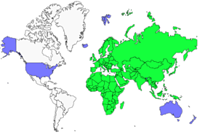
Geographic range :

Distribution sumatran.trogon

Synonyms : Kamyshnitsa (ru), Rörhöna (sv), Polla de agua (es), Gallinella d'acqua (it), Teichhuhn (al), Waterhoen (nl), Common Moorhen (en)

Gallinule poule-d'eau Physical description :
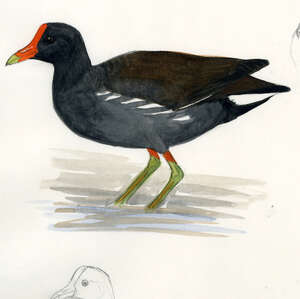
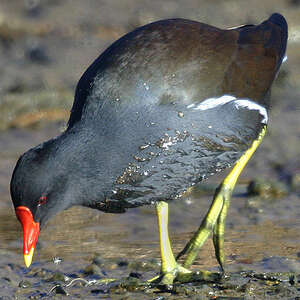
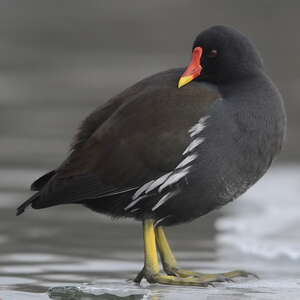
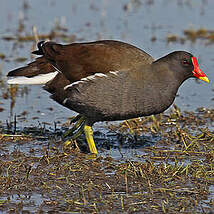
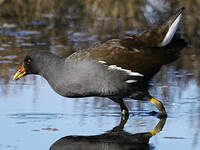
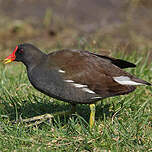
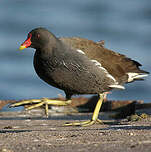
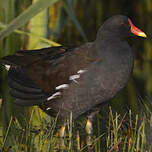
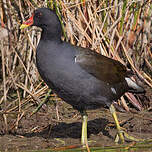
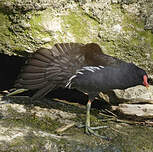
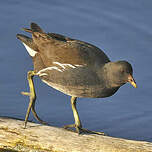
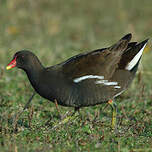
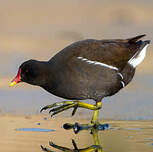
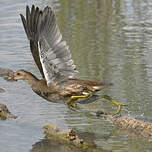
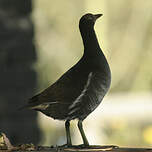
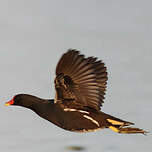
Common Moorhen has slate-black plumage. Upperparts are brownish. We can see white stripe on flanks and white median undertail coverts.
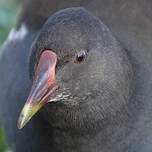
Pointed bill is red with yellow tip, and red frontal plate above. Eyes are dark red. Legs and long feet are greenish.
Both sexes are similar, with male slightly larger than female.
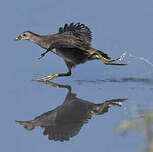
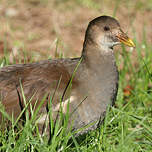
Juvenile is brownish with paler throat and belly. It has dull whitish-buff stripe on flanks. Bill and legs are dusky.
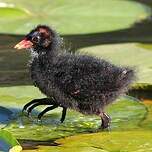
Chicks are covered with black down, and have red bill with black tip.

Voice :
Sound from CD 'Tous les Oiseaux d'Europe' by Jean C. Roché by courtesy of Sittelle and CEBA.
Common Moorhen utters a variety of sharp calls. We can frequently hear a low, rolling 'krrruck', a sudden short 'chuck', and a sharp 'kik' or 'kittick'. It gives a repeated fast clucking 'krek-krek-krek-krek' Gallinule poule-d'eau often in flight, and mainly at night during spring.

Habitat : Common Moorhen lives in freshwater or brackish wetlands with fringing vegetation and brushy cover. It is found near ponds, slow rivers, marshes and lakes, and also in parks in urban areas.
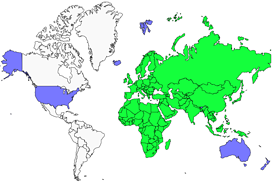
GEOGRAPHIC RANGE: Common Moorhen lives on all continents, except Australia and Antarctica. Birds of northern parts of the range migrate southwards in winter.

Behaviour : Common Moorhen is a familiar waterside bird. It swims, or walks along the shore, and runs for cover.
To feed, it picks food from the surface, or from aquatic emergent vegetation. It dips the head, dabbles and may dives for food, sometimes up to 45 seconds under the water. It takes molluscs and seeds from the underside of Gallinule poule-d'eau floating leaves.
It uses its long toes to walk on floating vegetation and soft mud. It doesn't have webbed feet, but it swims very well. While swimming, it bobs its head back and forth. Common Moorhen is active day and night.
It swallows sand and gravels to grind the vegetal food.
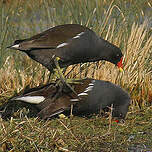
Courtship displays shows the male bringing water weeds to female. It also fans out its tail, in order to display the white undertail coverts. They are monogamous.
They build several nests, and once the chicks leave the nest, the others are used to sleep at night.

Flight : Common Moorhen runs over the surface to take off, and has a swift strong direct flight. It is able to migrate long distances.

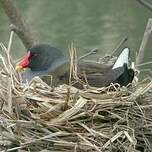
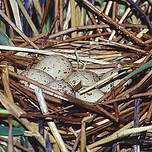
Reproduction-nesting : Common Moorhen's nest is a wide Gallinule poule-d'eau shallow cup made with dead vegetation (stems of cattails), well rimmed and lined with grass and leaves. The nest is located within a few feet of the water, but anchored with stems to the emergent vegetation. Sometimes, nest may be located on the ground, in a low shrub, or on floating vegetation. Both adults build the nest. A sloping runway allows reaching or leaving the nest. They sometimes nest in small colonies.
Female lays 6 to 10 cinnamon to olive-brown eggs, spotted Gallinule poule-d'eau with brown. Incubation lasts about 18 to 21 days by both parents. Incubation starts with the first egg laid, and up to four days separate the first from the last egg hatched. Chicks are precocial, and fed by both adults. But young leave the nest very soon, within 2 to 3 days, and are able to feed themselves within a few days of birth. They fledge in about 5 to 7 weeks.
This species may produce more than one brood per season, using the same nests.

Food habits : Common Moorhen is omnivorous, and feeds on seeds, grass, rootlets and soft parts of aquatic plants that get by diving. They also eat snails, worms, crayfish, grasshoppers, insects, algae, tadpoles and berries.

Protection / threats : Common Moorhen is common and widespread, despite habitat loss in some parts of its range.
Common Moorhen's nest is often lost to flooding.  

Other links :
Iucn
Birdlife


Gallinule poule-d'eau

Gallinule poule-d'eau

Gallinule poule-d'eau

Gallinule poule-d'eau

Gallinule poule-d'eau

Gallinule poule-d'eau


Specification sheet created by Nicole Bouglouan


Qui sommes-nous ? L'association | Mentions légales | Sources | Contacts | Print version
Updated on 2008/05/04 05:30:55 - © 1996-2008 Oiseaux.net

Grands échassiers, gallinacés, râles d'Europe

Gallinule poule-d'eau

Gallinule poule-d'eau

Gallinule poule-d'eau

Gallinule poule-d'eau

Gallinule poule-d'eau

Gallinule poule-d'eau

Gallinule poule-d'eau

Gallinule poule-d'eau

Gallinule poule-d'eau

Gallinule poule-d'eau

Gallinule poule-d'eau

Gallinule poule-d'eau

Gallinule poule-d'eau

Gallinule poule-d'eau

Common Moorhen