
Common Pheasant
Phasianus colchicus - Faisan de Colchide
Systematics
-
Order:
Galliformes
-
Family:
Phasianidés
-
Genus:
Phasianus
-
Species:
colchicus
Descriptor
Biometrics
- Size: 53 à 89 cm
- Wingspan: 70 à 90 cm.
- Weight: 900 à 1050 g
Longevity
8 years
Geographic range
Identification
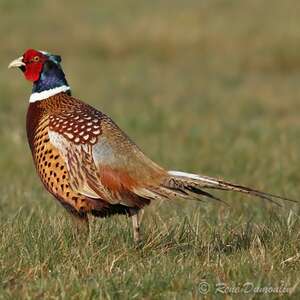
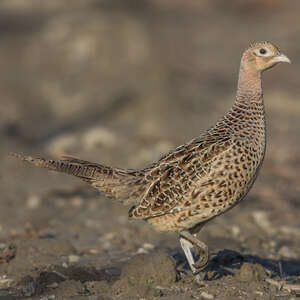
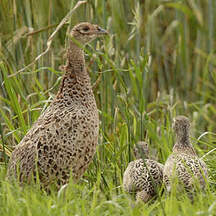
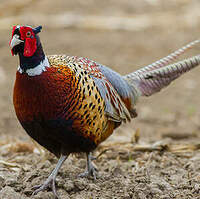
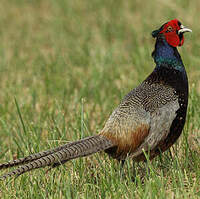
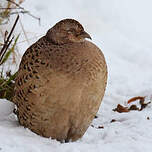
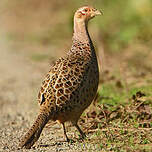
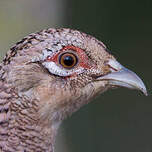
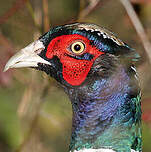
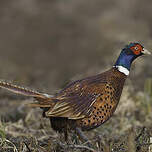
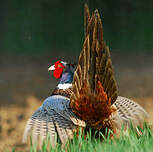
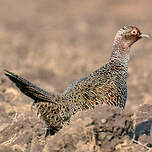
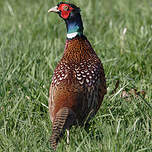
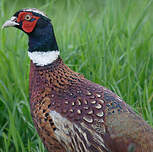
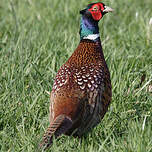
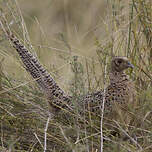
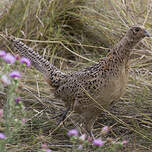
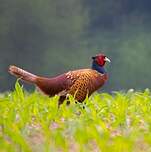
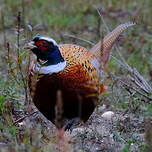
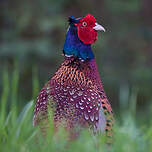
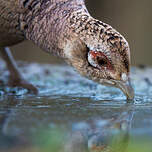
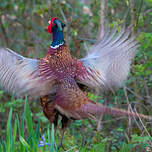
The Common Pheasant exhibits strong sexual dimorphism. The male (or cock) with its long tail and colourful plumage is a bird that stands out and is thus well-known to the general public. This species presents numerous subspecies, with characteristic plumage variants for each one, for example with or without a white collar. The body is composed entirely of warm hues ranging from russet beige to dark brown, including some mottled golden tones with a lovely effect. On the ground, the overall look is brownish-red. Many of the covering feathers are fringed or terminated in light shades on the upper part, dark brown or black on the flanks and underneath, which breaks up the uniformity of the plumage. The head is noteworthy. It is blue or green depending on the light, with shiny highlights, and is often underlined by a white collar. Around the golden eye, there is a patch of bare skin in a vivid red which enlarges with age. Tufts of dark green feathers stand up towards the back above the earzone, forming little ears. The cap is pale. The strong and slightly hooked bill is horn-coloured. The tail, with its long and staggered rectrices in beige with brown stripes, gives the bird its characteristic silhouette. The female (or hen) is smaller, with a relatively shorter tail and a cryptic plumage, in beige tones with darker markings, which perfectly camouflages it. The yellow eye is surrounded by a small reddish patch, reminiscent of the cock's caruncle, underlined by a whitish area. The upper part of the beak is brownish. The juvenile resembles the female but can be distinguished at first by its size and then by its relatively shorter tail.
Subspecific information 30 subspecies
- Phasianus colchicus colchicus (Transcaucasia. Georgia, Armenia, Azerbaijan.)
- Phasianus colchicus septentrionalis (n Caucasus. s Russia.)
- Phasianus colchicus talischensis (se Transcaucasia. Azerbaijan, nc Iran.)
- Phasianus colchicus persicus (sw Turkmenistan, ne Iran)
- Phasianus colchicus principalis (se Turkmenistan, nw Afghanistan)
- Phasianus colchicus chrysomelas (n Turkmenistan, w Uzbekistan)
- Phasianus colchicus zarudnyi (e Turkmenistan)
- Phasianus colchicus bianchii (se Uzbekistan, sw Tajikistan, ne Afghanistan)
- Phasianus colchicus zerafschanicus (s Uzbekistan)
- Phasianus colchicus turcestanicus (s Kazakhstan)
- Phasianus colchicus mongolicus (se Kazakhstan, n Kyrgyzstan)
- Phasianus colchicus shawii (w China)
- Phasianus colchicus tarimensis (Tarim Basin to Lop Nur. w China.)
- Phasianus colchicus vlangalii (Qaidam Basin. wc China.)
- Phasianus colchicus strauchi (ne Qinghai. c China.)
- Phasianus colchicus sohokhotensis (e Gansu. c China.)
- Phasianus colchicus satscheuensis (w Gansu. nc China.)
- Phasianus colchicus hagenbecki (w Mongolia)
- Phasianus colchicus edzinensis (sc Mongolia)
- Phasianus colchicus alaschanicus (Ningxia. nc China.)
- Phasianus colchicus kiangsuensis (ne China)
- Phasianus colchicus karpowi (ne China to Korea)
- Phasianus colchicus pallasi (se Siberia, ne China, ne Korea)
- Phasianus colchicus suehschanensis (nw Sichuan, s Gansu. wc China.)
- Phasianus colchicus elegans (w Sichuan to nw Yunnan. wc China. , ne Myanmar, e Tibet)
- Phasianus colchicus decollatus (c China)
- Phasianus colchicus rothschildi (se Yunnan. sc China. , nw Vietnam)
- Phasianus colchicus takatsukasae (sw Guandong. s China. , ne Vietnam)
- Phasianus colchicus torquatus (e China)
- Phasianus colchicus formosanus (Taiwan)
Foreign names
- Faisan de Colchide,
- Faisán vulgar,
- faisão-comum,
- Jagdfasan,
- fácán,
- Fazant,
- Fagiano comune,
- fasan,
- Fasan,
- bažant obyčajný,
- bažant obecný,
- Fasan,
- fasaani,
- faisà comú,
- Fashani,
- bażant (zwyczajny),
- parastais fazāns,
- fazan,
- Фазан,
- キジ,
- 雉鸡,
- 環頸雉,
Voice song and cries
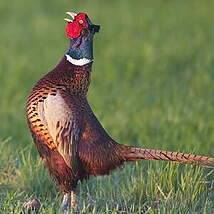
The territorial call is a powerful hraah hraah of a relatively high tone, harsh and raspy, emitted with its head pointed upwards and accompanied by a double sound of its wings. The alarm call is a series of two-syllable chattering notes kutuk kutuk kutuk... The takeoff, loud in itself, is often accompanied by guttural cries, from the male as well as the female Common Pheasant.
Habitat
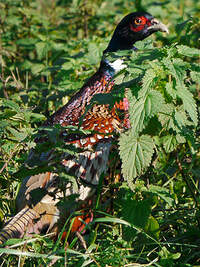
The Common Pheasant adapts to very varied environments, both on the plains and in the mountains, up to an altitude of 3000 m locally. Even agricultural areas suit it, provided that practices are not too intensive and the environment is not too simplified or artificialised. It just avoids dense forest environments, arid zones and very high mountains.
Behaviour character trait
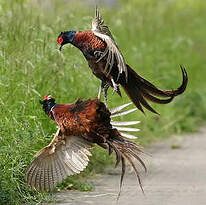
The Common Pheasant is a rather skittish bird, making its presence known to intruders when they enter its territory.
Flight
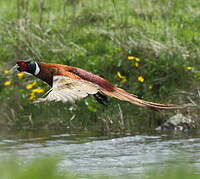
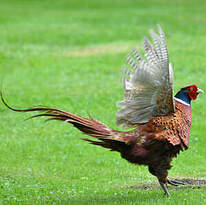
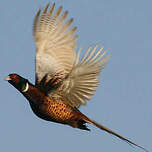
The Common Pheasant has a powerful, fast and direct flight. The flight is usually of short distance, following a disturbance for example, as it cannot be sustained for very long due to the disproportion between the bird's high weight and the small surface of its wings. The short and rounded wings and the long pointed tail give it a characteristic silhouette. Takeoff is very noisy.
Dietfeeding habits
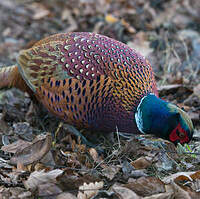
Common Pheasant adults mainly feed early in the morning and late in the evening. Their diet includes vegetable-based items (various seeds, cultivated grains, young shoots and buds, fruits) but also includes invertebrates. Their powerful claws are able to loosen those invertebrates in soft soil. On the other hand, the growing chicks need proteins and mostly eat invertebrates. They transition to a purely vegetarian diet at the age of 5 or 6 weeks.
Reproduction nesting
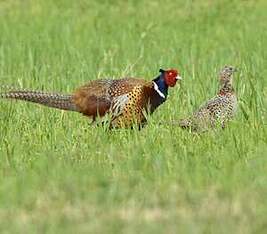
The adult male Common Pheasant is polygamous. A particularly attractive mature male can form a harem of several mature females.
Geographic range
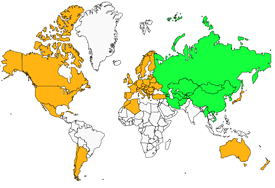
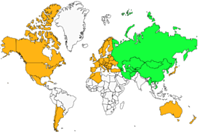
The natural range of the Common Pheasant species is Asian, extending from the Caucasus to the east of China and the Amur region of Russia. It is discontinuous and resolves into several subgroups. The species has been the subject of many introductions, especially in Europe where it has become common. Birds from breeding grounds are regularly released for hunting purposes. The species is generally considered to be sedentary in most circumstances, but large-scale movements have already been observed in certain eastern populations due to temporarily unfavorable conditions such as a severe cold spell. This is not the case in Europe.
Threats - protection
IUCN conservation status
concern
in the Wild
threatened
evaluated
The Common Pheasant is the most widespread and common of pheasants in the world. The species is generally not threatened, but looking at what is happening at sub-specific level, it can be seen that some subspecies have very low and declining population levels and warrant protection while others are flourishing, in particular due to introductions. It can be locally overabundant, but this is artificial. A very large number of pheasants are bred and then released into the wild each year to serve as game for hunters. Excessive hunting is the main cause of this.
Sources of information
- IOC World Bird List (v14.1), Gill, F and D Donsker (Eds). 2024-04-18.
- Grands échassiers, gallinacés, râles d'Europe, P. Géroudet
- HBW Alive,
- xeno-canto, Sharing bird sounds from around the world,
Other sources of interest
 Specification sheet created on
16/07/2023 by Jean François
Specification sheet created on
16/07/2023 by Jean FrançoisTranslation by AI Oiseaux.net
published: 26-01-2019 - Updated: 29-01-2019
© 1996-2024 Oiseaux.net
- Accipitriformes
- Aegotheliformes
- Anseriformes
- Apodiformes
- Apterygiformes
- Bucerotiformes
- Caprimulgiformes
- Cariamiformes
- Casuariiformes
- Charadriiformes
- Ciconiiformes
- Coliiformes
- Columbiformes
- Coraciiformes
- Cuculiformes
- Eurypygiformes
- Falconiformes
- Galliformes
- Gaviiformes
- Gruiformes
- Leptosomiformes
- Mesitornithiformes
- Musophagiformes
- Nyctibiiformes
- Opisthocomiformes
- Otidiformes
- Passeriformes
- Pelecaniformes
- Phaethontiformes
- Phoenicopteriformes
- Piciformes
- Podargiformes
- Podicipediformes
- Procellariiformes
- Psittaciformes
- Pterocliformes
- Rheiformes
- Sphenisciformes
- Steatornithiformes
- Strigiformes
- Struthioniformes
- Suliformes
- Tinamiformes
- Trogoniformes