Common Snipe

Birds      CharadriiformesScolopacidae      Id. Record Geographic rangePictures

Bécassine des marais Physical description :
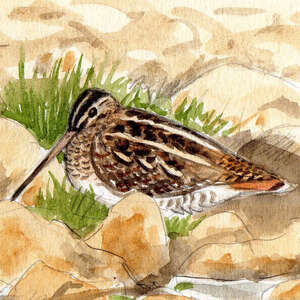
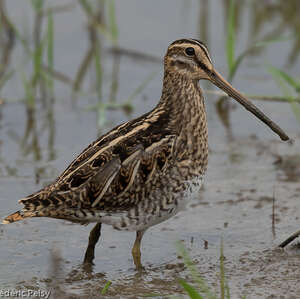
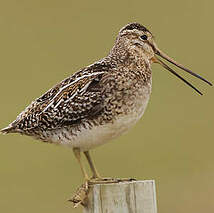
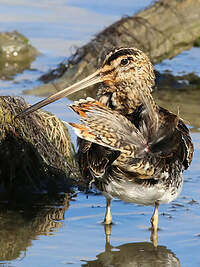
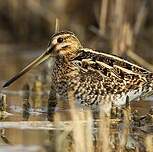
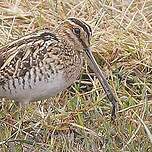
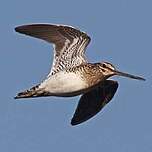
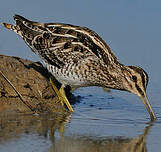
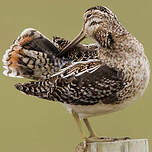
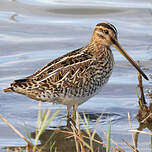
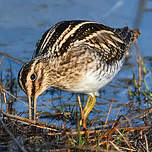
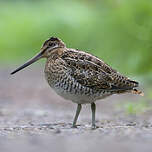
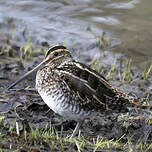
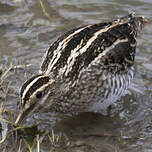
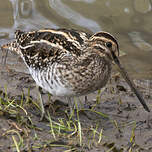
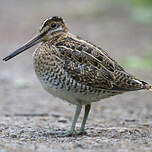
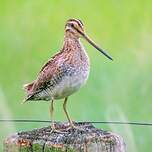
Common Snipe is very common and widespread. It has brown upperparts plumage, strongly striped and mottled with paler and darker brown. Underparts are white with black streaks on flanks. Breast is buff mottled with brown. Tail is rusty, finely barred with black. Wings are long and pointed.
Head shows bold stripes: a dark stripe through the eyes, with pale buff stripes above and below it, and dark and pale stripes on crown. Chin is white. Long and straight bill is dark. Eyes are black. Short legs and feet are greenish-yellow.
Both sexes are similar in plumage, with male slightly larger than female.
Juvenile is similar, with duller and narrower pale stripping on upperparts. Legs are greyish and bill is black. It reaches its Bécassine des marais adult plumage at one year.

Voice :
Sound from CD 'Tous les Oiseaux d'Europe' by Jean C. Roché by courtesy of Sittelle and CEBA.
Common Snipe utters a short and harsh rasping 'scaap' or 'schkape' in flight. During courtship displays, they give a repeated 'chipper-chipper-chipper-chipper', both in flight or perched.
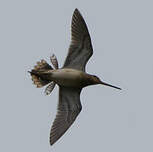
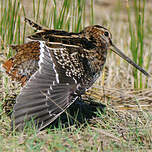
This species performs some 'drumming', spreading its tail feathers. The sound produced is a distinct drumming noise, caused by the air through the stiff tail feathers.

Habitat : Common Snipe lives and breeds in wet grasslands in freshwater marshes and ponds, flooded meadows, fields and sometimes, it may be found in salt marshes.
GEOGRAPHIC Bécassine des marais RANGE: Common Snipe is found in temperate Europe, Northern Africa, Asia and Americas. Birds of northern parts of the range migrate southwards to winter. There are year-round residents on the Pacific Coast of United States.

Behaviour : Common Snipe feeds on invertebrates, probing or picking up food by sight, and foraging in soft mud. The flexible tip of the bill allows feeling food while the bird probes into the ground. It feeds in muddy shallow waters, at the edges of lakes and ponds, close to the cover of waterside vegetation.
Common Snipe is a migratory bird, migrating southwards during the colder season of the year.
Courtship displays occur above the territory. Male performs high circles in mid-air, and then, it dives towards the ground in a rapid descent with slow wing beats and spreading its tail feathers, forming a right angle with its body. At this time, its tail produces a kind of drumming.
When Common Bécassine des marais Snipe is alarmed, it crouches and flushes suddenly at some metres, giving a harsh call and with a vigorous flight action; it flies high for long distance and drops back into cover.

Flight : Common Snipe performs an irregular or 'zigzag' flight. Flight displays are spectacular. Common Snipe is able to travel to a long distance in a short time. It flies at considerable elevation, with regular and rapid wing beats.

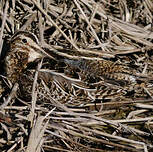
Reproduction-nesting : Common Snipe's nest is a shallow depression in the ground, on short clumps of grass, and under low vegetation. Nest is cup-shaped, made with fine grasses, mosses, dead leaves, and lined with Bécassine des marais fine plant materials. Nest is well hidden by overhanging vegetation. Common Snipe is a solitary nester.
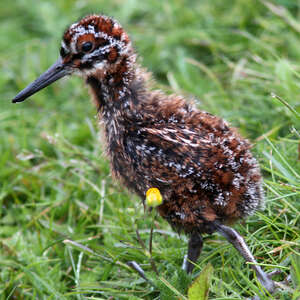
Female lays 3 to 4 brownish olive buff eggs, marked with dark spots. Incubation lasts about 18 to 20 days, by female alone. Both parents feed the young during the first week, and when they are ten days old, they are able to probe their own food. They are covered with Bécassine des marais marbled brown and black down, striped with black and speckled with white, providing good camouflage. Precocial chicks leave the nest when their down is dry. They run over vegetation, but they return to the nest to sleep.
Young fly at about 15 to 20 days after hatching. Parents divide the family in two groups and raise the young separately.
Both parents defend strongly the nest, performing distraction displays. Female stays at nest until predator is very close. At this time, she flushes suddenly from the nest.
This species produces one brood per year, occasionally two.

Food habits : Common Snipe feeds mainly on worms, but it also consumes insects, crustaceans, molluscs, and sometimes seeds and berries.

Protection / threats : Common Snipe is disturbed by human developments of wetlands, with swamps drainage, cultivation and canals. Birds are concentrated in other non adapted foraging areas, producing overpopulations that threaten economic interests of farmers and other groups depending from these areas.  

Other links :
Iucn
Birdlife


Bécassine des marais

Bécassine des marais

Bécassine des marais

Bécassine des marais

Bécassine des marais

Bécassine des marais


Specification sheet created by Nicole Bouglouan


Qui sommes-nous ? L'association | Mentions légales | Sources | Contacts | Print version
Updated on 2008/05/04 05:30:55 - © 1996-2008 Oiseaux.net

Les Bécassines

Bécassine des marais

Bécassine des marais

Bécassine des marais

Bécassine des marais

Bécassine des marais

Bécassine des marais

Bécassine des marais

Bécassine des marais

Bécassine des marais

Bécassine des marais

Bécassine des marais

Bécassine des marais

Bécassine des marais

Bécassine des marais

Bécassine des marais

Common Snipe