
European Robin
Erithacus rubecula - Rougegorge familier
Systematics
-
Order:
Passeriformes
-
Family:
Muscicapidés
-
Genus:
Erithacus
-
Species:
rubecula
Descriptor
Biometrics
- Size: 14 cm
- Wingspan: 20 à 22 cm.
- Weight: 16 à 22 g
Longevity
15 years
Geographic range
Identification
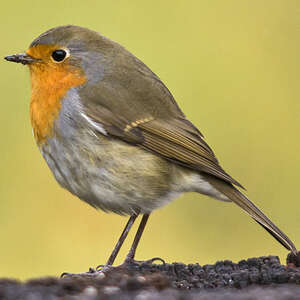
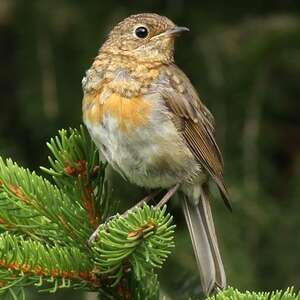
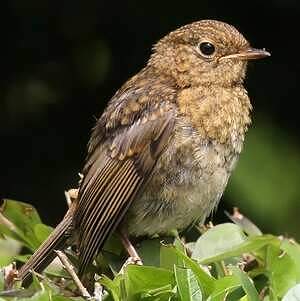
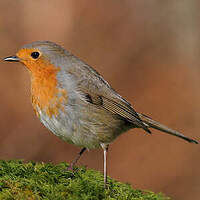
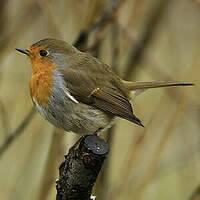
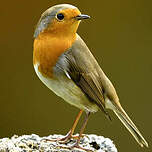
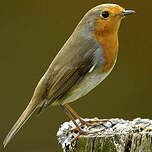
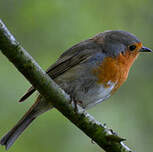
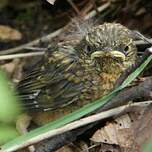
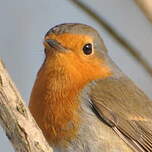
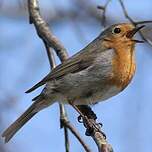
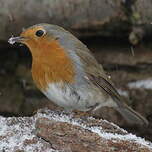
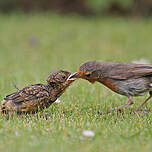
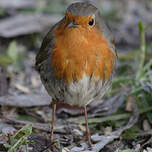
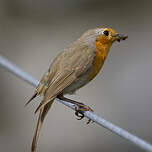
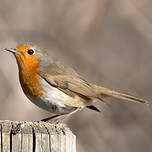
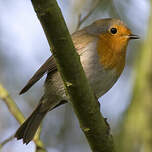
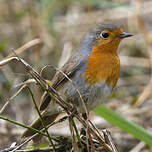
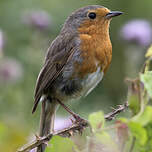
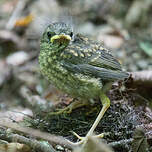
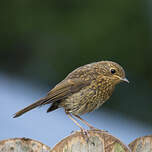
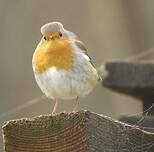
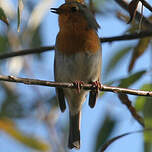
The European Robin is a small, round bird with relatively short wings that barely reach the middle of its tail. The adult is easily recognizable by the orange color that covers its entire front, forehead, lores, sides of the head, neck and chest. This large orange zone is outlined by a light gray band of color that is barely visible on the top of the forehead and on the sides of the neck and chest. The rest of the underside is a dirty white with tinges of rust on the sides. The upper parts are a brownish-olive hue, rather dark. The rump and uppertail coverts are a slightly warmer brown. The wings are outlined in a tawny color, which lightens the closed wings on which the darker primary coverts stand out. The eye is dark. The beak is thin, short and straight, and is a dark brown with a slightly lighter base. The legs are reddish-brown or brownish depending on the light, and sometimes pink. The juvenile has a similar silhouette to the adult, but with a very different look. The orange color is absent. The whole body is brown, widely spotted with rust-colored tawny, as is the rule among the Muscicapidae. The future orange breast can already be seen since the feathers at this level are redder than elsewhere. However, it will take the post juvenile molt for the first orange feathers to appear. On the closed wings, a reddish bar formed by the tips of the large coverts of this color stands out clearly. This character will remain after the first molt and be able to tell the following year that this is a second-year bird. Otherwise, in the first weeks, the yellow mouth corner is clearly visible.
Subspecific information 9 subspecies
- Erithacus rubecula rubecula (continental Europe to Ural Mts., w Turkey, islands in e Atlantic and nw Morocco)
- Erithacus rubecula melophilus (British Isles)
- Erithacus rubecula superbus (Tenerife I.. c Canary Islands.)
- Erithacus rubecula marionae (Gran Canaria I.. c Canary Islands.)
- Erithacus rubecula witherbyi (n Algeria and n Tunisia)
- Erithacus rubecula valens (s Crimea. s Ukraine.)
- Erithacus rubecula caucasicus (e Turkey and the Caucasus)
- Erithacus rubecula hyrcanus (se Azerbaijan and n Iran)
- Erithacus rubecula tataricus (Ural Mts. and sw Siberia)
Foreign names
- Rougegorge familier,
- Petirrojo europeo,
- pisco-de-peito-ruivo,
- Rotkehlchen,
- vörösbegy,
- Roodborst,
- Pettirosso,
- rödhake,
- Rødstrupe,
- červienka obyčajná,
- červenka obecná,
- Rødhals,
- punarinta,
- pit-roig,
- Glóbrystingur,
- rudzik,
- sarkanrīklīte,
- taščica,
- Зарянка,
- ヨーロッパコマドリ,
- 欧亚鸲,
- 歐亞歌鴝,
Voice song and cries
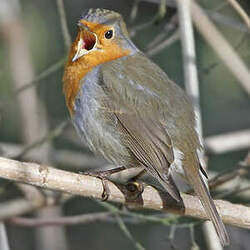
The European Robin's vocalizations are characteristic. Its most frequently heard call is an excitable metallic 'tic' which is often repeated in staccato, expressing a sort of unease. When the bird is very excited, this call can be repeated very quickly, and is used by adults near the nest when sensing danger, for example. Another classic call consists of a brief, sharp and piercing 'tsiih' which can be thought of as a contact call. Its song is very distinctive, consisting of a succession of whistled and rolled notes of a high tone, like a soft and liquid babble, that seem to flow naturally along a continuous phrase. This species has the particularity of singing again in autumn; this singing serves the males during the winter in defending a food territory. This singing is reputed to be softer than the springtime singing.
Habitat
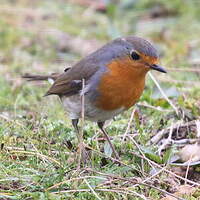
The European Robin is primarily a bird of the forest, whether deciduous, evergreen or mixed. It is the ideal environment it chooses to reproduce.
Behaviour character trait
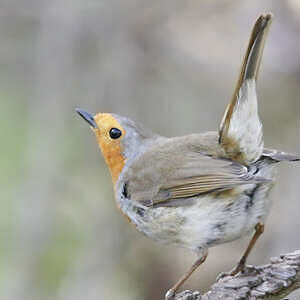
The European Robin is a solitary and territorial bird. Perched, it adopts an upright attitude, sometimes raising its tail and lowering its wings while bowing on its fairly sturdy legs. It uses its red breast as a warning and does not hesitate to display it on all occasions when it is necessary for him to assert his rights, real or usurped. Male territorials confront each other this way, chest high, while vocalizing abundantly to defend the boundaries of their domain. Even in the bad season, robins breast to defend a food territory and vigorously pursue intruders to drive them beyond the invisible boundaries they have set.
Flight
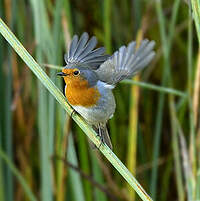
The European Robin flies easily, but we rarely have the opportunity to verify it since it is a nocturnal migratory bird whose long distance movements can't be observed. We mainly know it for its low and direct flight that it uses to flee when disturbed, to jump from one tree or bush to another or to cross an open road. The majority of its movements in the dark undergrowth remain invisible.
Dietfeeding habits
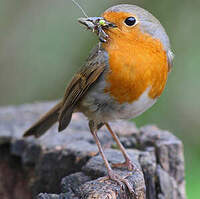
The European Robin is mainly insectivorous, particularly in the nice season, but also in the South in winter.
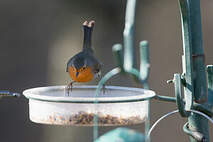
Reproduction nesting
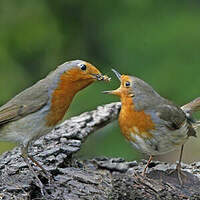
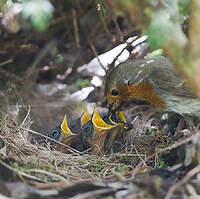
The European Robin is a semi-cavicole for nesting. The nest is always very well hidden in a crevice of rock or tree, against a slope covered with ivy, in a rotten stump, under a tuft of grass and very difficult to discover.
Geographic range
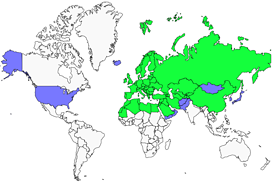
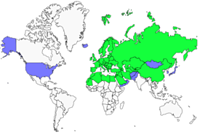
The European Robin is a species located mostly in western Eurasia. It spills over to some Atlantic islands occupied by different subspecies, and reaches west into the Maghreb and east into western Siberia. The northern population is migratory and usually winters in more southern areas, typically around the Mediterranean and at the edges of the Persian Gulf.
Threats - protection
IUCN conservation status
concern
in the Wild
threatened
evaluated
The European Robin is widely distributed over most of its range and is not threatened. Yet it is well known that this species is subject to intensive netting and trapping for food by people in the local area of the Mediterranean region, as with many other migrating birds.
Sources of information
- IOC World Bird List (v13.2), Gill, F and D Donsker (Eds). 2023.
Other sources of interest
 Specification sheet created on
06/07/2023 by Jean François
Specification sheet created on
06/07/2023 by Jean FrançoisTranslation by AI Oiseaux.net
published: 01-02-2017 - Updated: 08-02-2024
© 1996-2024 Oiseaux.net
- Accipitriformes
- Aegotheliformes
- Anseriformes
- Apodiformes
- Apterygiformes
- Bucerotiformes
- Caprimulgiformes
- Cariamiformes
- Casuariiformes
- Charadriiformes
- Ciconiiformes
- Coliiformes
- Columbiformes
- Coraciiformes
- Cuculiformes
- Eurypygiformes
- Falconiformes
- Galliformes
- Gaviiformes
- Gruiformes
- Leptosomiformes
- Mesitornithiformes
- Musophagiformes
- Nyctibiiformes
- Opisthocomiformes
- Otidiformes
- Passeriformes
- Pelecaniformes
- Phaethontiformes
- Phoenicopteriformes
- Piciformes
- Podargiformes
- Podicipediformes
- Procellariiformes
- Psittaciformes
- Pterocliformes
- Rheiformes
- Sphenisciformes
- Steatornithiformes
- Strigiformes
- Struthioniformes
- Suliformes
- Tinamiformes
- Trogoniformes