Galah

Birds      PsittaciformesPsittacidae      Id. Record Geographic rangePictures
Cacatoès rosalbin

Galah

Eolophus roseicapillus

Order  : Psittaciformes

Family : Psittacidae  ;

Biometrics :

Size : 35 à 36 cm
Wingspan :
Weight : 300 à 400gr

Longevity : 50 years

IUCN conservation status :

Extinct
Threatened
Least
concern
Extinc
in the Wild
Near
threatened
Not
evaluated

EX EW CR EN VU NT LC NE
Geographic range :

Distribution sumatran.trogon

Synonyms : Розовый какаду (ru), Cacatúa Galah (es), Cacatua pettorosa (it), Rosakakadu (al), Roze Kaketoe (nl), Galah (en)

Cacatoès rosalbin Family description :
Psittacidae is a large family, including several races of parrots of different sizes and colours, but with almost similar behaviour throughout their wide range. We find two main kinds of birds, the Cockatoos and the Parrots. The Cockatoos are large to medium-sized, with strong bill and conspicuo... to be continued

Physical description :
Galah seems to be the most abundant and familiar of all Australian parrots. This species has benefited from European settlement, becoming widespread and common, due to deforestation and cultivation of the land, which provides important food resources.
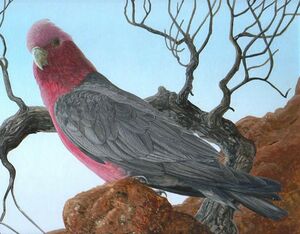
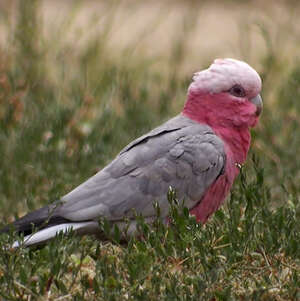
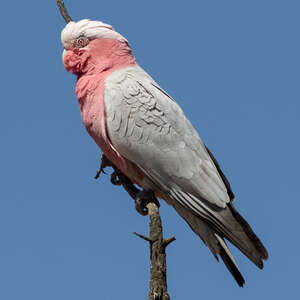
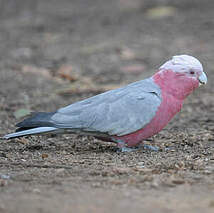
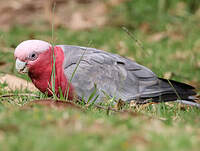
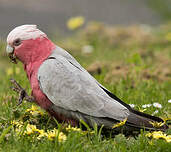
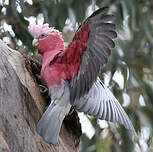
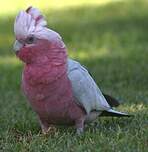
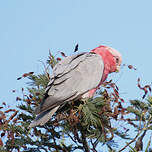
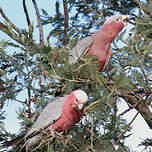
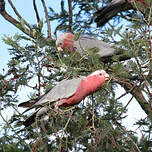
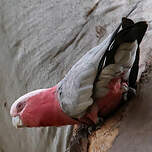
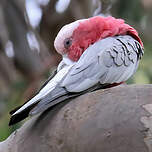
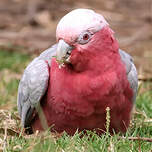
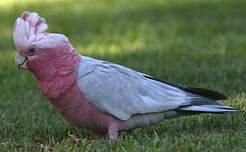
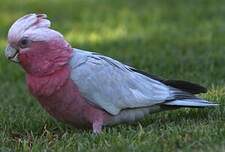
Adult male has pale grey upperparts on back, wings and tail. Secondaries, rump and uppertail coverts are whitish-grey. Cacatoès rosalbin
Underparts are rich dark pink, but lower abdomen and vent are whitish grey. Underwings and undertail feathers are grey. Lesser underwing coverts are dark pink.
On the head, crown and forehead are dark pink. The rear neck is rather whitish pink. Face, chin and throat are dark pink.
It has white or pink crest covering top half of head. We can see a pale pink fleshy eye-ring. Eyes are black. Hooked, strong bill is pale bluish-white. Legs and feet are grey.
Female is similar, but she has reddish-brown eyes.
Juvenile is similar to adults, with pink feathers slightly washed pale grey and smaller eye-ring.

There are three subspecies:
E.r. roseicapilla is very similar and lives in Western Australia.
E.r. albiceps has less important eye-ring which is deep pink to dull crimson. It lives in eastern Tasmania and east to SW Australia.
E.r. kuhli has paler plumage and shorter crest, and it is smaller in size. It lives in northern Australia.

Voice : Galah frequently gives contact call in flight, a brief 'chet' often repeated. This same call is given and repeated Cacatoès rosalbin more rapidly when bird is alarmed. When perched, it utters a 'tit-ew' or 'chet-it'. Advertising call is a prolonged 'chee-at' repeated several times. When Galah takes off, it utters 'lik-lik'.
When the bird is threatened or in territorial defence, it repeats a loud screeching 'scree', with erect crest, fanned tail and outspread wings.

Habitat : Galah favours timbered habitat, usually near water. It can be found in all habitats, except dense forests and treeless sandy deserts. It is relatively abundant in urban areas, parks and gardens. It is resident and sedentary in its range.
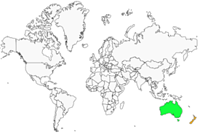
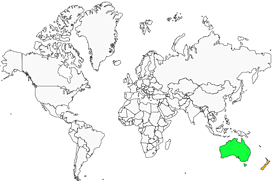
GEOGRAPHIC RANGE: Galah lives over most of Australia and some offshore islands. It can be found up to 1,600m, mostly below 1,300metres.

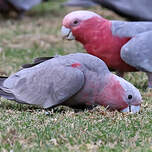
Behaviour : Galah feeds mainly on seeds. They form huge very noisy flocks, and they forage on the ground. They feed rather in the morning and in late afternoon, and spend most of time in cool weather. They shelter among foliage of tall trees, damaging the trees by stripping leaves and tearing Cacatoès rosalbin at bark. They may kill the trees by defoliation.
These large flocks gather in local food resources, and local cultivated areas suffer losses from these hungry flocks. Galah is considered a pest by farmers.
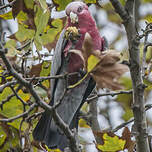
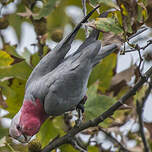
They adopt acrobatic postures and they are often seen hanging upside down, hold by only one foot, and flapping wings while giving loud 'scree'.
At dusk, they perform other acrobatics before to roost. They fly swiftly through treetops, twisting and turning while swooping down towards the ground, always screeching.
Acrobatics displays are incorporated into courtship ritual. Galah mates for life when it is four years old.
They have been recorded breeding with other cockatoo family.

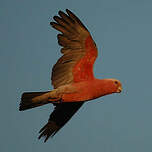
Flight : Galah Cacatoès rosalbin performs fast, strong flight with steady wing beats. It has rapid, deep wing beats at take off, becoming slower and shallower as the speed increases. It glides before to alight.

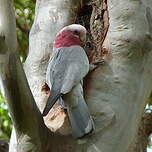
Reproduction-nesting : Galah nests in hollow in tree, or in cavity in cliffs. When in tree, it chews and strips the bark around the entrance. Nest is lined with leaves.
Breeding season varies, from February to July in the north, and from July to December in the south.
Female lays 2 to 5 white eggs. Incubation lasts about 4 weeks, shared by both adults.
Altricial chicks are fed at nest by parents during 5 to 6 weeks. Then, they leave the nest and gather at treetop, in nearby 'creche tree', with other young. Cacatoès rosalbin They are still fed by their parents for 2 to 3 weeks more.
Then, parents fly away for moult. Young become independent at about 6 to 8 weeks after hatching.
Young birds live in large nomadic flocks of non breeding birds until 2 or 3 years of age. There is high chick mortality with the half of the chicks dying in the first six months.

Food habits : Galah feeds on seeds and grains, fruits, berries, nuts, grasses, roots, green shoots, leaf buds, insects and their larvae.

Protection / threats : Galah is considered a pest in most parts of Australia. Local agriculture suffers losses, especially in the grain-producing district. They also damage the trees where they roost.
This species is common and abundant, and populations are increasing. These beautiful birds are unprotected, and they can be shot, trapped or poisoned in an attempt to reduce losses.  

Other links :
Iucn
Birdlife


Cacatoès rosalbin

Cacatoès rosalbin

Cacatoès rosalbin

Cacatoès rosalbin

Cacatoès rosalbin

Cacatoès rosalbin


Specification sheet created by Nicole Bouglouan


Qui sommes-nous ? L'association | Mentions légales | Sources | Contacts | Print version
Updated on 2008/05/05 05:34:55 - © 1996-2008 Oiseaux.net

Les Cacatoès

Cacatoès rosalbin

Cacatoès rosalbin

Cacatoès rosalbin

Cacatoès rosalbin

Cacatoès rosalbin

Cacatoès rosalbin

Cacatoès rosalbin

Cacatoès rosalbin

Cacatoès rosalbin

Cacatoès rosalbin

Cacatoès rosalbin

Cacatoès rosalbin

Cacatoès rosalbin

Cacatoès rosalbin

Galah