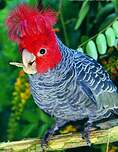
Gang-gang Cockatoo
Callocephalon fimbriatum
Order : Psittaciformes
Family :
Biometrics :
Size : 34 à 35 cm
Wingspan : 62-76 cm
Weight : 210-334 gr (M) - 240-300 gr (F)
IUCN conservation status :

EX EW CR EN VU NT LC NE
Geographic range :
Synonyms : Cacatùa gang gang (es), Cacatua gang gang (it), Helmkakadu (al), Helmkaketoe (nl), Gang-gang Cockatoo (en)
Family description :
Psittacidae is a large family, including several races of parrots of different sizes and colours, but with almost similar behaviour throughout their wide range.
We find two main kinds of birds, the Cockatoos and the Parrots.
The Cockatoos are large to medium-sized, with strong bill and conspicuo... to be continued
Physical description :
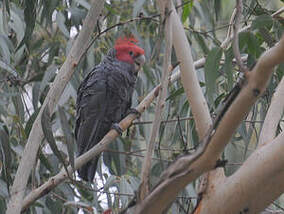
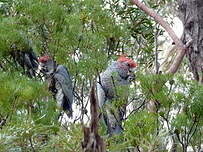
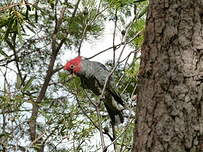
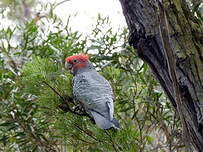
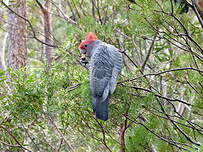
Gang Gang Cockatoo is a small, stocky parrot, with fine crest, broad wings and relatively short tail.
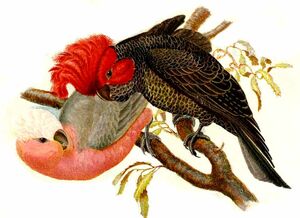
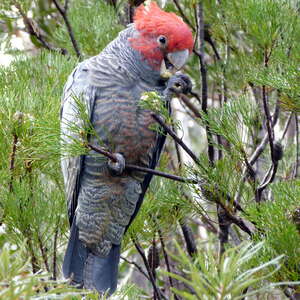
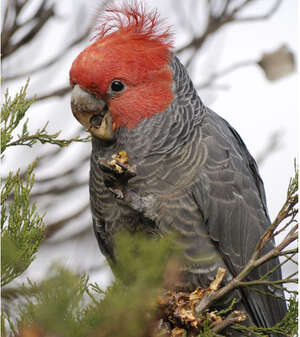
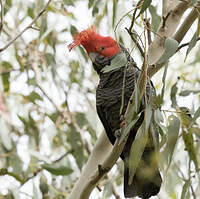
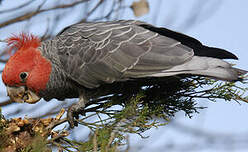
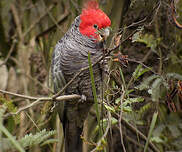
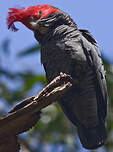
Male adult has forwards-ruffled scarlet crest made with filamentary feathers giving it a stunning head. Its plumage is slate-grey overall, except the dull green secondary coverts and the dark grey tail. Its body plumage shows scaled effect with pale grey-white feathers'
edges.
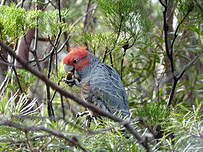
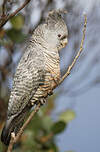
Female has dark grey head and ruffled crest. On the upperparts, she has barred yellow plumage, whereas the underparts are strongly barred pinkish-orange or yellowish, giving scaled effect too.
Immature is similar to female. However, young male is different with its red forehead and crown and its shorter reddish crest, less ruffled than in adult male.
Gang Gang Cockatoo can't be confused with any other parrot's species. However, when in flight, it sometimes resembles Galah.
Voice : Gang Gang Cockatoo utters very characteristic calls when in flight, or from an exposed perch at treetop. It gives a prolonged screech, ending in abrupt upwards inflection. Their calls are relatively similar to the noise produced by a cork twisted from a bottle. When it is feeding, it utters soft growling.
Habitat : During
summer, Gang Gang Cockatoo can be found in large mountain forests with Eucalyptus, and in woodlands with dense understory. It lives in cool areas as shaded gullies near streams.
During winter, it moves to lower elevation, in more arid woodland or scattered forests. It can be seen in roadsides and in suburban parks and gardens. This species needs tall trees for nesting.
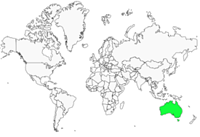
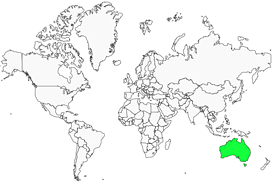
GEOGRAPHIC RANGE: Gang Gang Cockatoo lives in South-eastern Australia
and it is visible up to 2000 metres of elevation. This species was introduced to Kangaroo Island in South Australia.
Behaviour : Gang Gang Cockatoos populations living in mountains perform some movements in winter, moving down to coastal lowlands and lower valleys, whereas some birds remain higher. Very numerous Gang Gang Cockatoos come into Canberra suburbs where ornamental trees attract them, providing food resources.
They are usually seen in pairs or family groups, but they can gather in larger flocks at food and water sources. Gang Gang Cockatoo is very arboreal, and comes down only for drinking or sometimes for feeding if seed-cones are on the ground. At this moment, this bird seems to be very tame.
During midday, it rests in trees, among dense foliage.
During rain showers or falling snow, Gang Gang Cockatoo performs aerobatics, circling above the forest and swooping down periodically through treetops.
Flight : Gang Gang Cockatoo is a strong flier, flying with slow, sweeping wing-beats. Usually, it prefers to fly from tree to tree in short flights,
coming down to the ground, and rising up to alight on a branch. When flying very long distance, Gang Gang Cockatoo flies at considerable height, and descends in spiralling flight, twisting and turning easily.
Reproduction-nesting : Gang Gang Cockatoo reaches its sexual maturity at about four years of age. In southern Australia, breeding season occurs from October to January.
Female selects a natural cavity situated in tall healthy Eucalyptus. Nest is usually fairly high in the tree, not so far from water.
Both sexes enlarge the cavity by chewing the wood of the side entrance with the bill, and then, they line the nest with the woodchips.
Female usually lays 2 eggs, rarely 3. Both parents incubate during 24 to 30 days. They also feed the young and share the nesting duties.
Chicks remain at nest during about 8 weeks, but even after fledging, parents feed them for 4 to 6 weeks more.
They remain in family groups all winter. Sometimes, when several pairs are nesting in the same area, their young gather in one tree and form a 'crèche', while adults go away for food.
Food habits : Gang Gang Cockatoo is mainly vegetarian. It feeds mainly
on seeds from native or exotic trees, such as Eucalyptus, Acacia or Hawthorn. It also feeds on berries, fruits, nuts, and insects and their larvae.
It is mainly an arboreal bird, coming to the ground only for drinking or taking seeds in fallen cones. Outside breeding season, Gang Gang cockatoo forages in large flocks up to 60 birds. During nesting season, they are found in pairs or small groups.
Protection / threats : Gang Gang Cockatoo is not globally threatened. Populations seem to be secure, and now, it is common in winter in the suburbs of Canberra.
In addition, the great height of their nest protects them against human nest robbers.
Other links :
Iucn
Birdlife
Specification sheet created by Nicole Bouglouan
Qui sommes-nous ?
L'association |
Mentions légales |
Sources |
Contacts |
Print version
Updated on 2008/05/05 05:34:55 - © 1996-2008 Oiseaux.net
Gang-gang Cockatoo