Great Cormorant

Birds      PelecaniformesPhalacrocoracidae      Id. Record Geographic rangePictures
Grand Cormoran

Great Cormorant

Phalacrocorax carbo

Order  : Pelecaniformes

Family : Phalacrocoracidae  ;

Biometrics :

Size : 80 à 100 cm
Wingspan : 130 à 160 cm
Weight : 2000 à 2500 g

Longevity : 20 years

IUCN conservation status :

Extinct
Threatened
Least
concern
Extinc
in the Wild
Near
threatened
Not
evaluated

EX EW CR EN VU NT LC NE
Geographic range :

Distribution sumatran.trogon

Synonyms : Storskarv (kontinental ras) (sv), Cormorán grande (es), Cormorano (it), Kormoran (al), Aalscholver (nl), Great Cormorant (en)

Grand Cormoran Physical description :
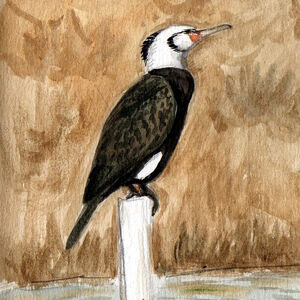
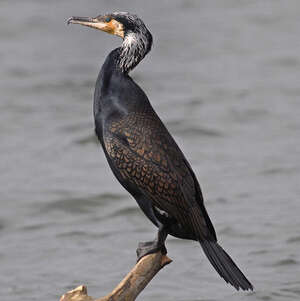
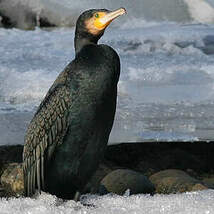
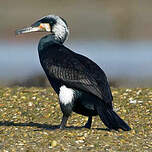
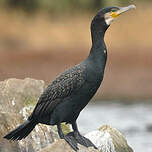
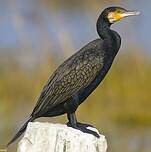
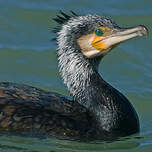
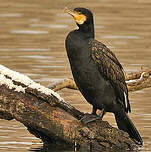
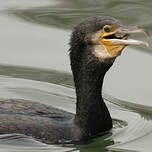
Great Cormorant adult in breeding plumage has black plumage, glossed blue and bronze. Back is grey-bronze, with dark edges. Tail is long and black. We can see a thigh white patch, used in courtship displays.
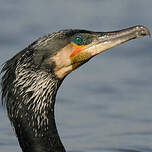
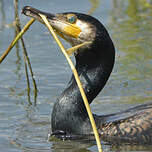
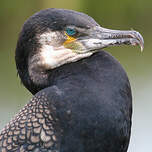
Head is black with a few white feathers on the loosely crested nape, including some elongated feathers. Throat and cheeks are white. Eyes are green, from emerald to turquoise. Hooked strong bill is blackish with yellow base. Legs and webbed feet are black.
Outside breeding season, Great Cormorant looses most of its white feathers and has duller plumage.
Both sexes are similar. Male is slightly larger than female, with larger bill.
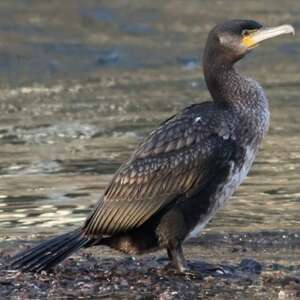
Juvenile has brownish neck and white belly, and sometimes mottled pale brown on breast, Grand Cormoran neck and flanks.
Second year resembles adult, but browner.

Several sub-species display more or less white in plumage:
Phalacrocorax carbo carbo nesting on Atlantic coasts;
Phalacrocorax carbo sinensis breeding from southern Europe to Central Asia, with extensive white on the head.
Phalacrocorax carbo lucidus from tropical Africa, with white cheeks, throat and neck.
Phalacrocorax carbo novaehollandiae with a crest.

Voice :
Sound from CD 'Tous les Oiseaux d'Europe' by Jean C. Roché by courtesy of Sittelle and CEBA.
Great Cormorant utters Grand Cormoran guttural croaking at nest and roost. Usually silent away from colonies.

Habitat : Great Cormorant lives in rocky or sandy coasts, in estuaries, lakes and large streams. They nest on cliffs, in rocky islands, and feed in sheltered water. They winter along the coasts.
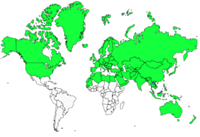
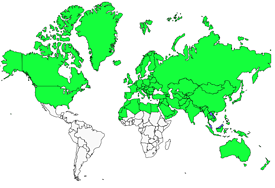
GEOGRAPHIC RANGE: Great Cormorant is found in northern Atlantic, Africa, Eurasia and Australasia. Birds move according to food resources.

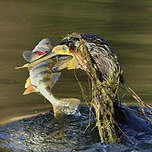
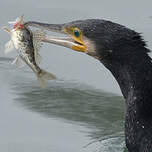
Behaviour : Great Cormorant feeds mainly on fish. It dives to capture its prey with its bill, and it is able to remain under water up to one minute or more. It brings the fish to the surface to shake and toss it before swallowing.
It swims under water in order Grand Cormoran to pursue its prey, only using its webbed feet. Outside breeding season, birds may fish in small groups, but they are often seen alone.
Great Cormorants spend most of their time sitting upright in rows on a sandy bank, or trees and man-made structures.
Great Cormorants are often considered as competitors by fishermen, and they have been persecuted. But their fishing abilities are sometimes turned to man's advantage, helping humans to fish, catching the prey without swallowing. Men put them a neck collar to prevent it, and send them to fish from a boat.
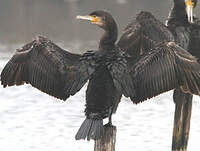
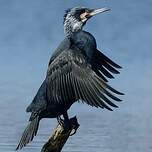
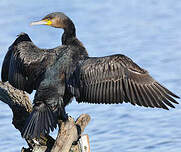
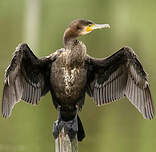
Great Cormorants have Grand Cormoran special feathers witch allow air to escape and water to penetrate the plumage. Under water, swimming is more efficient. But it also means that the bird have to dry its plumage in a characteristic posture, with wings spread out, perched on a branch. This pose may also help to digestion. It consumes about 400 to 700 grams of fish per day.
During courtship displays, the white thigh patches are often exposed, when male at rest on water, with frequent wing beats, and the bird projects the head back and fans its tail.
Other display shows the male swinging its head back and forth, with erect tail, while is calling loudly. Female responds Grand Cormoran by swinging slightly its head and 'purring'.
This species is gregarious, and nest in colonies on cliff ledges or trees, on coasts or inland.
Great Cormorant has been observed swallowing small pebbles when it needs extra weight to dive more easily. It regurgitates them after feeding.

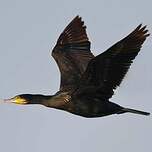
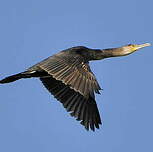
Flight : Great Cormorant flies with steady wing beats and occasional glides. It circles inland waters before landing in shallow glide. Its take-off Grand Cormoran is laboured, with some bounds on the surface before the flight. When they fly in flock, they form a loose 'V'.

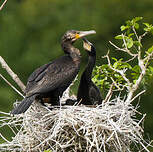
Reproduction-nesting : Great Cormorant breeds at any time, according to food resources. Nest is a large structure of sticks and seaweeds, lined with finer materials. Both parents build the nest in a low tree, on the ground, on cliff ledges or on abrupt slopes. Breeding colonies may include up to 2000 pairs, although smaller colonies are typical.
Female lays 3 to 4 blue-white eggs. Incubation lasts about 29 to 31 days, by both adults. They use their large webbed feet to incubate the eggs. Grand Cormoran They place the eggs above the feet, to warm them between feet and body.
Chicks hatch at intervals and are altricial. They are fed by both parents, with regurgitated liquid, and later, chicks get solid food into parents' throats. They fledge at about 50 days of age, but they depend of their parents for up to 70 days.
This species produces only one brood per year.

Food habits : Great Cormorant feeds mainly on fish and aquatic invertebrates. In freshwater, it may consume crustaceans, frogs and various insects.

Protection / threats : Great Cormorants have been persecuted by human, as fish competitors, and in the past, this species was almost extinct.
Now, with conservation efforts, numbers are increasing and the status of the species are secure.
Hatchlings may be preyed upon by raptors before fledging.  

Other links :
Iucn
Birdlife


Grand Cormoran

Grand Cormoran

Grand Cormoran

Grand Cormoran

Grand Cormoran

Grand Cormoran


Specification sheet created by Nicole Bouglouan


Qui sommes-nous ? L'association | Mentions légales | Sources | Contacts | Print version
Updated on 2008/05/04 05:30:55 - © 1996-2008 Oiseaux.net

Le Grand Cormoran

Grand Cormoran

Grand Cormoran

Grand Cormoran

Grand Cormoran

Grand Cormoran

Grand Cormoran

Grand Cormoran

Grand Cormoran

Grand Cormoran

Grand Cormoran

Grand Cormoran

Grand Cormoran

Grand Cormoran

Great Cormorant