
Grey Heron
Ardea cinerea - Héron cendré
Systematics
-
Order:
Pelecaniformes
-
Family:
Ardéidés
-
Genus:
Ardea
-
Species:
cinerea
Descriptor
Biometrics
- Size: 98 cm
- Wingspan: 175 à 195 cm.
- Weight: 600 à 1200 g
Longevity
25 years
Geographic range

Identification
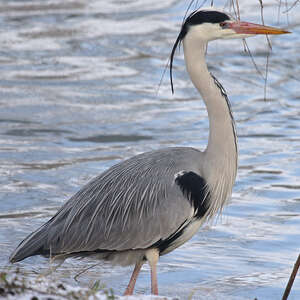
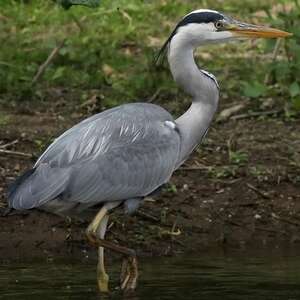
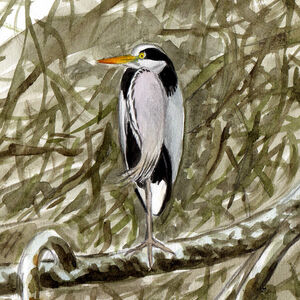
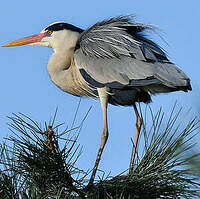
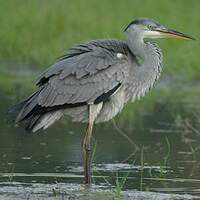
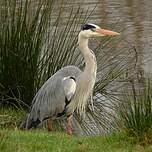
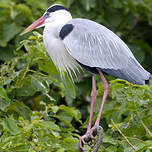
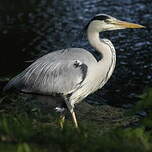
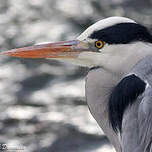
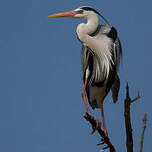
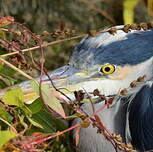
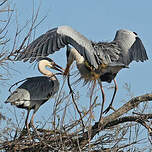
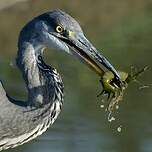
The Grey Heron is one of our largest members of the heron family and the largest in Europe. It is easily recogniseable by its large size, grey colouring and distinctive silhouette when flying. Its plumage is medium grey on the upperparts and white underneath. Flight feathers, remiges and rectrices are dark-brown resulting in a typical contrast between them and the rest of the body, which is easily seen during flight. The plumage becomes more pronounced in the adult. The crown feathers are well defined and extend in to a small crest. The beak yellow, the front of the neck has clear black streaks and a white patch on the wrist above the small black coverts. The scapulars lengthen and the legs lighten. This plumage is maintained for much of the year, but in the mating season the plumage of the breeding adult changes. The beak becomes a yellow orange, lores become blue, crest becomes longer, long ornament feathers grow at the bottom of the neck and around the scapulars and the legs turn even more yellow. The male can be distinguished from the female by his brighter colours. These decorations are important during mating displays. The juvenille and immature have a plumage similar to the inter-mating adult, but duller, with the upper beak and legs being dark.
Subspecific information 4 subspecies
- Ardea cinerea cinerea (w Europe to e Asia to India and Africa)
- Ardea cinerea jouyi (n China, Korea and Japan to Sumatra and Java)
- Ardea cinerea monicae (Banc d'Arguin. Mauritania.)
- Ardea cinerea firasa (Madagascar, Comoros and Aldabra)
Foreign names
- Héron cendré,
- Garza real,
- garça-real-comum,
- Graureiher,
- szürke gém,
- Blauwe Reiger,
- Airone cenerino,
- gråhäger,
- Gråhegre,
- volavka popolavá,
- volavka popelavá,
- Fiskehejre,
- harmaahaikara,
- Bloureier,
- bernat pescaire,
- Gráhegri,
- czapla siwa,
- zivju gārnis,
- siva čaplja,
- Серая цапля,
- Cangak abu,
- アオサギ,
- 苍鹭,
- นกกระสานวล,
- 蒼鷺,
Voice song and cries
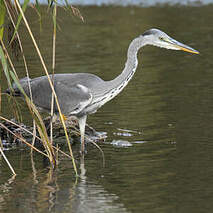
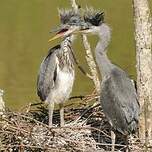
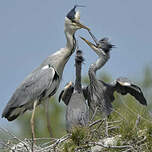
The Grey Heron has no song. Its usual call, for example when it takes flight, is a rough and hoarse waarr. The flight call is of the same type, but a bit softer. It's a croaking and sonorous weeh with a higher pitch. When settling in the colony, various guttural and hoarse cries can be heard. The almost grown youngbirds beg for food at the nest with repetitive kakakakakaka... peeping.
Habitat
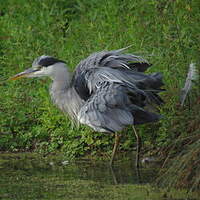
The Grey Heron frequents all fresh or brackish waters as long as there are fishes. During the interseason, it also visits agricultural areas in search of rodents and other prey on land. To reproduce, it looks for woody areas with large trees to make its nest (forests, riparian vegetation, poplar groves, bushes and parks). Locally, reed-beds are the chosen place for nesting.
Behaviour character trait
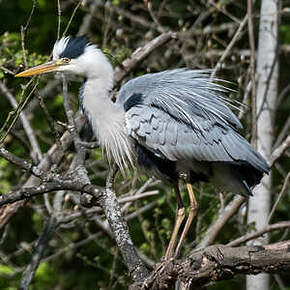
The Grey Heron is fundamentally a gregarious bird at all times. During the breeding season, adults reproduce in colonies that can count several hundreds of nests. Territoriality is then limited to the immediate area around the nest. Outside the breeding season for adults and at all times for immatures, birds gather for the night in dormitories in places that protect them from predators (in trees, on water islets, on mudflats, etc.). On the other hand, when they are fishing, they become very solitary and territorial and fiercely defend their fishing areas against intruders.
Flight
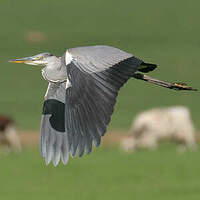
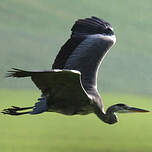
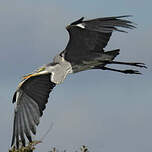
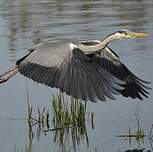
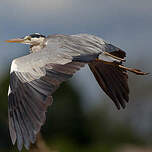
Like other herons, the Grey Heron tucks its neck in flight in order to balance the body's weight. The neck then forms a prominent loop beneath. The feet are then stretched back. Finally, the long and wide wings appear arched, with the wrist raised and the tip drooping. These characteristics are at the root of an unmistakable silhouette. Flight is ample, heavy and powerful. Herons are capable of flying great distances and many populations are migratory.
Dietfeeding habits
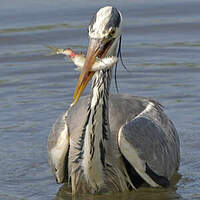
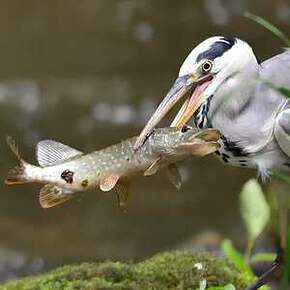
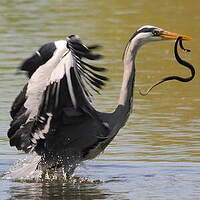
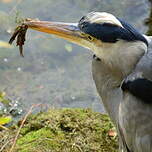
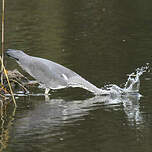
The Grey Heron primarily feeds on fish, particularly for the food supply of young herons. Its diet also includes amphibians such as frogs, some invertebrates such as crayfish and amphibious creatures such as the grass snake, and the water shrew, albeit marginally.
Reproduction nesting
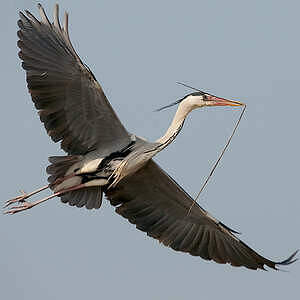
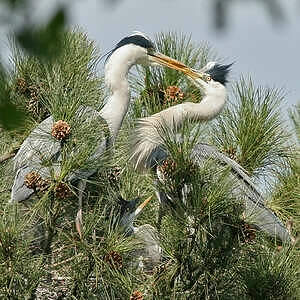
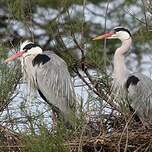
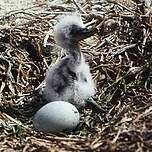
The Grey Heron is a monogamous colonial species. It is either arboreal or paludicole for reproduction. In the first case, the nest is built in a large tree, usually at the end of a branch in the canopy. The nest is made of twigs and branches with a roughly cut and lined with some finer plant materials. It is quite wide and flat, although relatively small for the bird's size. When such nests neighbor with Carrion Crow nests as is fairly common, the size difference may not be that obvious. It's the morphology that matters. When they neighbor with nests of other ardeids, waders or cormorants since colonies are often mixed, it may be quite hard to tell them apart and count them.
Geographic range
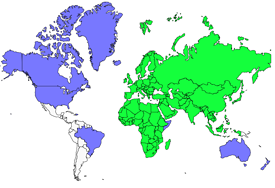
The Grey Heron is widespread throughout the Old World, from the Atlantic to the Pacific and latitudinally, from the north of Scandinavia and Siberia to the south of Africa, India and Indonesia. It is absent from the Arctic regions, large desert areas (Sahara, Arabia, Asian deserts) and Oceania (Australia, Papua New Guinea, etc.).
Threats - protection
IUCN conservation status
concern
in the Wild
threatened
evaluated
Currently, the Grey Heron species is doing well, at least in Europe, thanks to its complete protection. It is expanding on the edges of its area. However, taking into account its colonies in managing forest areas is desirable.
Sources of information
- IOC World Bird List (v14.1), Gill, F and D Donsker (Eds). 2024-04-18.
- Grands échassiers, gallinacés, râles d'Europe, P. Géroudet
- HBW Alive,
- xeno-canto, Sharing bird sounds from around the world,
Other sources of interest
 Specification sheet created on
09/07/2023 by Jean François
Specification sheet created on
09/07/2023 by Jean FrançoisTranslation by AI Oiseaux.net
published: 28-01-2019 - Updated: 04-02-2019
© 1996-2024 Oiseaux.net
- Accipitriformes
- Aegotheliformes
- Anseriformes
- Apodiformes
- Apterygiformes
- Bucerotiformes
- Caprimulgiformes
- Cariamiformes
- Casuariiformes
- Charadriiformes
- Ciconiiformes
- Coliiformes
- Columbiformes
- Coraciiformes
- Cuculiformes
- Eurypygiformes
- Falconiformes
- Galliformes
- Gaviiformes
- Gruiformes
- Leptosomiformes
- Mesitornithiformes
- Musophagiformes
- Nyctibiiformes
- Opisthocomiformes
- Otidiformes
- Passeriformes
- Pelecaniformes
- Phaethontiformes
- Phoenicopteriformes
- Piciformes
- Podargiformes
- Podicipediformes
- Procellariiformes
- Psittaciformes
- Pterocliformes
- Rheiformes
- Sphenisciformes
- Steatornithiformes
- Strigiformes
- Struthioniformes
- Suliformes
- Tinamiformes
- Trogoniformes