
House Sparrow
Passer domesticus - Moineau domestique
Systematics
-
Order:
Passeriformes
-
Family:
Passéridés
-
Genus:
Passer
-
Species:
domesticus
Descriptor
Biometrics
- Size: 17 cm
- Wingspan: 25 cm.
- Weight: 30 à 39 g
Longevity
13 years
Geographic range
Identification
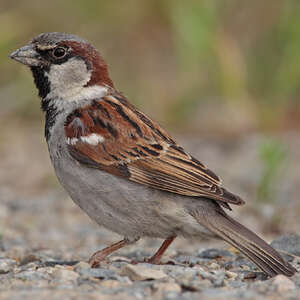
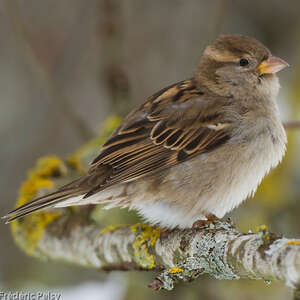
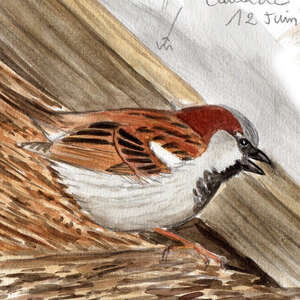
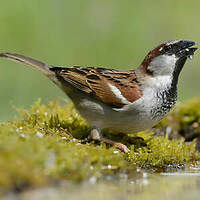
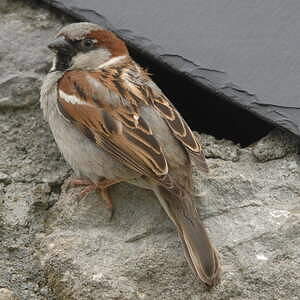
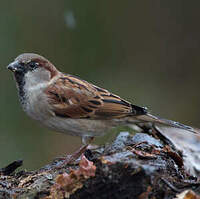
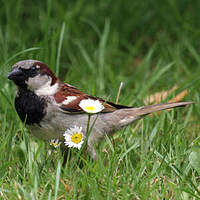
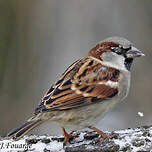
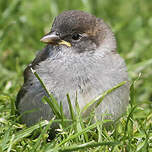
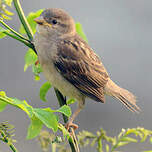
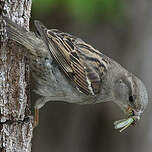
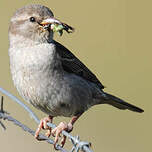
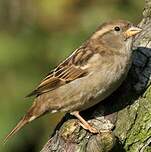
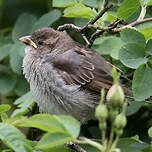
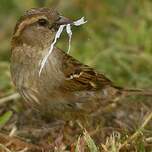
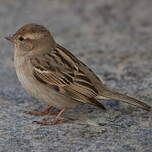
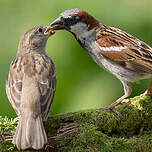
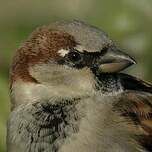
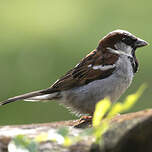
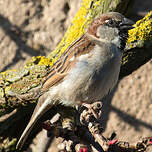
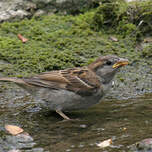
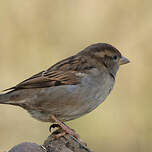
Everyone knows the piaf (House Sparrow) - so common in urban environments and so unafraid that passers-by hardly even take a look, except for when they have some morsels to throw them. Yet, this small, hopping ball of feathers, robust and fearless, deserves our attention. The House Sparrow presents a clear sexual dimorphism. The male adult has quite sober but still colorful plumage when you look closely. Its head is remarkable, with a grey cap, chestnut neck, dirty-white cheeks and a black throat extending into a bib on the chest. The dark eye is enclosed in a black loral zone which continues underneath, while a small white supraloral streak is common among the domesticus subspecies. The upper body shows warm colors, brown and fawn, with longitudinal blackish streaks. The white tip of the medium-sized coverts forms a small wing bar. The light grey on the back and rump is only visible when the wings lift, so especially while taking flight. The rectrices are brownish-grey with a beige edge. The underbody is whitish, tinged with cream or grey in certain areas. The strong beaked is black. The legs are pink. The adult female has a much quieter plumage, without the warm tones of the male. The upper body, including the head, look brown, light fawn or beige. The mantle is striped lengthwise in blackish tones. The white wing bar is much narrower. The back and rump are brown but do not present as much contrast. The brown head has a pale eyebrow extending from the eye to the sides of the neck. The beak is brownish, often with yellow at the base of the lower mandible. The underbody is similar to that of the male, but usually slightly striped by dark. The juvenile looks a lot like the female, but with more subtle features, paler beak, almost formless eyebrow, barely visible wing bar, and, in the first age, shiny plumage and a clearly visible yellow corner of its mouth. The 12 recognized subspecies only differ in terms of plumage details.
Subspecific information 12 subspecies
- Passer domesticus domesticus (w and n Europe through n Asia to ne Siberia and n Japan, introduced in the Americas, South Africa and Australia)
- Passer domesticus balearoibericus (s Europe. except Italy. to c Turkey)
- Passer domesticus biblicus (Cyprus, n Israel and nw Jordan to w Syria and se Turkey to nw Iran.)
- Passer domesticus hyrcanus (se Azerbaijan and n Iran)
- Passer domesticus persicus (c Iran to w and s Afghanistan)
- Passer domesticus indicus (s Israel and s Palestine through Arabia and east to India and c Southeast Asia)
- Passer domesticus bactrianus (w Turkmenistan and ne Iran to w China and nw Pakistan)
- Passer domesticus parkini (nw and c Himalayas)
- Passer domesticus hufufae (ne Arabia)
- Passer domesticus tingitanus (nw Africa)
- Passer domesticus niloticus (Egypt)
- Passer domesticus rufidorsalis (Sudan and Eritrea)
Foreign names
- Moineau domestique,
- Gorrión común,
- pardal-de-telhado,
- Haussperling,
- házi veréb,
- Huismus,
- Passera Europea,
- gråsparv,
- Gråspurv,
- vrabec domový,
- vrabec domácí,
- Gråspurv,
- varpunen,
- Huismossie,
- pardal comú,
- Gráspör,
- wróbel (zwyczajny),
- mājas zvirbulis,
- domači vrabec,
- Домовый воробей,
- イエスズメ,
- 家麻雀,
- นกกระจอกใหญ่,
- 家麻雀,
Voice song and cries
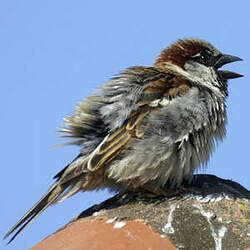
Among House Sparrows, we can't really talk about singing. Rather, it's brief and often endlessly repeated territorial cries that serve as a substitute for singing. In the case of the House Sparrow, which is sedentary, the males are vocal very early, as of January. He proclaims his territory by endlessly repeating his tchip, tchiup or tchirp singing, perching on the ridge of a roof, a chimney, a gutter or any other close post to the coveted cavity for the nest. From this somewhat tiresome sequence, we can remember that it is this distinctive cry that earned it its slang name of piaf. The cries are quite varied. The most common cry is a tien contact call, often repeated twice or three times. The usual alarm call, untranslatable, is a very rapid sequence of notes, almost a trill, repeated as long as the danger persists.
Habitat
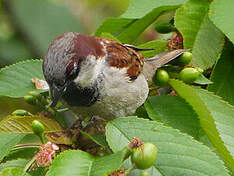
The House Sparrow is one of the most anthropophilic species. It lives almost everywhere where humans are present and builds buildings, cities and villages, hamlets, isolated farms, etc.
Behaviour character trait
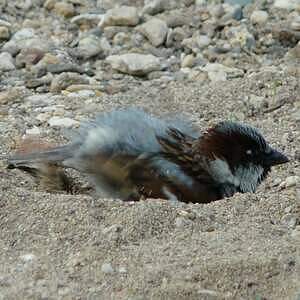
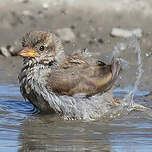
Two adjectives are a good fit to describe the House Sparrow: sedentary and gregarious. It is probably the most homebound species in Western Europe. A House Sparrow born in a village has all the chances of spending its entire life there and it is visible in all seasons. Furthermore, it always looks for the company of other individuals of the same species. It nests willingly in loose colonies and, during the gap between courting seasons, it forms groups that are often large and can either be monospecific or mixed with its congeners, the Chaffinch. They look for food together, expose themselves to the sun's rays to groom themselves.
Flight
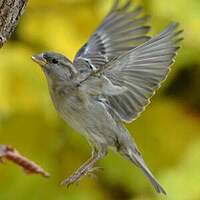
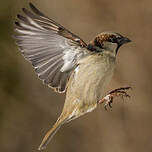
The House Sparrow has a powerful, fast and direct flight. The flapping is interrupted by brief moments where the wings are stuck to its body, but the flight does not become undulated like with other finches.
Dietfeeding habits
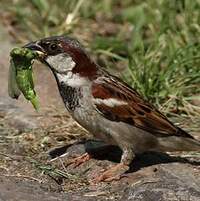
The House Sparrow can be qualified as an omnivore. The adult mainly feeds on various seeds, but it is an opportunistic bird and does not turn down small animals, which remain minority in its diet.
Reproduction nesting
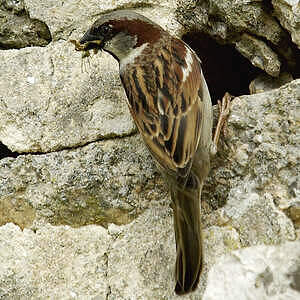
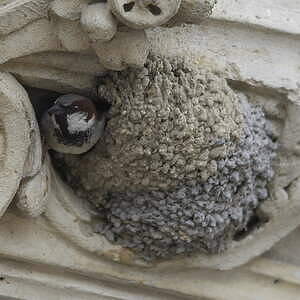
At the end of winter, at the start of March, breeding season begins for the House Sparrow. This in turn is accompanied by the nuptial parades described above, as well as the choice of reproduction site which the male will defend quite vigorously with his voice. The species is more or less a cave dweller; its nest is placed in a cavity in the most varied of locations, but always at a respectable height to avoid plundering. It is a construction in the shape of a ball, quite voluminous, somewhat loose and weak, with a lateral opening. It is made up of vegetal elements (dried leaves, in particular stems and linear leaves of grass, tassels and fibres) and is consolidated by feathers and horsehair.
Geographic range
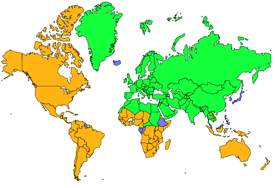
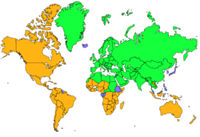
The House Sparrow is a species of the old world, occupying a very wide range in the boreal, temperate and subtropical biomes. This range extends from Iceland to the west to Kamchatka to the east, and from the North Cape to the north to Sri Lanka to the south. 12 subspecies share this vast range, with the subspecies type domesticus, the one which occupies Europe, having the widest distribution, from the Atlantic to the west to China. It has been introduced, voluntarily or not, to many places in the world, for example in North America where it has become very common in the United States and Canada, Venezuela, the Canary Islands, Sub-Saharan Africa (for example in Ivory Coast and Rwanda) in Southeast Asia (Singapore), Australia, etc. Most populations are sedentary. Only the Asian subspecies bactrianus and parkini are migratory.
Threats - protection
IUCN conservation status
concern
in the Wild
threatened
evaluated
Despite a certain decline due to changes in farming practices and crop rotation methods, the House Sparrow remains a common and widely distributed bird. But since the 1980s, a clear decline has started in major cities, in Europe as well as on the American continent, which is inexorably continuing. This is the case of (the City of) Paris, where the House Sparrow is disappearing. The modern urban habitat, increasingly concrete-based, no longer provides the sparrow with enough food to feed normally and the renovation of buildings deprives it of its nesting sites.
Sources of information
- IOC World Bird List (v14.1), Gill, F and D Donsker (Eds). 2024-04-18.
- Les passereaux d'Europe, tome 2, P. Géroudet, M. Cuisin
- Le Moineau domestique, BOUCHARD Serge
- Avibase, Lepage Denis
- HBW Alive,
- xeno-canto, Sharing bird sounds from around the world,
Other sources of interest
 Specification sheet created on
07/07/2023 by Jean François
Specification sheet created on
07/07/2023 by Jean FrançoisTranslation by AI Oiseaux.net
published: 08-12-2017 - Updated: 19-03-2018
© 1996-2024 Oiseaux.net
- Accipitriformes
- Aegotheliformes
- Anseriformes
- Apodiformes
- Apterygiformes
- Bucerotiformes
- Caprimulgiformes
- Cariamiformes
- Casuariiformes
- Charadriiformes
- Ciconiiformes
- Coliiformes
- Columbiformes
- Coraciiformes
- Cuculiformes
- Eurypygiformes
- Falconiformes
- Galliformes
- Gaviiformes
- Gruiformes
- Leptosomiformes
- Mesitornithiformes
- Musophagiformes
- Nyctibiiformes
- Opisthocomiformes
- Otidiformes
- Passeriformes
- Pelecaniformes
- Phaethontiformes
- Phoenicopteriformes
- Piciformes
- Podargiformes
- Podicipediformes
- Procellariiformes
- Psittaciformes
- Pterocliformes
- Rheiformes
- Sphenisciformes
- Steatornithiformes
- Strigiformes
- Struthioniformes
- Suliformes
- Tinamiformes
- Trogoniformes