Hyacinth Macaw

Birds      PsittaciformesPsittacidae      Id. Record Geographic rangePictures
Ara hyacinthe

Hyacinth Macaw

Anodorhynchus hyacinthinus

Order  : Psittaciformes

Family : Psittacidae  ;

Biometrics :

Size : 100 cm
Wingspan : 130 à 150 cm
Weight : 1200 à 1500 gr

Longevity : 60 years

IUCN conservation status :

Extinct
Threatened
Least
concern
Extinc
in the Wild
Near
threatened
Not
evaluated

EX EW CR EN VU NT LC NE
Geographic range :

Distribution sumatran.trogon

Synonyms : Гиацинтовый Ара (ru), Hyasintara (sv), Guacamayo Jacinto (es), Ara giacinto (it), Hyazinthara (al), Hyacinthara (nl), Hyacinth Macaw (en)

Ara hyacinthe Family description :
Psittacidae is a large family, including several races of parrots of different sizes and colours, but with almost similar behaviour throughout their wide range. We find two main kinds of birds, the Cockatoos and the Parrots. The Cockatoos are large to medium-sized, with strong bill and conspicuo... to be continued

Physical description :
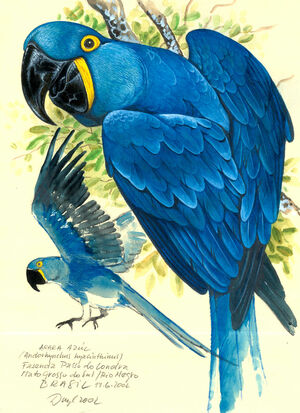
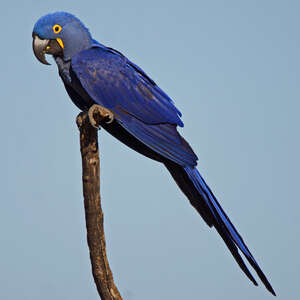
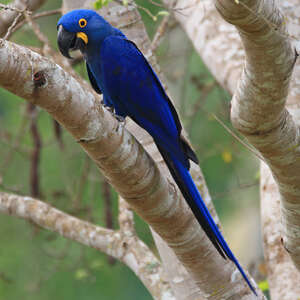
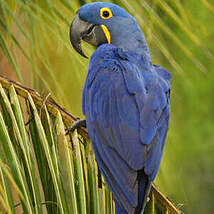
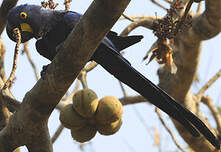
Hyacinth Macaw is a magnificent large blue macaw, but it is an endangered species. It is the largest parrot in the world.
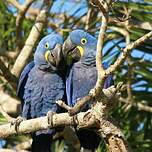
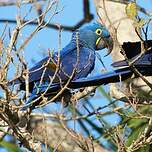
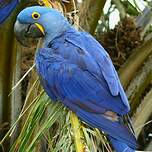
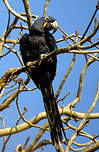
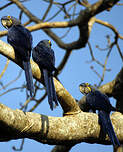
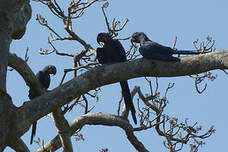
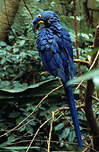
Adult male has deep cobalt-blue plumage overall. Wings are slightly darker. Long tail is very graduated.
Under wings and under tail feathers are dark grey.
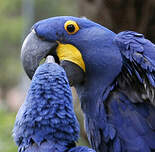
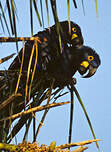
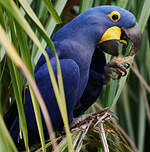
Head is slightly paler than body. We can see two bare yellow and narrow lappets crescent-shaped, Ara hyacinthe surrounding the base of the lower mandible.
Heavy, hooked bill is blackish. Eyes are dark brown, with bare, yellow eye-ring. Legs and zygodactyl feet are blackish.
Both sexes are similar, with female slightly slender than male.
Juvenile resembles adults, with bare skin facial patches duller and paler. Tail is shorter.

We find one similar species, the Anodorhynchus leari, which is smaller, with slightly duller plumage, and different shape of facial lappet (larger).

Voice : Hyacinth Ara hyacinthe Macaw utters discordant and guttural 'kraaa-aaa', when in flight. It repeats these calls in bursts. When alarmed, it gives shrill 'kraa-ee...kraa-ee', and also harsh shrieks. When at roost, we can hear some barks and yelps, and also growls.
Hyacinth Macaw's calls usually are loud and harsh, guttural sounds, often heard over hundreds of metres in nature. Its large size makes its calls lower in frequency than in other macaws.

Habitat : Hyacinth Macaw lives mainly in moderately wooded areas with palm trees. They can be numerous Ara hyacinthe in gallery forests or in woodlands bordered with scrublands, but also in deciduous small forests and occasionally flooded grasslands. It usually avoids heavily forested areas.
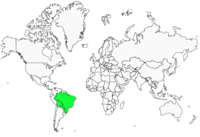
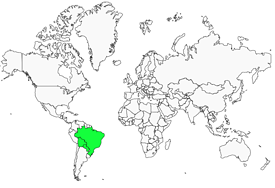
GEOGRAPHIC RANGE: We can find 3 local populations of Hyacinth Macaws in central South America, in north-eastern, in central-eastern and in south-central Brazil. It is also found in eastern Bolivia and north-eastern Paraguay.

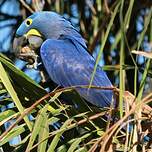
Behaviour : Hyacinth Macaw feeds mainly on palm nuts, taken in trees or on the ground. The macaw uses its heavy bill for scoring the nut. Then, as with a cutter, it shears the nut into two parts. It cuts very cleanly, almost as human work.
In order to avoid predation by Hyacinth Macaws in palm trees, plants produce little by little harder seeds, and some macaws with very large bills are able to open the nuts. Their young get these heavier and larger bills by genes, and bills become larger in each generation.
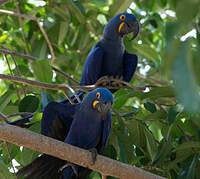
Hyacinth Macaw is resident in its range, performing some dispersion for food. It is usually seen alone or in small groups of up to 4 birds, but they are often seen in larger groups of 12 to 20 birds, where pairs and Ara hyacinthe family trios are often recognized.
Hyacinth Macaw is a noisy species, and feeds mainly in the morning and late afternoon, and it can be active on moon nights. It rests during the heat of day in the canopy. Pairs are always close to each other. They roost in flocks in trees at night.
When disturbed, they take off from canopy, and circle over treetops while giving their loud calls.
Hyacinth Macaw is very playful, being quiet for a moment, and doing some funny things at times. They are able to mimic human voices.

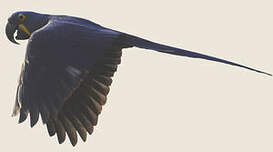
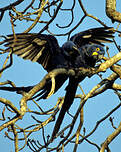
Flight : Hyacinth Macaw has buoyant, effortless flight, with shallow wing beats. Long tail makes it easy to identify Ara hyacinthe in the air. It can perform long-distance flights, very high in the sky. Pairs fly together, side by side, with one bird slightly behind the other. They maintain constant contact by calls. They can reach flight speed of up to 55 km per hour.

Reproduction-nesting : Hyacinth Macaw nests in holes in trees, but it does not excavate the cavity itself. It can also nest in cliff-faces. This species breeds after rainy season which occurs from August to December. They pair for life.
Female lays 1 or 2 eggs. The second is laid several Ara hyacinthe days after the first. Incubation lasts about one month, by female. Male feeds her during this period. Chick fledges about 4 months after hatching.
The smaller chick often dies and only one survives. It remains with parents for about 6 months, and both adults feed it.
Young will reach its sexual maturity at 7 to 10 years of age.
This species produces one single brood per season, but it does not breed every year.

Food habits : Hyacinth Macaw feeds mainly on palm nuts, but it consumes wide variety of seeds, and fruits in trees. It can sometimes feed on clay. Clay helps the bird to absorb the poison naturally contained in some seeds and unripe fruits. Sometimes, Ara hyacinthe they eat nuts yet consumed by cattle and past through their digestive system, which makes the nuts softer and easier to open.

Protection / threats : Hyacinth Macaw was relatively common, numerous years ago, but now, this species is suffering dramatic declines, by habitat loss, trapping for live-bird trade, and use of their feathers for headdresses for tourist trade. Kayapo Indians of Gorotire in Brazil need at least up to 10 macaws to make only one headdress.
Its habitat is reduced by human developments, and regular grass fires which destroy the nests.
Hyacinth Macaw' species is now considered as Endangered Species.  

Other links :
Iucn
Birdlife


Specification sheet created by Nicole Bouglouan


Qui sommes-nous ? L'association | Mentions légales | Sources | Contacts | Print version
Updated on 2008/05/05 05:34:55 - © 1996-2008 Oiseaux.net

Le Marais Breton-Vendéen

Ara hyacinthe

Ara hyacinthe

Ara hyacinthe

Hyacinth Macaw