
Little Egret
Egretta garzetta - Aigrette garzette
Systematics
-
Order:
Pelecaniformes
-
Family:
Ardéidés
-
Genus:
Egretta
-
Species:
garzetta
Descriptor
Biometrics
- Size: 65 cm
- Wingspan: 86 à 104 cm.
- Weight: 500 à 638 g
Longevity
9 years
Geographic range

Identification
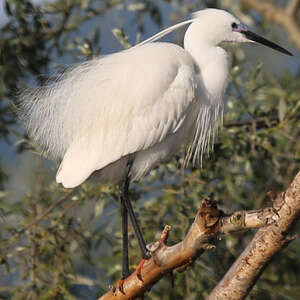
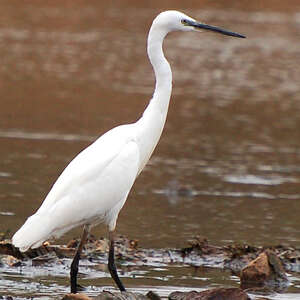
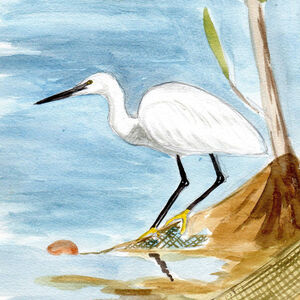
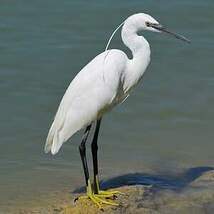
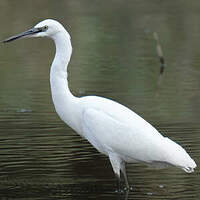
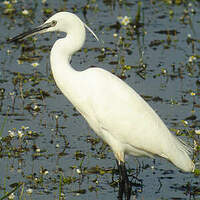
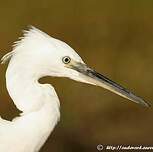
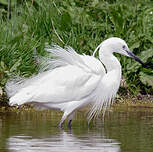
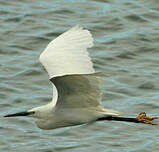
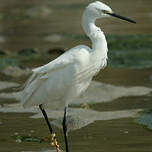
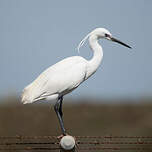
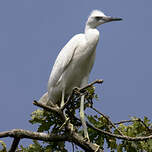
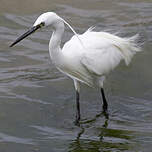
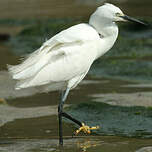
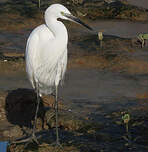
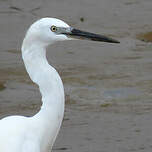
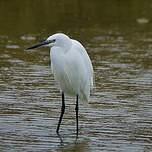
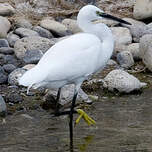
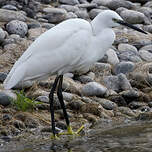
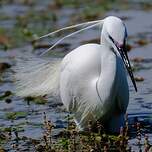
The Little Egret is one of the species of small herons with immaculate white plumage found across the world. But its dark morph is extremely rare in its homeland. Like all egrets, it has a slender and elegant body. Its black beak is like a true dagger, long and thin, very slightly curved downwards. The lores can vary in colour depending on the physiological state. During the inter-breeding period, they are yellow-green, in line with the yellow iris. But during the breeding period, the breeding adults see their lores turn pinkish-blue or purple. The long black legs are adorned with yellow fingers, except in the subspecies of Oceania where they may be all black, or else with yellow soles. During breeding, ornamental feathers appear, filamentous at the back of the head, feathery and downy at the lower neck, at the back of the arm and on the back, taking part in the specific nuptial plumage. It is these particular feathers that have earned these birds the generic name of egrets.
Subspecific information 2 subspecies
- Egretta garzetta garzetta (Europe to Japan south to Africa, India and the Philippines)
- Egretta garzetta nigripes (Sundas to Australia and New Zealand)
Foreign names
- Aigrette garzette,
- Garceta común,
- garça-branca-pequena,
- Seidenreiher,
- kis kócsag,
- Kleine Zilverreiger,
- Garzetta,
- silkeshäger,
- Silkehegre,
- beluša malá,
- volavka stříbřitá,
- Silkehejre,
- silkkihaikara,
- Kleinwitreier,
- martinet blanc comú,
- Bjarthegri,
- czapla nadobna,
- mazais baltais gārnis,
- mala bela čaplja,
- Малая белая цапля,
- Kuntul kecil,
- コサギ,
- 白鹭,
- นกยางเปีย,
- 小白鷺,
Voice song and cries
Under the circumstances, the Little Egret can be silent or vocal. When disturbed or confronted with an aggressive interaction context, it can emit a raspy single cry of raaah or repeated krah krah krah. This is the cry that is heard when it is disturbed in its fishing spots, for example. In nesting colonies, it becomes much more talkative when its territoriality is a source of tension with its neighbors in the colony. Often, its cries mingle with the cries of other species present, the colonies being often multi-species, and the concert can be loud. The chicks in the nest beg with the typical ke ke ke of the family.
Habitat
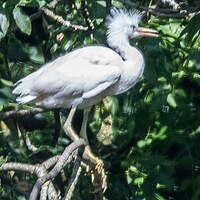
The Little Egret frequents a wide range of habitats, but with one constant: the presence of free, fresh or saline water, in which it finds its food. This is why it can be found inside the land, thanks to the hydrographic network and natural or artificial water bodies, and in coastal areas, in the shallow waters of lagoons, estuaries, rice fields and other salt marshes; much less on the coast itself. On the other hand, it needs wooded areas suitable for its arboreal and colonial reproduction.
Behaviour character trait
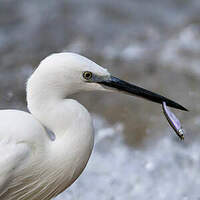
The Little Egret is a common and gregarious species. It is most often found in the immediate vicinity of the waters where it comes to fish, usually in small groups.
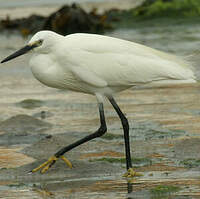
Between fishing sessions, they rest in groups, either on the ground in the open, in the middle of a field or marsh for example, or perched on a small grove or forest edge near the water.
Long-distance movements, between the colony and faraway fishing areas, or migratory ones, are made in relatively disorganized small groups.
Flight
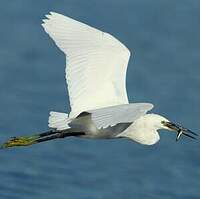
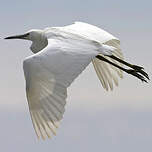
The long, wide and curved wings of the Little Egret give it a smooth, generous and powerful flight, with slow flappings. It rarely glides.
Dietfeeding habits
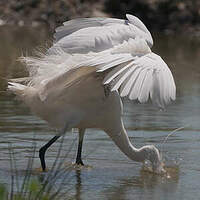
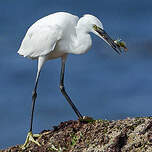
The Little Egret feeds on a wide variety of vertebrate prey (small fish, amphibians and their larvae, even small lizards) and invertebrates (worms, crustaceans, mollusks, and various aquatic and other insects) caught with its beak. It is much less adapted to terrestrial environments than its congener, the Great Egret, or of course, the Cattle Egret.
Reproduction nesting
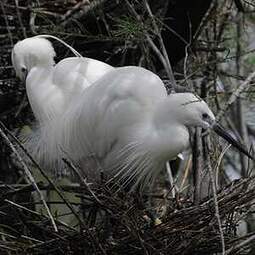
Depending on local conditions, the Little Egret can nest on the ground in very sheltered areas, but more regularly in reedbeds, flooded willows, wet thickets or wet woodlands, close to or away from the water.
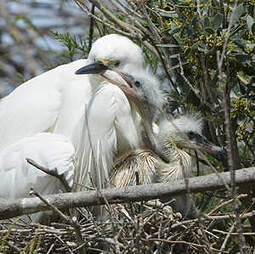
Its nesting is colonial, and it can share the nesting grounds with other waterbirds (mainly herons, but also cormorants, ibises, spoonbills, and up to 17 different species in an Indian study). The nest is a platform, made of fairly thin woody branches, 30-35 cm in width, 10-15 cm in height. It is built by the couple on the mating grounds, to a height of up to 20 m. The fragility of the construction means that the nest is rarely reused the following year.
The mating ritual highlights the ornamental feathers, with the male being most active in the seduction operations and to ward off annoying neighbours.
Once the nest is complete, the female lays 3-5 light blu-green eggs at intervals of one to two days. Incubation starts with the 2nd or 3rd egg laid and lasts 21-25 days, shared by the couple.
The chicks hatch one after the other, covered in white down, with pink beak and feet but quickly becoming pale grey. They are fed by both parents with food regurgitated directly into the oral cavity.
After 3 weeks, the young leave the nest to venture onto the nearby branches. They make their first flight at 5 weeks, accompanied by their parents. The species only has one brood per year.
Geographic range

The Little Egret is a species from the Old World. It is replaced in the New World by a closely related species, a vicariant species of sorts, the Snowy Egret (Egretta thula). Its distribution range ranges from the Atlantic to the Pacific, at temperate and tropical latitudes. It is missing from most of Northern Europe and almost all of Russia.
Threats - protection
IUCN conservation status
concern
in the Wild
threatened
evaluated
The population of Little Egrets appears to be stable. The species, which is common, is not generally under threat. Locally, it may be subject to problems of destruction or modification of its habitat due to human pressure, which is presumably rising steadily. Fortunately, the colonies in some major breeding areas, such as the Camargue, are protected.

Sources of information
- IOC World Bird List (v14.1), Gill, F and D Donsker (Eds). 2024-04-18.
Other sources of interest
 Specification sheet created on
01/07/2023 by Jean François
Specification sheet created on
01/07/2023 by Jean FrançoisTranslation by AI Oiseaux.net
published: 29-01-2017 - Updated: 30-01-2017
© 1996-2024 Oiseaux.net
- Accipitriformes
- Aegotheliformes
- Anseriformes
- Apodiformes
- Apterygiformes
- Bucerotiformes
- Caprimulgiformes
- Cariamiformes
- Casuariiformes
- Charadriiformes
- Ciconiiformes
- Coliiformes
- Columbiformes
- Coraciiformes
- Cuculiformes
- Eurypygiformes
- Falconiformes
- Galliformes
- Gaviiformes
- Gruiformes
- Leptosomiformes
- Mesitornithiformes
- Musophagiformes
- Nyctibiiformes
- Opisthocomiformes
- Otidiformes
- Passeriformes
- Pelecaniformes
- Phaethontiformes
- Phoenicopteriformes
- Piciformes
- Podargiformes
- Podicipediformes
- Procellariiformes
- Psittaciformes
- Pterocliformes
- Rheiformes
- Sphenisciformes
- Steatornithiformes
- Strigiformes
- Struthioniformes
- Suliformes
- Tinamiformes
- Trogoniformes