
Little Owl
Athene noctua - Chevêche d'Athéna
Systematics
-
Order:
Strigiformes
-
Family:
Strigidés
-
Genus:
Athene
-
Species:
noctua
Descriptor
Biometrics
- Size: 23 cm
- Wingspan: 54 à 58 cm.
- Weight: 150 à 200 g
Longevity
16 years
Geographic range
Identification
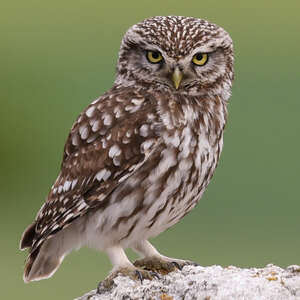
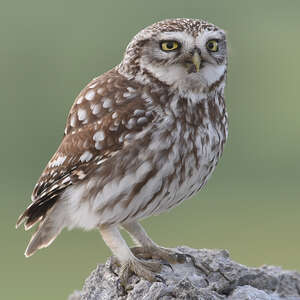
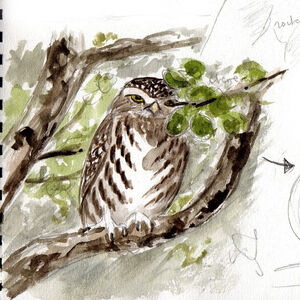
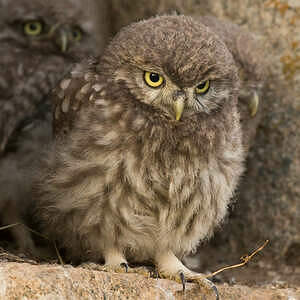
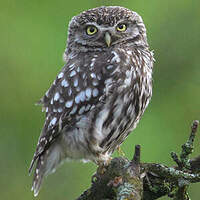
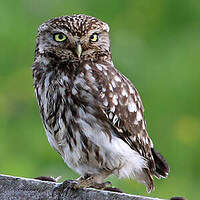
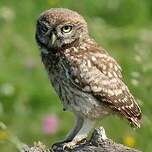
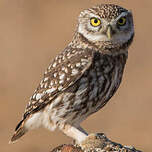
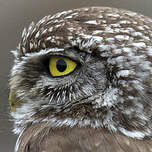
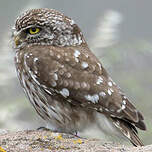
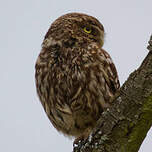
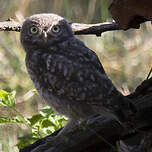
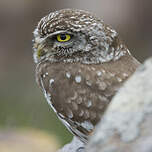
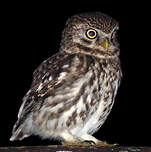
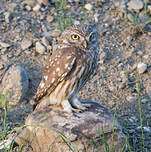
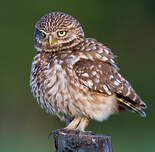
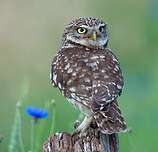
The Little Owl (Chevêche d'Athéna) is a small owl measuring a bit over 20 cm in length with a wingspan between 45 to 50 cm and a weight of around 200 g. It has a compact body, with a large head, short wings and tail. There is no sexual dimorphism, with the female simply being a bit larger than the male. The adult plumage is a brown speckled with white on top, and white with brown striations underneath. Its head is wider than high, with the sides curving around and a somewhat rectangular shape. The crown is brown, finely speckled in white. The facial disks of brown and white highlight the eyes which look like golden yellow, topped with white eyebrows, which form an X shape from the front, with a straw-colored beak in the middle. Interestingly, the nape of the neck also has a brown and white design which resembles the facial disks, so when the Little Owl turns its head 180 degrees, or has its back turned to us, it can seem like it is always watching us. This is a characteristic common to the family and must be an adaptation to deter potential predators. The wings and tail feathers appear barred. The tarses are white-feathered. The juvenile looks much like the adult, but with a more uniform plumage, less clearly marked and less "well-groomed". The facial mask is also less distinct. Color variations of the plumage vary greatly from one subspecies to another, of which there are 13. Birds in the northern parts of its range are darker than birds in the south, particularly of desert regions, which are often very light. The subspecies from Western and Northern Europe, vidalii, is the darkest, with lilith in the Middle East being the lightest.
Subspecific information 13 subspecies
- Athene noctua noctua (c, s and se Europe to nw Russia)
- Athene noctua vidalii (w Europe)
- Athene noctua indigena (Romania to Greece through Ukraine and Turkey east to s Russia)
- Athene noctua lilith (Cyprus, s Turkey to Iraq and the Sinai. Egypt.)
- Athene noctua bactriana (Iraq and Azerbaijan to Pakistan and nw India)
- Athene noctua orientalis (ne Kazakhstan, nw China)
- Athene noctua ludlowi (Himalayas)
- Athene noctua impasta (wc China)
- Athene noctua plumipes (Mongolia, sc Siberia and ne China)
- Athene noctua glaux (coastal n Africa to sw Israel)
- Athene noctua saharae (Morocco to w Egypt, c Arabia)
- Athene noctua spilogastra (e Sudan, Eritrea and ne Ethiopia)
- Athene noctua somaliensis (e Ethiopia and Somalia)
Foreign names
- Chevêche d'Athéna,
- Mochuelo europeo,
- mocho-galego,
- Steinkauz,
- kuvik,
- Steenuil,
- Civetta,
- minervauggla,
- Kirkeugle,
- kuvik obyčajný,
- sýček obecný,
- Kirkeugle,
- minervanpöllö,
- mussol comú,
- Kattugla,
- pójdźka (zwyczajna),
- mājas apogs,
- čuk,
- Домовый сыч,
- コキンメフクロウ,
- 纵纹腹小鸮,
- 縱紋腹小鴞,
Voice song and cries
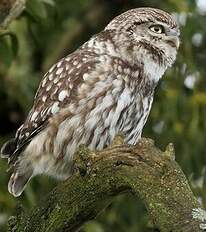
The vocabulary of the Little Owl is quite rich. She is particularly vocal at dusk during the breeding season. Territorial calls, alarm calls and others convey her activity. It is around small villages in the agricultural plains where you are most likely to hear it. The usual call is a powerful bitonal wiou. It is a warning or alarm call if there is an intrusion into the territory. It is somewhat reminiscent of the cry of the buzzard. The song is a rising, interrogative Haaaah of high pitch that carries far. There are also drawn-out wouuu that can have the same tone as the song of the Scops Little Owl, so there can be potential errors, barked miou, etc. It has been shown that the cries of the adult male can be heard up to 4 km in the plain without any obstacle.
Habitat
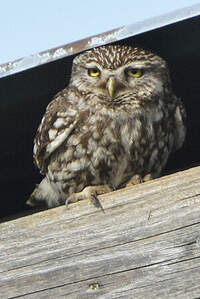
The Little Owl has three requirements to be present, open spaces for hunting, cavities for nesting and this in plain.
Behaviour character trait
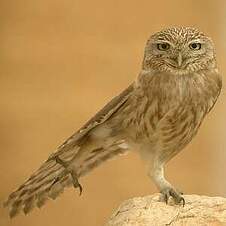
The Little Owl is a sedentary bird, present all year round in its territories. This characteristic limits its distribution to regions capable of providing it with subsistence during the bad season, that is, regions without long lasting snow cover.
Flight
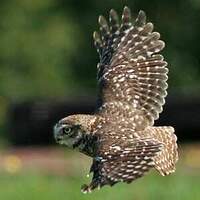
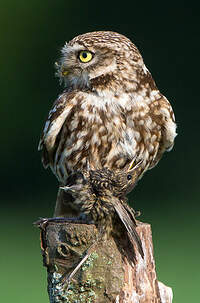
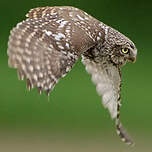
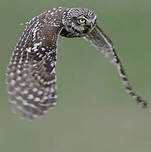
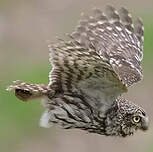
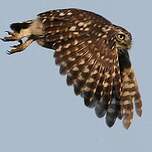
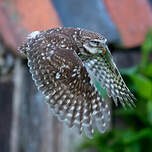
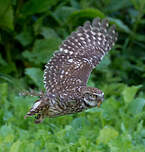
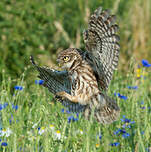
The large wings with rapid but shallow beats alternating with brief rest sequences give the Little Owl a distinctive, direct, low and slightly undulating flight with no equivalent among other birds of the same size.
Dietfeeding habits
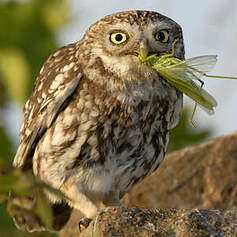
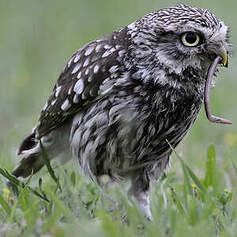
The Little Owl mostly hunts at dusk and in the early night. Although it is quite diurnal, it does not hunt during the day.
Reproduction nesting
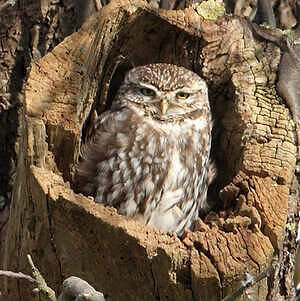
The Little Owl is monogamous and, due to the sedentary nature of the species, couples are likely to be stable over time, perhaps even until the death of one of the partners. Sexual displays begin early, in the middle of winter, but the breeding season itself extends from March to August. There is only one nesting per year. For nesting, the Little Owl is cave-dwelling, that is to say it nests in a cavity. Like all other nocturnal raptors, it does not build a nest, the female simply laying her eggs on the substrate of the cavity, which can be of very variable nature.
Geographic range
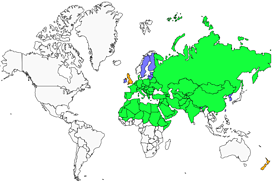
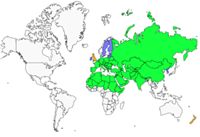
The Little Owl's range covers the whole of Eurasia from the Atlantic to the Pacific in a continuous band, including temperate and Mediterranean regions. It is also present throughout the northern part of Africa and the Arabian Peninsula, albeit fragmented. It is well represented in the Maghreb and along the Nile Valley. To the north, it is naturally absent in the British Isles (where it has been introduced), Scandinavia, and most of Russia. Its southern limit is the line connecting the northern tip of Mauritania to Somalia.
Threats - protection
IUCN conservation status
concern
in the Wild
threatened
evaluated
The Little Owl of Athena was forced to suffer, in the developed northern countries of its range, the alteration of agricultural landscapes as they were known in the past. This is the case in our country and, to use the words of the French organization Vigienature, The species declined sharply in France in the second half of the twentieth century due to the deterioration of its habitat (reparceling, disappearance of meadows and hollow trees, urbanization). Collisions with cars are one of the main causes of mortality. But for the last 20 years, it has been given an increase of +91%. However, Vigienature states The spectacular increase in the abundance index of this species should be considered with caution, as it is based on small numbers, of up to 40 individuals detected per year. It is still an indication that the Little Owl, after a temporary emptiness at the end of the 20th century, is improving its situation a little. But at the same time, the introduced population from Britain is in decline. The Little Owl of Athena populations had declined in the 1960s, among other things, due to the use of organochlorine pesticides. Since then, these products have been banned and the species is doing better. For the moment, the species is not globally threatened at the world level. For Birdlife International, the population is stable. The size of the range and population is such that the species does not approach the status of a vulnerable species. But beware, the threats, in the strict sense, persist, not least the lethal car traffic that continues to increase. For this last factor, specific and necessarily expensive facilities would be necessary to force birds to fly higher and thus avoid vehicles. It is a bit utopian.
Sources of information
- IOC World Bird List (v14.1), Gill, F and D Donsker (Eds). 2024-04-18.
- La Chevêche d'Athéna Athene noctua dans la Réserve de Biosphère des Vosges du Nord, Génot Jean-Claude
- La Chouette chevêche, JUILLARD Michel
- Les rapaces diurnes et nocturnes d'Europe, M. Cuisin, P. Geroudet
- Avibase, Lepage Denis
- Birds of the World, The Cornell Lab of Ornithology
- xeno-canto, Sharing bird sounds from around the world,
Other sources of interest
 Specification sheet created on
09/07/2023 by Jean François
Specification sheet created on
09/07/2023 by Jean FrançoisTranslation by AI Oiseaux.net
published: 01-06-2020 - Updated: 07-09-2020
© 1996-2024 Oiseaux.net
- Accipitriformes
- Aegotheliformes
- Anseriformes
- Apodiformes
- Apterygiformes
- Bucerotiformes
- Caprimulgiformes
- Cariamiformes
- Casuariiformes
- Charadriiformes
- Ciconiiformes
- Coliiformes
- Columbiformes
- Coraciiformes
- Cuculiformes
- Eurypygiformes
- Falconiformes
- Galliformes
- Gaviiformes
- Gruiformes
- Leptosomiformes
- Mesitornithiformes
- Musophagiformes
- Nyctibiiformes
- Opisthocomiformes
- Otidiformes
- Passeriformes
- Pelecaniformes
- Phaethontiformes
- Phoenicopteriformes
- Piciformes
- Podargiformes
- Podicipediformes
- Procellariiformes
- Psittaciformes
- Pterocliformes
- Rheiformes
- Sphenisciformes
- Steatornithiformes
- Strigiformes
- Struthioniformes
- Suliformes
- Tinamiformes
- Trogoniformes