
Osprey
Pandion haliaetus - Balbuzard pêcheur
Systematics
-
Order:
Accipitriformes
-
Family:
Pandionidés
-
Genus:
Pandion
-
Species:
haliaetus
Descriptor
Biometrics
- Size: 58 cm
- Wingspan: 127 à 174 cm.
- Weight: 1200 à 2050 g
Longevity
32 years
Geographic range
Identification
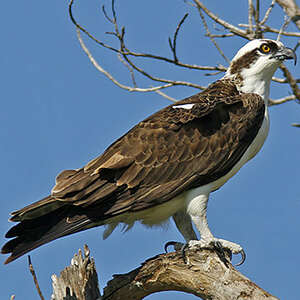
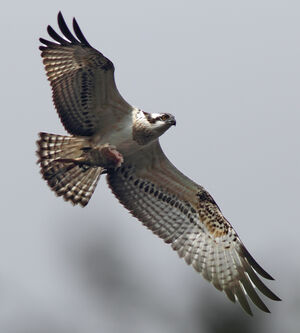
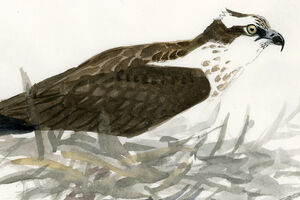
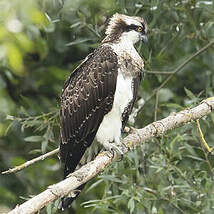
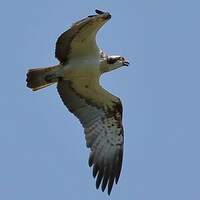
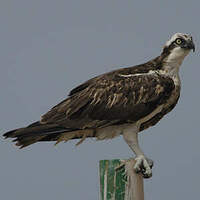
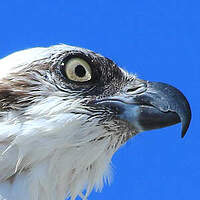
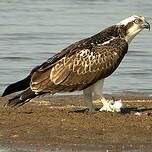
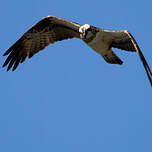
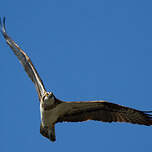
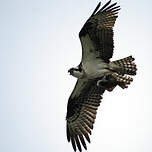
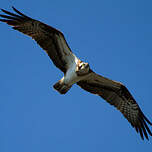
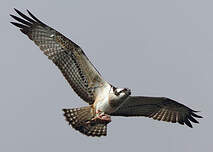
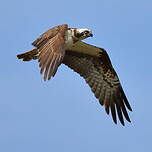
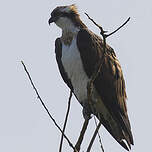
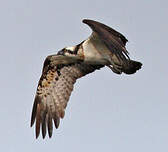
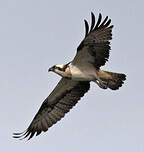
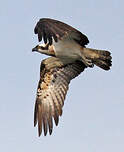
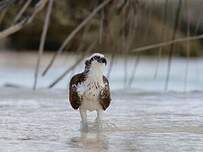
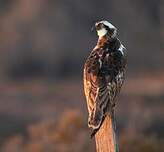
The Osprey is a large diurnal raptor, bigger than a Buzzard, with long and fairly narrow wings. When in flight, its raised wrists give it a characteristic silhouette resembling that of a large gull. It also shows a strong contrast between the upper parts of its body, which are a dark brown, and its underside, which is white, another characteristic. The black wrists stand in stark relief on a light ground. The white head, barred with black below the yellow iris eye, is also distinctive. The cere is a bluish gray.
The legs, well-separated from the plumage, are adapted for preying on fish.
The sexes are not greatly distinct. The female is simply a bit bigger and more marked around the chest. The juvenile has cover feathers, bordered in pale. Its iris is darker, orange. The immature examples are intermediate.
Subspecific information 4 subspecies
- Pandion haliaetus haliaetus (Europe and Asia)
- Pandion haliaetus carolinensis (Canada to s USA)
- Pandion haliaetus ridgwayi (e Belize, Cuba, Bahamas)
- Pandion haliaetus cristatus ()
Foreign names
- Balbuzard pêcheur,
- Águila pescadora,
- guincho-ocidental,
- Fischadler,
- halászsas,
- Visarend,
- Falco pescatore,
- fiskgjuse,
- Fiskeørn,
- kršiak rybár,
- orlovec říční,
- Fiskeørn,
- sääksi (kalasääski),
- Visvalk,
- àguila pescadora,
- Gjóður,
- rybołów,
- zivju ērglis,
- ribji orel,
- Скопа,
- Elang tiram,
- ミサゴ,
- 鹗,
- เหยี่ยวออสเปร,
- 西方魚鷹,
Voice song and cries
Habitat
Given its very specialized, and one could say exclusive, diet, the Osprey needs aquatic habitats that are rich in fish throughout the year.
Given its widespread global distribution, the variety of habitats is obviously great, ranging from expansive boreal forests to salty lagoons in tropical deserts, including all the intermediate aquatic habitats. The habitat must simply possess ample water, with plentiful fish in all seasons, as well as favourable natural or artificial nesting supports (dominant trees, pylons, rocky crags) during the breeding season. Open-air perches are also always appreciated.
Depending on latitude, the elements of the habitat are very varied. To mention only the most important, these include deciduous, mixed, or coniferous forests, still or flowing waters (lakes, ponds, rivers, rivers, marine or inland lagoons), and rocky coastal shores.
Behaviour character trait
The Osprey is a raptor that is easy to observe since most of its activities take place in the open air, such as fishing and its spectacular mating rituals.
Flight
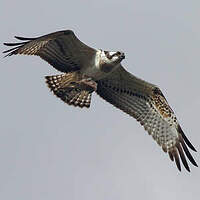
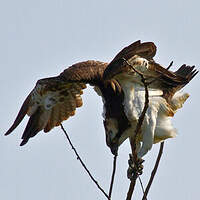
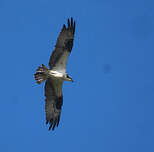
The Osprey has a smooth flight, due to the wide and slow beats of its long wings, which it uses especially for its migratory journeys. It often glides when conditions are favorable, for instance when migrating in rising air currents, as its wings provide lots of lift. It may be mistaken from far away for a seagull. This impression is further enhanced by its bicolored plumage.
Dietfeeding habits
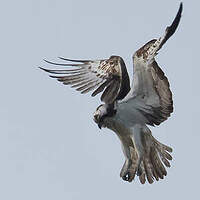
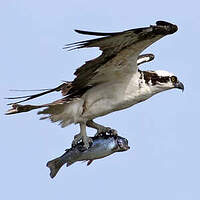
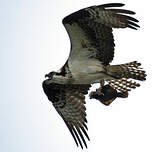
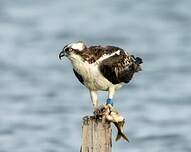
The Osprey feeds exclusively on fish caught alive at shallow depths in a spectacular way. It starts with a reconnaissance flight 10-20 m above the surface, head turned down.
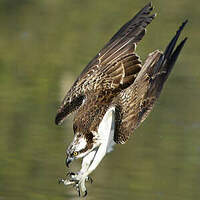
The legs, well cleared of the plumage, are adapted for predating on the fish. The scaly tarsi are very robust. The fingers, of which the external one is opposable, are finished with a strong, curved and sharp claw. The underside of the foot is lined with rough hornlets facilitating the grip of the fish.
The impact with the water is violent and generates splashing. The bird comes out again with a fish in its claws, or not if it missed its shot. The prey generally weigh 150 to 350 grams but can exceptionally reach 1 kg and measure 35 cm.
On the way back, it is often harassed by crows or other raptors that try to steal its prey.
Reproduction nesting
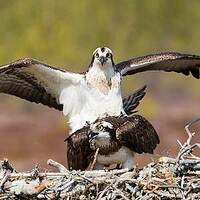
As already said earlier, Ospreys are not a gregarious bird, even during the inter-breeding period. In reproduction, the male is monogamous and the couple nests within a territory they defend.
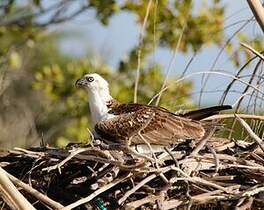
The nest is made out of branches placed on a dominant point, a big tree, an electrical pylon, a rocky crag,... If there are no predators, e.g. on an islet, it can be built on the ground. Generally it is used from one year to the other and can reach an imposing size. Also, the couple can continue loading it during the breeding season.
The breeding period varies according to latitude. In middle Europe, the return to the nesting site occurs in April. The female lays on average 3 (1 to 4) whitish-cream eggs with brown-russet stains which she incubates for around 5 weeks. The fledglings become flight capable at age 7-8 weeks. This will have taken about 3 months.
Geographic range
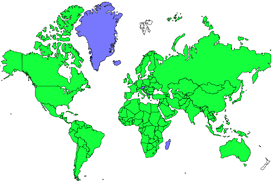
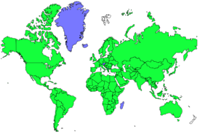
This bird has one of the widest ranges. It nests in Europe, Asia, Australia, Africa, and North America. The only continent from which Ospreys are absent is Antarctica.
In winter, it leaves its northern nesting regions and migrates to warmer climates. European birds go to overwinter in Sub-Saharan Africa, North Americans to Central and South America, and those from Northern Asia to the Indian continent and Southeast Asia.
Central Americans and those from the Western Pacific, from Japan to Australia, are sedentary.
Threats - protection
IUCN conservation status
concern
in the Wild
threatened
evaluated
Ospreys have long been persecuted by fishermen and fish farmers because of their piscivorous diet, and have been threatened for a long time. That is why they did not reproduce in continental France. The installation of a nesting couple in the Orléans Forest in the 1980s, therefore, came as a surprise. Thanks to the protection, the couple maintained, and after a decade a small nesting population emerged. The species is doing a bit better. Migrants are probably still illegally shot during their passage, as traditions are strong, but the context has still improved. The problem of pesticides, which are omnipresent, remains.
Sources of information
- IOC World Bird List (v14.1), Gill, F and D Donsker (Eds). 2023.
- Guide encyclopédique des oiseaux du Paléarctique Occidental, BEAMAN Mark
- Guide des oiseaux de France et d'Europe, Roger Tory Peterson, Guy Mountfort, P. A. D (Phill
- Avibase, Lepage Denis
- Wikipédia, Wikipedia, The Free Encyclopedia
Other sources of interest
 Specification sheet created on
28/10/2023 by Jean François
Specification sheet created on
28/10/2023 by Jean FrançoisTranslation by AI Oiseaux.net
published: 27-10-2023 - Updated: 06-11-2023
© 1996-2024 Oiseaux.net
- Accipitriformes
- Aegotheliformes
- Anseriformes
- Apodiformes
- Apterygiformes
- Bucerotiformes
- Caprimulgiformes
- Cariamiformes
- Casuariiformes
- Charadriiformes
- Ciconiiformes
- Coliiformes
- Columbiformes
- Coraciiformes
- Cuculiformes
- Eurypygiformes
- Falconiformes
- Galliformes
- Gaviiformes
- Gruiformes
- Leptosomiformes
- Mesitornithiformes
- Musophagiformes
- Nyctibiiformes
- Opisthocomiformes
- Otidiformes
- Passeriformes
- Pelecaniformes
- Phaethontiformes
- Phoenicopteriformes
- Piciformes
- Podargiformes
- Podicipediformes
- Procellariiformes
- Psittaciformes
- Pterocliformes
- Rheiformes
- Sphenisciformes
- Steatornithiformes
- Strigiformes
- Struthioniformes
- Suliformes
- Tinamiformes
- Trogoniformes