Smooth-billed Ani

Birds      CuculiformesCuculidae      Id. Record Geographic rangePictures
Ani à bec lisse

Smooth-billed Ani

Crotophaga ani

Order  : Cuculiformes

Family : Cuculidae  ;

Biometrics :

Size : 33 à 36 cm
Wingspan : 43 à 45 cm
Weight : 95 à 119 gr

IUCN conservation status :

Extinct
Threatened
Least
concern
Extinc
in the Wild
Near
threatened
Not
evaluated

EX EW CR EN VU NT LC NE
Geographic range :

Distribution sumatran.trogon

Synonyms : Личинкоед ани (ru), Slätnäbbad ani (sv), Garrapatero Aní (es), Ani beccoliscio (it), Glattschnabelani (al), Gladsnavelani (nl), Smooth-billed Ani (en)

Ani à bec lisse Physical description :
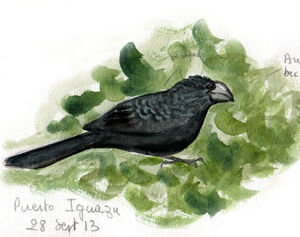
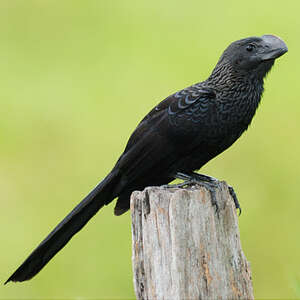
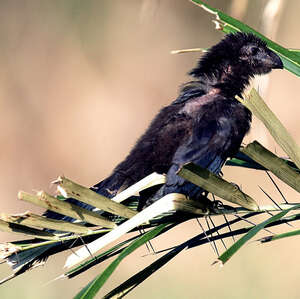
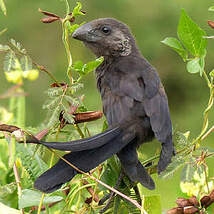
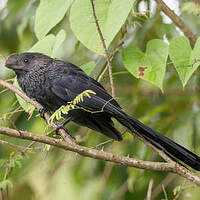
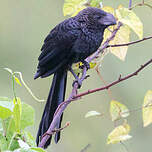
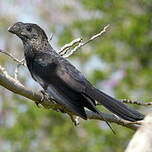
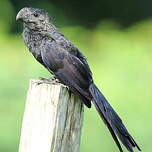
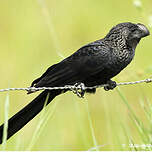
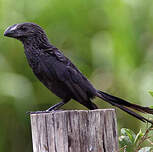
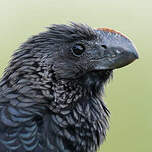
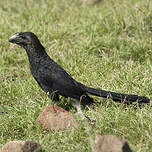
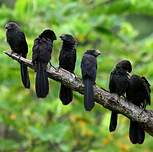
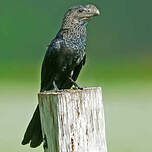
Smooth-billed Ani has black colours overall. Plumage is black overall with some bronze iridescence, and pale scaled effect on chest and back due to silver feathers' edges. Long tail is often dipped and wagged. Wings are pointed.
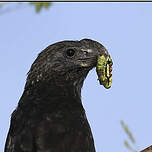
Bill, bare facial skin, legs and feet are black. Eyes are dark brown to black. Smooth-billed Ani has bulky parrot-like bill, with a hump on the upper mandible, near the base. Bill is down-curved, and laterally flattened.
There is a similar species, the Groove-billed Ani, with smaller bill with grooves, and different calls. It lives in southern Texas, and their ranges don't overlap.
Both sexes are similar.
Juvenile is duller than adults.
Smooth-billed Ani is a member of the Cuckoos family, Ani à bec lisse but it is not a brood parasite.

Voice : Smooth-billed Ani utters a whining 'quee-lick' prolongated. We can also hear a slurred 'ree-o-rink' usually repeated one to four times; a mewing 'reeeahh' and a slurred mewing 'reeh-yuh' or a 'roohr-ehw'. They are noisy when in groups.

Habitat : Smooth-billed Ani lives in open and semi-open country, savannahs, scrublands, and cultivated areas. It is found in wet second growth, brushy fields and road sides, and near livestock.
GEOGRAPHIC RANGE: Smooth-billed Ani lives Ani à bec lisse in Central America, Caribbean, and large part of South America. It benefits from deforestation for enlarging its range where it is resident. It may perform some local movement during dry season.

Behaviour : Smooth-billed Ani is often seen in pairs or in small groups. They climb and flutter in bushes, hop on the ground with loosely cocked tail.
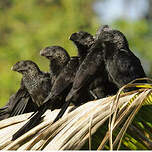
This species is very gregarious. When they roost together during cold nights, they perform mutual preening during long moments.
Smooth-billed Ani is often seen with cattle, walking, jumping or running for grasshoppers, and removing ticks from cows' backs. It catches preys disturbed by cows. Ani à bec lisse
It feeds on the ground, foraging in scrublands and fields, but also in trees and shrubs. It picks berries from bushes. It also forages on prey disturbed by Army Ants (eciton burchelli).
When threatened by predators, birds retreat silently into dense foliage in trees.
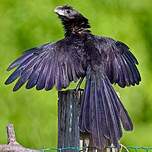
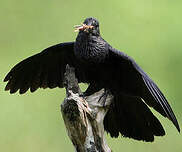
When perched, it uses its long tail for balance, and chicks use bill and feet to climb through branches in trees. These birds like to take sunbathes with outstretched wings, Ani à bec lisse perched on tree top.
Courtship displays include courtship feeding during copulation, male offering a large insect to female while mounting her. Male follows female through trees, as she jumps from branch to branch.

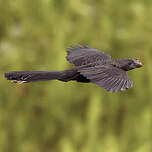
Flight : Smooth-billed Ani has slow weak flight, with rapid shallow stiff wing beats, interspersed with short glides. But as cuckoos, it flies in a straight line, and several birds may fly one behind the other, while calling.

Reproduction-nesting : Smooth-billed Ani may nest singly or communally. Nest may Ani à bec lisse be built by several birds at the same time. Then, females lay eggs in the same nest and raise their young. This species may breed year round.
Nest is a bulky cup made with sticks. It may size about 30 cm in diameter and 10 cm depth. It is built at about 1, 50 to 9 metres above the ground, in dense shrub, in tree or in thorny bush. It is lined with green leaves and placed in dense tangle.
Each female may lay up to 7 greenish-blue eggs. Nest may contain up to 25 to 30 eggs, and usually, about 10 chicks hatch. Eggs may be laid in different layers separated by leaves. Dominant female lays her eggs last. Her eggs are presumed to have best chances for hatching.
Incubation lasts about 13 to 15 days, shared by several pairs which take turns. Both sexes have brood patch on belly and lower breast.
Altricial chicks hatch naked and blind, but they grow up rapidly. Young fledge at about 7 to 10 days. They can't fly, but they are able to climb around the nest only 5 days after hatching.
Young are fed by several adults, and even by young of the previous year. They reach their independence one month after fledging, but they may wait the next breeding season for leaving the family group.
This species may produce three broods per year.

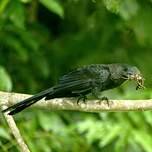
Food habits : Smooth-billed Ani feeds mainly on insects (grasshoppers, caterpillars and moths), but it also consumes lizards, cattle parasites, snails, seeds, fruits and berries.

Protection / threats : Smooth-billed Ani adults are preyed upon by birds of prey, juveniles by corvidae, cats and rats, which eat nestlings and eggs.
This species is not threatened at this time.  

Other links :
Iucn
Birdlife


Ani à bec lisse

Ani à bec lisse

Ani à bec lisse

Ani à bec lisse

Ani à bec lisse

Ani à bec lisse


Specification sheet created by Nicole Bouglouan


Qui sommes-nous ? L'association | Mentions légales | Sources | Contacts | Print version
Updated on 2008/05/04 05:30:55 - © 1996-2008 Oiseaux.net

Le guide ornitho : Les 848 espèces d'Europe en 4000 dessins

Ani à bec lisse

Ani à bec lisse

Ani à bec lisse

Ani à bec lisse

Ani à bec lisse

Ani à bec lisse

Ani à bec lisse

Ani à bec lisse

Ani à bec lisse

Ani à bec lisse

Smooth-billed Ani