Snowy Egret

Birds      CiconiiformesArdeidae      Id. Record Geographic rangePictures

Aigrette neigeuse Physical description :
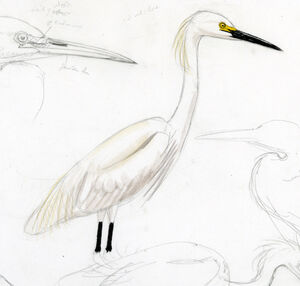
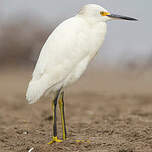
Snowy Egret is a medium-sized egret, with a delicate silhouette. The male is slightly larger than female.
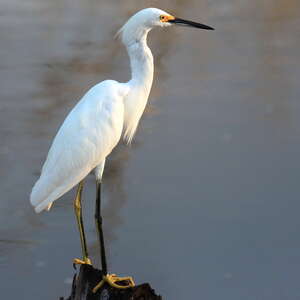
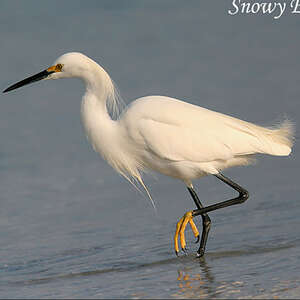
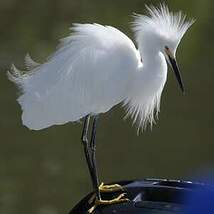
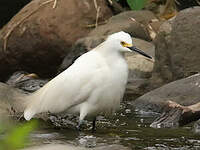
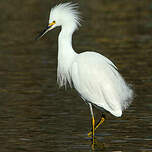
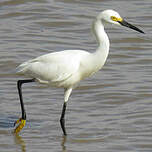
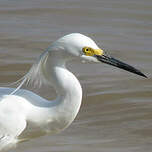
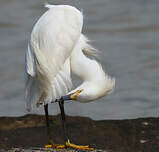
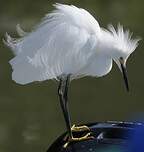
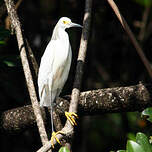
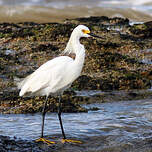
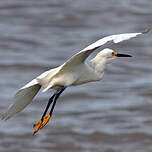
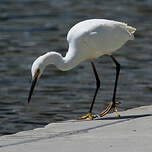
Its plumage is entirely white. Bill is long, black and thin, with bright yellow base, from eye to eye on upper part of the face. Legs are long, fine and black, feet are bright yellow. Eyes are yellow.
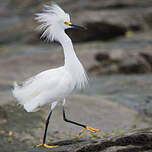
Adults in breeding plumage have long silky feathers on chest and crown. Feet change in colour, turning from bright yellow to orange.
Immature have rear legs yellowish instead black.

Voice : Snowy Egret is usually silent far from colonies during breeding season. It utters some sounds during courtship displays to attract female.
When threatened, or in territory defence, it gives a loud nasal 'squawk'.

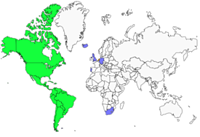
Habitat : Snowy Aigrette neigeuse Egret usually prefers shallow waters of creeks or stretches of the sea for feeding. Salt ponds, tidal areas, shallow bays and mangroves are its preferred habitats in North America. Most common areas are between coasts and islands, because of the constant availability of food resources.
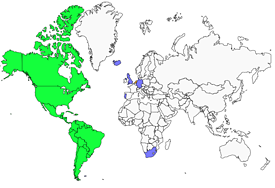
It winters in Caribbean, where it finds suitable habitat, salt lagoons, freshwater ponds, grassy pools, beaches, shallow rocky areas, rice fields and wet meadows. Throughout Central America, it prefers lowlands close to freshwaters, lakes and large mouths. In South America, it lives in coastal mangroves, mudflats and marshes rather than in higher areas.

Behaviour : Breeding Aigrette neigeuse season starts in late March or early April, when Snowy Egret male performs its flight displays and vocalizes in order to attract a female. Most common courtship display behaviour shows the male hunching its body and moving from top to bottom with bill pointed upright. It gives at this time a call which attracts its mate. Change of feet colour indicates the beginning of the parade. Breeding adults are also characterized by their long delicate feathers. As soon as the pair is formed, mates copulate, and may build a nest for their young.
Snowy Egret is very gregarious, and builds its Aigrette neigeuse nest very close to the other egrets and herons' nests. Copulation occurs in the nest, without preliminary ritual.
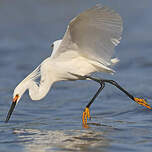
It feeds in group with other species. It forages while walking slowly or quickly, it may run, jump, and probe with its bill in order to disturb preys which it will pursue. It walks with upright posture, and flattened wings. This posture is very good to feed because it allows a quick direction change to catch its preys. It fishes rather at dusk or in the early morning. It can fly up to three kilometres between colony and feeding areas.

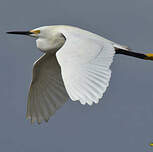
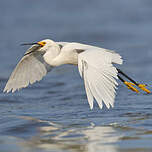
Flight : Snowy Egret uses the flight to escape terrestrial predators. Its attitude in flight is that of all egrets and herons, with retracted neck, straight head, and legs extended behind.

Reproduction-nesting : Snowy Egret female builds the nest on the territory defended by the male. Pair nests in isolated areas around estuaries, and Aigrette neigeuse nest may be situated either on the ground, or at about 8 to 10 metres of high in a tree. It is made with stems and woven small twigs, collected on the ground by female or stolen in other nest. Snowy Egret can also use an old nest.
Female lays 3 to 6 pale greenish blue eggs. Incubation lasts about 24 days, shared by both parents. Chicks have their first plumage two weeks after hatching. Adults fed them bringing food to the nest. Young are continuously fed during ten days. During the first five days, they are fed by regurgitation into the nest. Sometimes, one of the parents places its bill in the bill of a young and regurgitates. Youngest is fed before the others. Then, parents spend half of time out of the nest, but if weather is bad, young are brooded as long as necessary.
Parents remove the egg shells away from the nest, and keep it clean by ejecting debris outside of the nest. Young people reach their sexual maturity at one or two years.

Food habits : Snowy Egret feeds on earth worms, aquatic and terrestrial insects, crabs, shrimps, crayfish, shellfish, fish, frogs, lizards and snakes. It usually consumes 75% of fish and 25% of crustaceans.

Protection / threats : Snowy Egret has predators such as owls, eagles, venomous snakes, raccoons, corvidae and alligators. It has a venomous snakes' innate knowledge which often allows it to escape.
It seems that hunting continues in Central America and South America, with the European request of feathers for the ornaments.
Chemical pollution and degradation of habitat by drainage of wetlands are two important threats for this species.
Fortunately, Snowy Egret North American populations are now reconstituted, thanks to species protection measures.  

Other links :
Iucn
Birdlife


Aigrette neigeuse

Aigrette neigeuse

Aigrette neigeuse

Aigrette neigeuse

Aigrette neigeuse

Aigrette neigeuse


Specification sheet created by Nicole Bouglouan


Qui sommes-nous ? L'association | Mentions légales | Sources | Contacts | Print version
Updated on 2008/05/04 05:30:55 - © 1996-2008 Oiseaux.net

Herons and Egrets of the World: A Photographic Journey

Aigrette neigeuse

Aigrette neigeuse

Aigrette neigeuse

Aigrette neigeuse

Aigrette neigeuse

Aigrette neigeuse

Aigrette neigeuse

Aigrette neigeuse

Aigrette neigeuse

Aigrette neigeuse

Snowy Egret