White-winged Guan

Birds      GalliformesCracidae      Id. Record Geographic rangePictures
Pénélope à ailes blanches

White-winged Guan

Penelope albipennis

Order  : Galliformes

Family : Cracidae  ;

Biometrics :

Size : 70 cm
Wingspan :
Weight :

IUCN conservation status :

Extinct
Threatened
Least
concern
Extinc
in the Wild
Near
threatened
Not
evaluated

EX EW CR EN VU NT LC NE

Geographic range :

Distribution sumatran.trogon

Synonyms : Pava Aliblanca (es), Penelope alibianche (it), Weißschwingenguan (al), Witvleugelsjakohoen (nl), White-winged Guan (en)

Pénélope à ailes blanches Physical description :
White-winged Guan is a Critically Endangered species. Discovered in 1876, it has been presumed extinct very quickly. Rediscovered in 1977, it is critically threatened by habitat loss. The main goal is to reintroduce this species into natural suitable habitats.

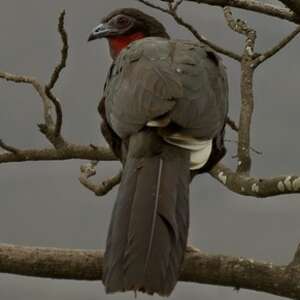
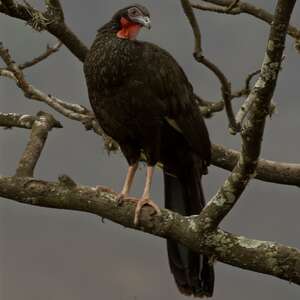
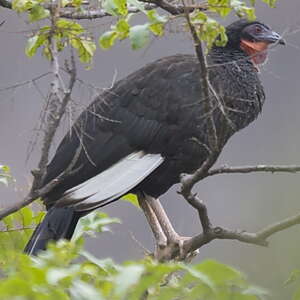
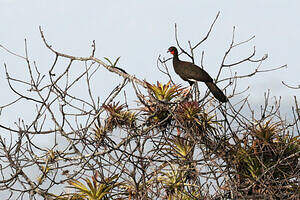
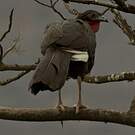
Adult resembles black turkey. It has blackish-brown plumage overall. On the wings, we can see the conspicuous white primaries, more visible in flight. Long tail is blackish-brown. The neck is flecked buffy-white.
On the underparts, plumage is blackish-brown, with some fine pale streaks on the breast. The underwings show the same white pattern in primaries.
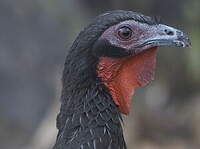
On the blackish head, the bare skin of lores and eye-ring is purplish. On the throat, a bare red-orange double-lobed Pénélope à ailes blanches dewlap floats on the upper neck.
Strong bill is blue with black tip. Eyes are brown. Legs and feet are pinkish.
Both sexes are similar.
Juvenile is pale greyish before fledging, but it shows pale tips on wing coverts, as a band.

Voice : White-winged Guan utters deep, hoarse, nasal 'och...och...och' during breeding season.
It is a noisy bird, producing varied sounds such as grunts, growls, cackles, yelps and crows.
All these sounds accompany varied behaviours such as courtship displays, mating and contact within the flock, including territorial defence and alarm calls.
Guans do not utter true songs. They are replaced by particular wing-drumming during the flight displays.

Habitat : White-winged Guan lives in dry forested slopes and ravines from 300 to 900 metres of elevation. It prefers valleys with permanent water, and dry deciduous forest with dense covert. It may frequent cultivated areas where it finds some food. Formerly, this species frequented coastal forests and mangroves where it spent the warm hours of the midday.
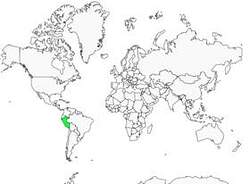
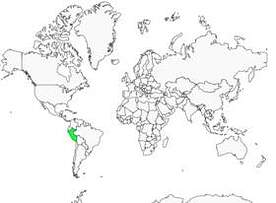
GEOGRAPHIC RANGE: White-winged Guan lives in very restricted range, in extreme North-western Peru. This species survives in Lambayeque and in Piura.

Behaviour : White-winged Guan feeds mainly on varied plant matter, according Pénélope à ailes blanches to the season. They often forage in pairs or small family groups. Outside of breeding season, larger groups can be seen foraging, up to ten birds. The food items are taken with the bill from the vegetation or from the ground for fallen fruits, seeds and some insects and invertebrates. Usually, Guans are mainly arboreal, but when food is less abundant, they feed on the ground.
White-winged Guan performs characteristic wing-drumming flights in the early morning, hopping from perch to perch.
It begins its activities before dawn, and performs these flight displays in the darkness, before sunrise. This behaviour is closely related to breeding season, but it can be observed sporadically during the year.
The wing-drumming of the guans is unique among the Cracidae. It is a special flight. The bird is perched in tall tree. It flies off and performs a brief glide in the open, and produces this wing-whir during about three seconds. This sound is provided by very rapid wing-beats (twice as fast as in regular flight). Then, it glides to another perch, usually lower than the previous. These flight displays occur over 50 to 170 metres in distance. An individual may perform this behaviour several times in the same session and change of perch. This behaviour is also used for maintaining the pair bonds.
After these displays, the birds drink at the bottom of the ravines where they live. They rest in shady place when temperature increases at midday, and return to feeding areas in the late afternoon.
They roost in trees, at mid-level, well hidden among the foliage. The roost may vary day after day, following the wandering of the species.
White-winged Guan is sedentary, but some movements occur locally and seasonally.

Flight : White-winged Guan, as other Cracidae, has moderate capacity for flight, and sustained flights are rare. But it is able to perform long glides after very active wing-beats, with the help of the long tail as support.
The bird climbs up through the branches, and when it reaches the canopy, it flies off again until to be too much low. And it climbs up again.

Reproduction-nesting : Breeding season peak is mainly in spring, but eggs can be laid almost at any time of the year.
The nest is very often situated among vegetation, in tree or bush, at varied heights. Both mates build it, at about 2 to 5 metres above the ground in the dense forest.
The nest is relatively small for this large bird. It is made with sticks, twigs and other plant materials. Interior can be lined with fresh vegetation.
Female lays 2 to 3 eggs. Incubation is usually by female while the male remains in the surroundings, watching for potential danger. Incubation lasts about four weeks.
Chicks are covered with yellowish and black down on upperparts, and paler on underparts. They are precocial and leave the nest very soon after hatching. They are fed by both parents the first days, but little by little, they feed themselves while parents sometimes provide them some food.

Food habits : White-winged Guan is mainly vegetarian, feeding on ripe fruits, berries and pods. It may also consume flowers, as whole or only the petals, buds, leaves and seeds extracted from the fruits. It also takes vegetables in cultivated areas, and some insects, but not often.

Protection / threats : White-winged Guan is Critically Endangered species. It suffers from habitat loss and hunting for consumption. Predators such as raptors also take some numbers of these birds.
This species is now protected, but illegal hunting continues in some parts of the range.  

Other links :
Iucn
Birdlife


Specification sheet created by Nicole Bouglouan


Qui sommes-nous ? L'association | Mentions légales | Sources | Contacts | Print version
Updated on 2008/04/29 05:36:33 - © 1996-2008 Oiseaux.net

Oiseaux marins

White-winged Guan