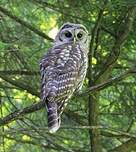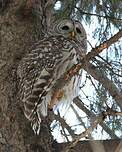
Barred Owl

Birds      StrigiformesStrigidae      Id. Record Geographic rangePictures
Chouette rayée

Barred Owl

Strix varia

Order  : Strigiformes

Family : Strigidae  ;

Biometrics :

Size : 45 à 58 cm
Wingspan : 102-127 cm
Weight : 470-1050 gr

Longevity : 10 years

IUCN conservation status :

Extinct
Threatened
Least
concern
Extinc
in the Wild
Near
threatened
Not
evaluated

EX EW CR EN VU NT LC NE
Geographic range :

Distribution sumatran.trogon

Synonyms : Kråsuggla (sv), Cárabo Norteamericano (es), Allocco barrato (it), Streifenkauz (al), Gestreepte Bosuil (nl), Barred Owl (en)

Chouette rayée Physical description :
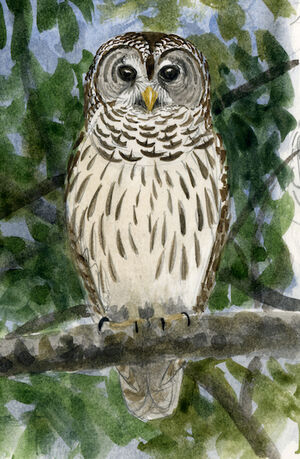
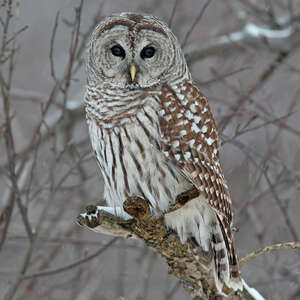
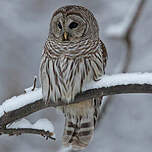
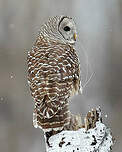
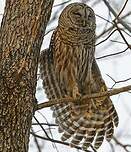
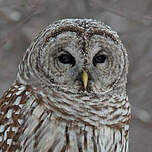
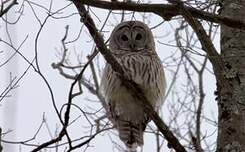
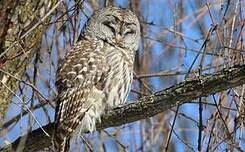
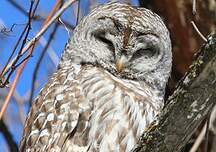
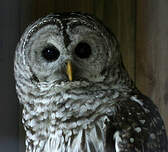
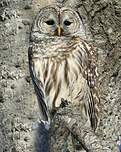
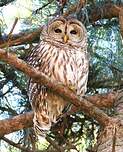
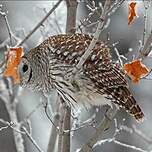
Barred Owl has grey-brown plumage. Breast is horizontally streaked with white barring, while belly has vertical barring. It has brown back with white spots. Tail is long.
Some Barred Owls have pink belly feathers, due to eating a lot of crayfish.
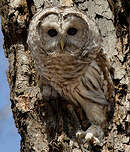
Barred Owl has rounded head, without ear tufts. It has two whitish-brown facial disks, with neat dark brown border.
Eyes are brown, while most owls have yellow eyes.
Bill is yellow, partially covered with feathers. It is sharp, but small.
Legs are feathered, and claws are black.
Both sexes are similar in plumage, but female is larger than male.
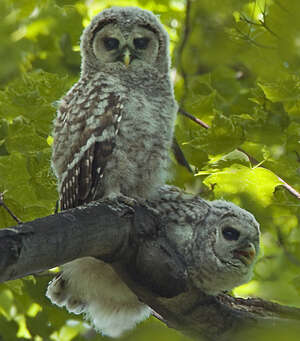
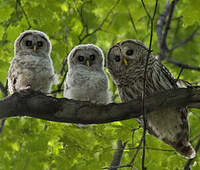
Juveniles have red-brown plumage, with buff barring on neck.

Voice : Barred Owl is a very vocal species. It Chouette rayée has distinctive call, a series of loud hoots 'who-cook-for-you, who-cook-for-you-all', and also a 'hoo-ah', sometimes following an ascending barking.
Mates utter typical calls such as caterwauling, making duets 'hoo-hoo, hoo-WAAAHH'.
Calls often include series of 8, then silence, listening for replies from other owls.

Habitat : Barred Owl is common in dense coniferous forests near water source, deep moist forests, swamps and stream side woodlands.
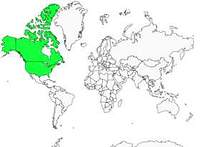
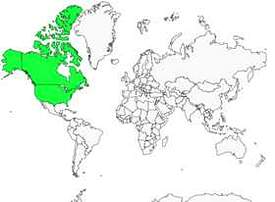
GEOGRAPHIC RANGE: Barred Owl is widespread in North America, overall in the eastern half of the continent, and south to Central America, and in the north-western of North America. Northern birds may migrate, depending of food resources.

Behaviour : To hunt, Barred Owl uses a perch from where it dives upon its prey. Main preys are small rodents, but also other mammals and birds.
Birds are taken while they are settled in their nocturnal roosts, because Barred Owl can't catch them on the wing. They may also swoop down to the water's edge to catch some amphibians. It also forages for large insects attracted by campfires.
It grabs preys with its claws. Chouette rayée It may cache preys in tree branches and nests.
Barred Owl eats the prey on the spot, but it carries large preys to a perch and tears apart before eating. They eat fur and bones, so, they regurgitate pellets which we can find under its favourite perches.
Barred Owl is solitary for most of the year, only living in family groups during breeding season until young fledge.
It is a nocturnal bird, often seen at dawn and dusk, but it can be seen during the day.
It has special toes, with normally two forwards and two backwards. But it can turn a back toe forwards if it is necessary. That allows it to hold on to a perch.
Male and female stay together on the territory all year round. They reuse the same nest every year. They are thought to be monogamous, pairing for life.
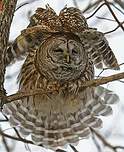
Male and female perform courtship displays, vocalizing loudly. They will nod, bow with half-spread wings, and shake and twist their heads from side to side. Male chases after female, and males displays together, swaying back and forth, raising wings, and hovering near a branch.

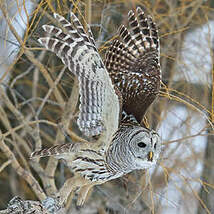
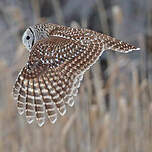
Flight : Barred Owl flies with rapid wing beats, because it has special soft feathers, helping it to sneak up on night animals. But these feathers can't catch the Chouette rayée wind very well, and the Owl has to work hard to fly.

Reproduction-nesting : Barred Owl nests in natural cavities, holes in tree trunks or branches. It doesn't build a nest, but it may add some soft materials such as feathers and fine
grasses in the bottom. Sometimes, if any hole is available, it will use an old nest, abandoned by some hawk or crow.
Female lays 2 to 3 white eggs, almost round. Incubation lasts about 28 to 33 days, by female, fed by the male during this period. Chicks hatch covered with white fluffy down, and they have closed eyes during one week. They can fledge at about 42 days of age, but before to fly, they crawl out of the nest and sit together, looking around them, near the nest. If they fall on the ground, they can climb back up with their beaks and claws. Parents feed them, tearing meat into small pieces.
When they are able to fly, they follow adults and learn to hunt. They are fed by parents for long time, about up to six months, and they reach their sexual maturity at about two years.
This species produces one single brood per season.

Food habits : Barred Owls are carnivores. They can eat mice, squirrels, foxes, rabbits, bats, small birds, snakes, amphibians, lizards, fish, crayfish and bugs.

Protection / threats : Barred Owls have some predators, such as raccoons and weasels, eating eggs and nestlings.
Adults may be killed by Great-Horned Owl and Northern Goshawks, and collisions by vehicles.
Barred Owl has successfully expanded its range, some decades ago, into north-western of North America.  

Other links :
Iucn
Birdlife


Chouette rayée

Chouette rayée

Chouette rayée

Chouette rayée

Chouette rayée

Chouette rayée


Specification sheet created by Nicole Bouglouan


Qui sommes-nous ? L'association | Mentions légales | Sources | Contacts | Print version
Updated on 2008/04/29 05:36:33 - © 1996-2008 Oiseaux.net

La chouette chevèche

Chouette rayée

Chouette rayée

Chouette rayée

Chouette rayée

Chouette rayée

Chouette rayée

Chouette rayée

Chouette rayée

Chouette rayée

Chouette rayée

Barred Owl