
Grey-winged Trumpeter
Psophia crepitans - Agami trompette
Systematics
-
Order:
Gruiformes
-
Family:
Psophiidés
-
Genus:
Psophia
-
Species:
crepitans
Descriptor
Biometrics
- Size: 52 cm
- Wingspan: -
- Weight: 1000 à 1300 g
Geographic range
Identification
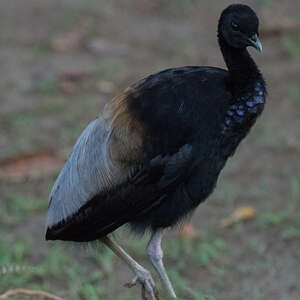
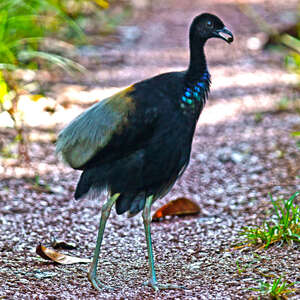
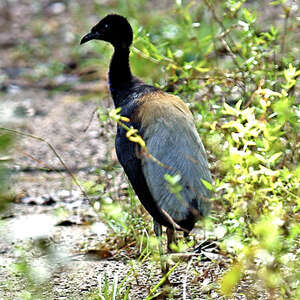
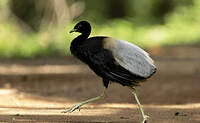
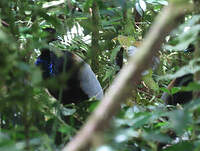
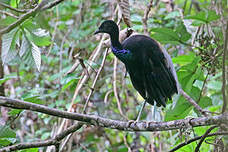
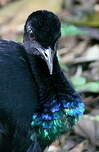
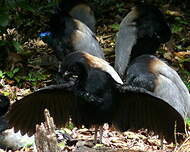
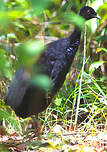
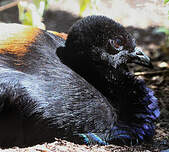
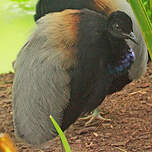
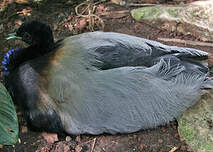
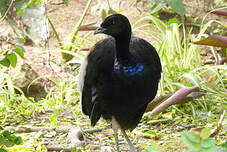
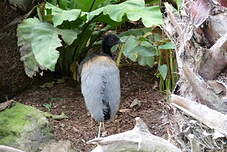
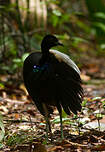
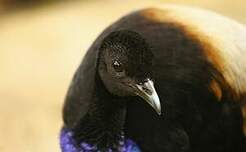
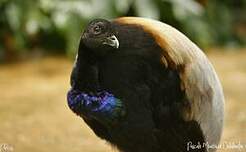
The Grey-winged Trumpeter is the size of a domestic chicken or pheasant. Its plumage is black except for the lower back which is grey-ash. A diffuse band of brown-red separates in the centre of its back the black of its upper part from the grey of its lower part. Its wings are strongly curved and always kept away from its body. Its tail is covered by its fluffy back feathers, which extend onto its rump, giving the bird its rounded and arched appearance. Its rather long and black neck has short metallic green and purple feathers. Its short and powerful beak, similar to a gallinaceous bird, together with its relatively long legs are greenish.
Subspecific information 3 subspecies
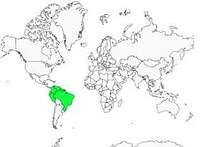
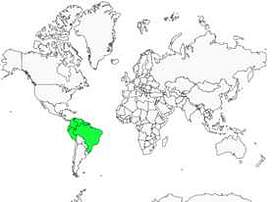
- Psophia crepitans crepitans (Venezuela and se Colombia through the Guianas and n Brazil)
- Psophia crepitans napensis (se Colombia to ne Peru and nw Brazil)
- Psophia crepitans ochroptera (nc Brazil)
Foreign names
- Agami trompette,
- Trompetero aligrís,
- jacamim-de-costas-cinzentas,
- Grauflügel-Trompetervogel,
- szürkeszárnyú dobosdaru,
- Trompetvogel,
- Trombettiere aligrigie,
- gråvingad trumpetare,
- Gråvingetrompetfugl,
- trubač agami,
- trubač agami,
- Grårygget Trompetérfugl,
- kyssäkurki,
- trompeter alagrís,
- gruchacz siwoskrzydły,
- Сероспинный трубач,
- ラッパチョウ,
- 灰翅喇叭声鹤,
- 灰翅喇叭鳥,
Voice song and cries
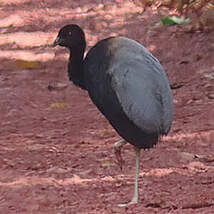
The Grey-winged Trumpeter usually produces a very nasal sound. A kind of chuckling sound which can phonetically be represented as a series of close whu whu which gradually get louder, ending with a soft sound before repeating itself. Another of its calls is comparable to the chopping sound produced by guineafowl.
Habitat
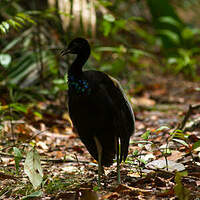
The Grey-winged Trumpeter mainly lives in wet tropical forests of Northern South America. It can sometimes be found on the edges of creeks with cool soils and in Guyana's pine forest. However, it usually avoids cultivated areas and stays in forests.
Behaviour character trait
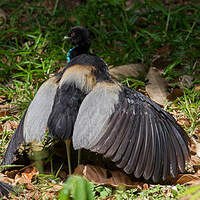
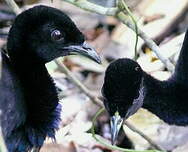
The Grey-winged Trumpeter is a terrestrial bird that lives in groups of six to twenty individuals. They peck the ground of the forest together.
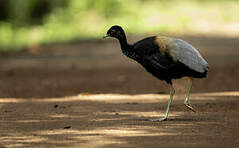
Flight
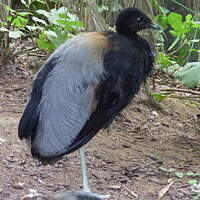
The Grey-winged Trumpeter does not fly very well and only for short distances. It only uses flight to escape from a predator or to perch with its group on a tree where it is safe to rest.
Dietfeeding habits
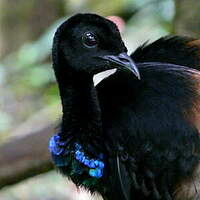
The Grey-winged Trumpeter pecks at the seeds on the ground. It also consumes small reptiles (lizards, snakes), insects and fruits that are dropped to the ground by some arboreal animals like coatis, howler monkeys, parrots or toucans.
Reproduction nesting
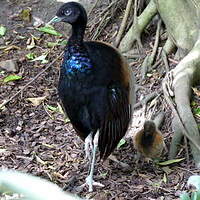
Before mating, the male and female perform a parade. This consists of loud dances accompanied by jumps and various acrobatics.
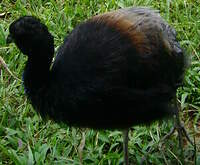
The breeding season is poorly known in the wild. Only a few females from the group (or even only one) lay eggs. The laying female practices polyandry. The Grey-winged Trumpeter nests on the ground in dense forests or in a tree hole. The female can lay up to ten green or cream-white eggs. The dominant male, assisted by other group members, feeds the female during the incubation period which lasts about a month.
Geographic range
Threats - protection
IUCN conservation status
concern
in the Wild
threatened
evaluated
This bird, the victim of intensive hunting, has declined significantly in recent years. It can now be found almost exclusively in deep forests, where they have found refuge. It has disappeared from the vicinity of villages and the coastal strip. The rampant deforestation is further reducing their distribution area. Although this species is not yet threatened, the lack of regulation is worrying.
Sources of information
- IOC World Bird List (v14.1), Gill, F and D Donsker (Eds). 2024-04-18.
- Vol. 3 - Handbook of the Birds of the World, Josep del Hoyo-Andrew Elliott-Jordi Sargatal
- Avibase, Lepage Denis
- Birds in Suriname, South America, Jan Hein Ribot
- CREAGUS@Monterey Bay, Don Roberson
- Wikipédia, Wikipedia, The Free Encyclopedia
Other sources of interest
 Specification sheet created on
03/08/2023 by Jean-Pierre Trouillas
Specification sheet created on
03/08/2023 by Jean-Pierre TrouillasTranslation by AI Oiseaux.net
published: 02-02-2009 - Updated: 04-02-2009
© 1996-2024 Oiseaux.net
- Accipitriformes
- Aegotheliformes
- Anseriformes
- Apodiformes
- Apterygiformes
- Bucerotiformes
- Caprimulgiformes
- Cariamiformes
- Casuariiformes
- Charadriiformes
- Ciconiiformes
- Coliiformes
- Columbiformes
- Coraciiformes
- Cuculiformes
- Eurypygiformes
- Falconiformes
- Galliformes
- Gaviiformes
- Gruiformes
- Leptosomiformes
- Mesitornithiformes
- Musophagiformes
- Nyctibiiformes
- Opisthocomiformes
- Otidiformes
- Passeriformes
- Pelecaniformes
- Phaethontiformes
- Phoenicopteriformes
- Piciformes
- Podargiformes
- Podicipediformes
- Procellariiformes
- Psittaciformes
- Pterocliformes
- Rheiformes
- Sphenisciformes
- Steatornithiformes
- Strigiformes
- Struthioniformes
- Suliformes
- Tinamiformes
- Trogoniformes