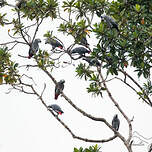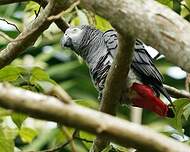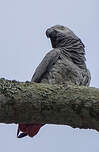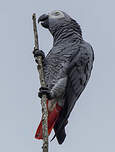
Grey Parrot
Psittacus erithacus
Order : Psittaciformes
Family :
Biometrics :
Size : 28 à 39 cm
Wingspan :
Weight : 400 à 490 gr
Longevity : 73 years
IUCN conservation status :

EX EW CR EN VU NT LC NE
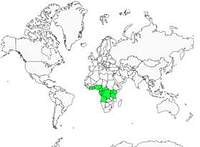
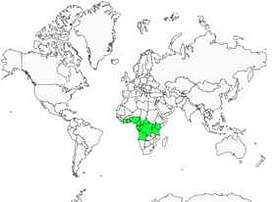
Geographic range :
Synonyms : Loro Yaco (es), Pappagallo cenerino (it), Graupapagei (al), Grijze Roodstaartpapegaai (nl), Grey Parrot (en)
Family description :
Psittacidae is a large family, including several races of parrots of different sizes and colours, but with almost similar behaviour throughout their wide range.
We find two main kinds of birds, the Cockatoos and the Parrots.
The Cockatoos are large to medium-sized, with strong bill and conspicuo... to be continued
Physical description :
The Grey Parrot is a common cagebird. This species is known as domestic pet since several centuries. These parrots figure on Egyptian hieroglyphs and several civilisations kept also Grey Parrots as pets. This parrot accompanied the Portuguese sailors during their long crossings over the seas.
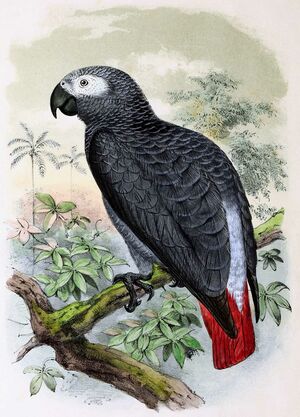
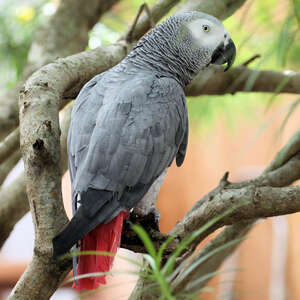
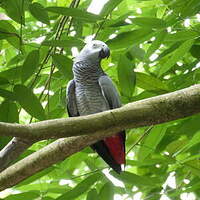
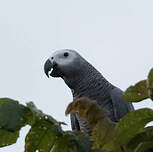
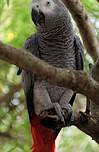
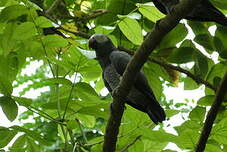
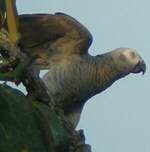
Grey Parrot adult male is a stocky parrot. Body plumage is grey with
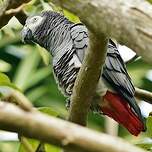
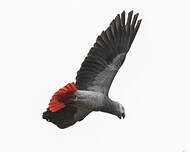
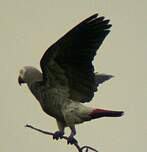
paler edges giving heavy scaled effect, mainly on head, neck, back and breast. Wings are darker grey with blackish primaries. Uppertail coverts and tail are bright red.
On the underparts, the grey scaled effect of the breast extends onto paler grey to whitish on belly and vent. Undertail feathers are red.
Head is scaled white and paler, with bare white facial skin including cere, lores and wide eye-ring. The strong, hooked bill is blackish. Eyes are pale yellow. Legs and feet are grey to darker grey.
Both sexes are similar.
Immature has red tail with darker tips and grey eyes.
We find two subspecies:
Psittacus erithacus erithacus has pale grey plumage, cherry-red tail and black bill. It is found in eastern Ivory Coast to western Kenya and north-western Tanzania.
Psittacus erithacus timneh is darker grey. Tail is dark maroon with brownish edges. On the bill, the upper mandible is reddish with black tip. It is found in West Africa, in Sierra Leone to Ivory Coast.
Voice : Grey Parrot utters numerous
kinds of sounds, usually high-pitched, such as screams and squawks, but it also gives prolonged whistles. Common sounds are harsh 'kraark...kraark...kraark', sharp 'rak-rak-rak-rak' or 'kree-aark...kree-aark...kree-aark'.
Grey Parrot is able to imitate the calls of other birds' species.
Habitat : Grey Parrot lives mainly in lowland primary and secondary rainforest. It also frequents edges and clearings, and can be found in mangroves and gallery forest. It feeds in wooded savannahs and cultivated areas. Grey Parrot is visible from lowlands up to 2200 metres of elevation. It is closely associated with oil palms.
GEOGRAPHIC RANGE: Grey Parrot lives in West to Central Africa.
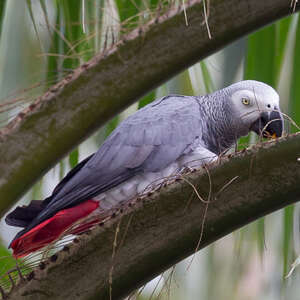
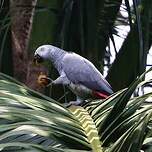
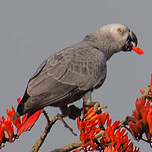
Behaviour : Grey Parrot feeds on fruits and seeds. It depends on the oil palm for food, but it only eats the oily flesh, not the nut. It seems to be more attracted by red fruits than others.
When they feed in maize crops, the large groups often damage the plantations.
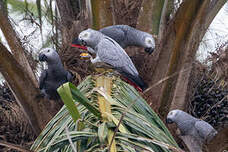
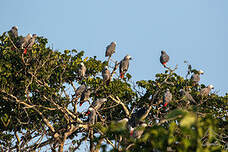
Grey Parrot is a gregarious species. They are very noisy when they gather in large flocks at nighttime's roosts. They sleep together in tall trees such as raphia palms often at forest edges, but also on small islands in the middle of streams or inland lakes.
They leave the roost at sunrise in small flocks. They join their feeding areas flying high in the sky. They come back to the roost following usual regular routes, and this return lasts until after dusk.
Grey Parrot feeds in different manners. It often feeds high in the canopy, but it can be seen on the ground where it takes clay and mineral soil.
Grey Parrot is resident in its range, and moves according to the production of fruits by particular trees' species. It travels short distances between the roost and the feeding area.
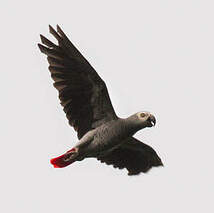
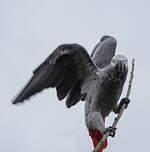
Flight : Grey Parrot flies fast with direct flight. Its wing beats are rapid and shallow.
Reproduction-nesting : Breeding season varies according to the region.
Grey Parrot nests in cavity, usually a hole situated high in tall tree. This species is usually solitary nester, but sometimes, two or three nests can be found in the same tree.
Female lays 2 to 3 white eggs. Incubation lasts about 21 to 30 days, depending on the intervals between the laying of each egg.
Chicks are fed by both parents. Young fledge about 80 days after hatching.
Food habits : Grey Parrot feeds on fruits and seeds. It depends mainly on oil palm for food, only eating the oily flesh, not the nut.
It also damages maize crops, feeding in cultivated areas in large flocks.
Protection / threats : Grey Parrot is locally abundant. However, this species is threatened by destruction of the forests, and mainly by the loss of the tall nesting trees.
Grey Parrot is also the most trapped parrot for pet-trade, which is considered as the cause of the decline of this species. From common in recent past, the Grey Parrot is now locally common in its range, to relatively rare in some parts of the range.
'Grey Parrot is one of the best known and widely kept parrots in aviculture and as a pet. Its popularity relates especially to its versatility as a mimic and its intelligence, shown to the world by Alex, a famous Grey Parrot who died in 2007. Trade in this species has affected wild populations, and the Loro Parque Fundación supports a project in Cameroon to examine the possibilities for sustainable trade.' (Text by Loro Parque Fundación).
Other links :
Iucn
Birdlife
Specification sheet created by Nicole Bouglouan
Qui sommes-nous ?
L'association |
Mentions légales |
Sources |
Contacts |
Print version
Updated on 2008/05/05 05:34:55 - © 1996-2008 Oiseaux.net
Grey Parrot