Military Macaw

Birds      PsittaciformesPsittacidae      Id. Record Geographic rangePictures
Ara militaire

Military Macaw

Ara militaris

Order  : Psittaciformes

Family : Psittacidae  ;

Biometrics :

Size : 70 à 71 cm
Wingspan : 99 à 110 cm
Weight : 900 à 1100 gr

Longevity : 60 years

IUCN conservation status :

Extinct
Threatened
Least
concern
Extinc
in the Wild
Near
threatened
Not
evaluated

EX EW CR EN VU NT LC NE
Geographic range :

Distribution sumatran.trogon

Synonyms : Militärara (sv), Guacamayo Militar (es), Ara militare (it), Soldatenara (al), Soldatenara (nl), Military Macaw (en)

Ara militaire Family description :
Psittacidae is a large family, including several races of parrots of different sizes and colours, but with almost similar behaviour throughout their wide range. We find two main kinds of birds, the Cockatoos and the Parrots. The Cockatoos are large to medium-sized, with strong bill and conspicuo... to be continued

Physical description :
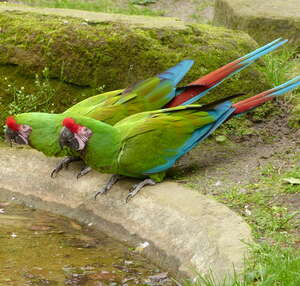
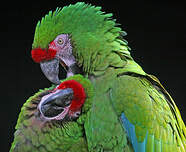
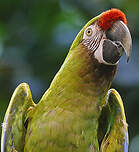
Very similar to Ara ambigua, the Military Macaw is smaller in size and darker in plumage.
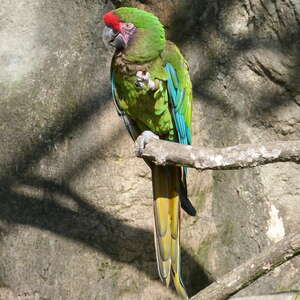
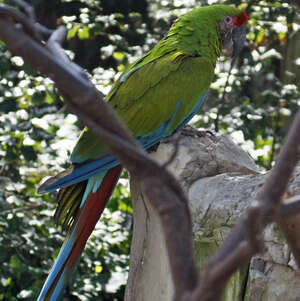
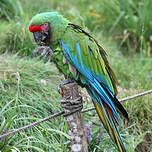
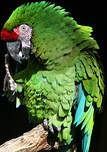
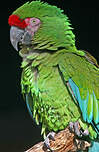
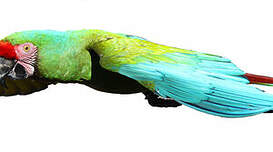
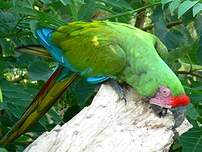
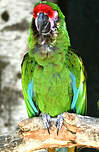
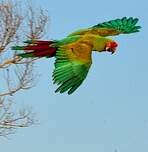
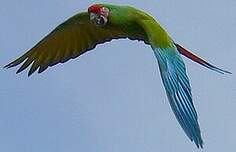
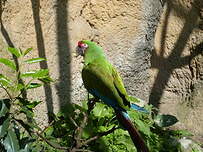
Adult has green plumage on upperparts, slightly washed olive on back and upperwing coverts. Flight feathers are blue. Uppertail coverts, lower back and rump are blue. Graduated tail is brownish-red with blue tips.
On the underparts, body is green with blue undertail coverts. Ara militaire Undertail feathers are olive-green. On the underwing, coverts are green, and flight feathers are olive-green.
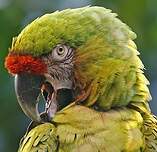
On the green head, forehead is red. The bare skin on the face is pinkish-white, with fine feathered lines blackish on the cheeks, and red on the lores. Above the eyes, green crown is washed blue until the nape. Throat is olive-green.
Strong, hooked bill is blackish. Eyes are yellow. Legs and feet are dark grey.
Both sexes are similar.
Juvenile resembles adults, with shorter tail, grey eyes and paler bare skin. It reaches its sexual maturity between 2 and 4 years of age.

We find three subspecies:
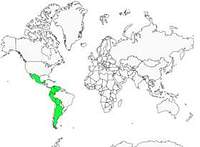
Ara militaris militaris, from NW Venezuela, Colombia, E Ecuador and N Peru.
Ara militaris mexicana, from Mexico.
Ara militaris boliviana, from Bolivia and N Argentina.
Differences between them are doubtful and indistinct.

Voice : Military Ara militaire Macaw utters raucous 'kraa-aaak' in flight or when perched. We can also hear a loud shrill 'kee-eeah'. It is often heard before seen, identified by its loud screeching and croaking.

Habitat : Military Macaw lives mainly in temperate semi-arid mountainous areas, and in tropical deciduous forests, near water. It is visible from 600 to 2600 metres of elevation. It moves seasonally to lowlands, frequenting humid forests and thorny woodlands.
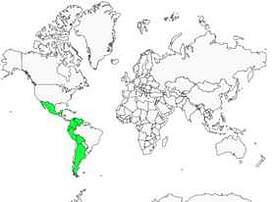
GEOGRAPHIC RANGE: Military Macaw is found from western Mexico to Bolivia, north-western Argentina and western Venezuela.

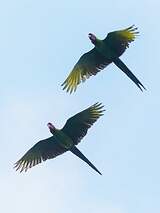
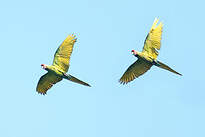
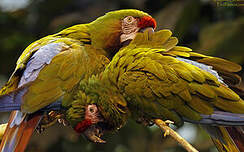
Behaviour : Military Macaw lives in pairs or in family groups. But it is often seen in flocks up to 40 birds at communal roosts where they sleep at night, in tall trees or on cliff-faces. They are very noisy and conspicuous at dawn and dusk, during their flights between the roost and their feeding areas. During these flights, pairs' mates fly close to each other.
Military Macaw feeds on nuts and fruits in palm trees and Ficus. This arboreal species feeds at high level Ara militaire in trees and in canopy. When resting during the day, they perch in exposed dead trees, at top of branches.
Military Macaw performs seasonal movements to feed on particular fruits, and wanders locally in many regions.
When the Military Macaw moves or climbs in trees, its beak plays the role of the 'third hand' and allows the bird to climb easily with help of feet and beak.

Flight : Military Macaw has rapid and direct flight, performing slow and shallow wing beats. It is able to reach speeds of 55 km per hour. It is often noisy in flight.

Reproduction-nesting : Breeding season occurs from January to March, but it may vary according to the country. Ara militaire
Military Macaw nests in cavities, usually a hole in treetop, but also in cliff-faces in canyons where the nest may be established in fissures or rocky crevices, at about 200 metres above the ground.
Female lays 2 to 3 white eggs. Incubation lasts about 28 days to one month, by female. She is fed by male during this period, and then, the male brings food to her for the chicks.
Young fledge about 12 weeks after hatching.
Mates are monogamous and they remain together for life. They perform aerobatics as flight displays during courtship period.

Food habits : Military Macaw feeds on seeds, nuts, fruits and berries. It also eats other kinds of vegetal matters when in tree. It can break open hard-shelled Ara militaire nuts, thanks to its powerful beak.
Military Macaw, as other Psittacidae, visits heaps of clay along riverbanks. They congregate at these places, and lick the clay in order to detoxify the poisonous substances included in their vegetal diet.

Protection / threats : Military Macaw is locally common in some remote areas, but its numbers are declining. This species is threatened by habitat loss due to clearing and deforestation for cattle and agriculture. The heavy trapping for illegal trade and the use of its feathers as ornaments are important facts in its decline.
Military Macaw is classified as Vulnerable.  

Other links :
Iucn
Birdlife


Specification sheet created by Nicole Bouglouan


Qui sommes-nous ? L'association | Mentions légales | Sources | Contacts | Print version
Updated on 2008/05/05 05:34:55 - © 1996-2008 Oiseaux.net

Le Marais Breton-Vendéen

Ara militaire

Ara militaire

Ara militaire

Ara militaire

Ara militaire

Ara militaire

Military Macaw