
New Zealand Falcon
Falco novaeseelandiae - Faucon de Nouvelle-Zélande
Systematics
-
Order:
Falconiformes
-
Family:
Falconidés
-
Genus:
Falco
-
Species:
novaeseelandiae
Descriptor
Biometrics
- Size: 48 cm
- Wingspan: 66 à 91 cm.
- Weight: 250 à 600 g
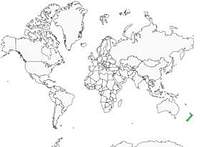
Geographic range
Identification
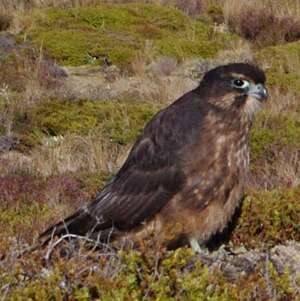
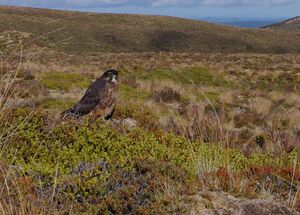
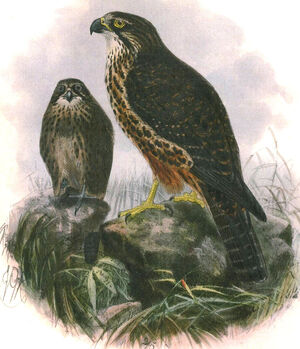
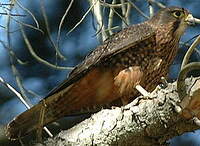
A large falcon species (larger than a Peregrine) with similar sexes - although the female is clearly larger than the male. The back and wing are a blueish black, more or less dark depending on regions, and littered with white spots. Birds from the east of the South Island are larger and paler than their North Island counterparts. Chin is white, the breast is markedly streaked, belly and undertail rufous. Wings are barred underneath. Juveniles are much darker, the back and upperwings a uniform blue-black and the underparts all rufous. The legs are yellow.
Subspecific information monotypic species
Foreign names
- Faucon de Nouvelle-Zélande,
- Halcón maorí,
- falcão-neozelandês,
- Maorifalke,
- új-zélandi sólyom,
- Nieuw-Zeelandse Valk,
- Falco di Nuova Zelanda,
- nyazeelandfalk,
- Maorifalk,
- sokol jastrabovitý,
- ostříž novozélandský,
- Newzealandsk Falk,
- uudenseelanninhaukka,
- falcó de Nova Zelanda,
- sokół nowozelandzki,
- Новозеландский сокол,
- ニュージーランドハヤブサ,
- 新西兰隼,
- 鶉隼,
Voice song and cries
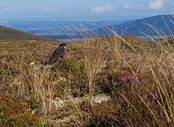
Habitat
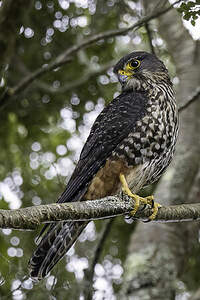
It is found in diverse habitats: forest edges, copses, but also tussock land in the South Island. In winter, the young can be observed in orchards and cities.
Behaviour character trait
This falcon is extremely aggressive, especially when defending its nest and is known to pursue its victims inside farm buildings. The species has some detractors despite the protection it is under.
Flight
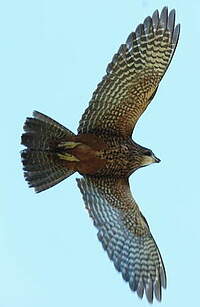
Generally flies close to the ground, like a sparrowhawk, to catch its prey by surprise.
Dietfeeding habits
First and foremost a bird specialist, with the female capable of taking down herons or ducks. It is also known to hunt rabbit and young hares.
Reproduction nesting
Sexual maturity occurs at two year of age. Like other falcon, it does not build a nest and lays its eggs directly on the ground, a platform in a tree (e.g. a broken branch or a large epiphyte). The clutch (2-4 eggs) is incubated for approximately 5 weeks and the chicks stay in the nest for roughly 5 weeks after hatching. the fledglings depend on their parents for food for 2-3 months. The mean breeding success is 1.9 young per pair having laid eggs.
Geographic range
Threats - protection
IUCN conservation status
concern
in the Wild
threatened
evaluated
The introduction of many mammalian predator (dogs, cats, possums, mustelids, rats, etc.) to New Zealand is most likely the main cause of the species' decline. Current population estimates are of some 4,000 pairs. The New Zealand Falcon is classed as "near threatened" by BirdLife International. However, it seems that the introduction of the rabbit, Song Thrush and blackbird may have widened its prey spectrum.
Sources of information
- IOC World Bird List (v14.1), Gill, F and D Donsker (Eds). 2024-04-18.
- Raptors of the World, a field guide, Ferguson-Lees James et Christie David
- The hand guide to the birds of New Zealand, Robertson Hugh et Heather Barrie
- Avibase, Lepage Denis
- BirdLife International, BirdLife International
- Vol. 2 - Handbook of the Birds of the World, Josep del Hoyo-Andrew Elliot--Jordi Sargatal
Other sources of interest

- Accipitriformes
- Aegotheliformes
- Anseriformes
- Apodiformes
- Apterygiformes
- Bucerotiformes
- Caprimulgiformes
- Cariamiformes
- Casuariiformes
- Charadriiformes
- Ciconiiformes
- Coliiformes
- Columbiformes
- Coraciiformes
- Cuculiformes
- Eurypygiformes
- Falconiformes
- Galliformes
- Gaviiformes
- Gruiformes
- Leptosomiformes
- Mesitornithiformes
- Musophagiformes
- Nyctibiiformes
- Opisthocomiformes
- Otidiformes
- Passeriformes
- Pelecaniformes
- Phaethontiformes
- Phoenicopteriformes
- Piciformes
- Podargiformes
- Podicipediformes
- Procellariiformes
- Psittaciformes
- Pterocliformes
- Rheiformes
- Sphenisciformes
- Steatornithiformes
- Strigiformes
- Struthioniformes
- Suliformes
- Tinamiformes
- Trogoniformes