Ce printemps, les oiseaux chantent librement.
Aidez Oiseaux.net à rester libre, gratuit et sans pub.
Falcated Duck - Mareca falcata
Canard à faucilles
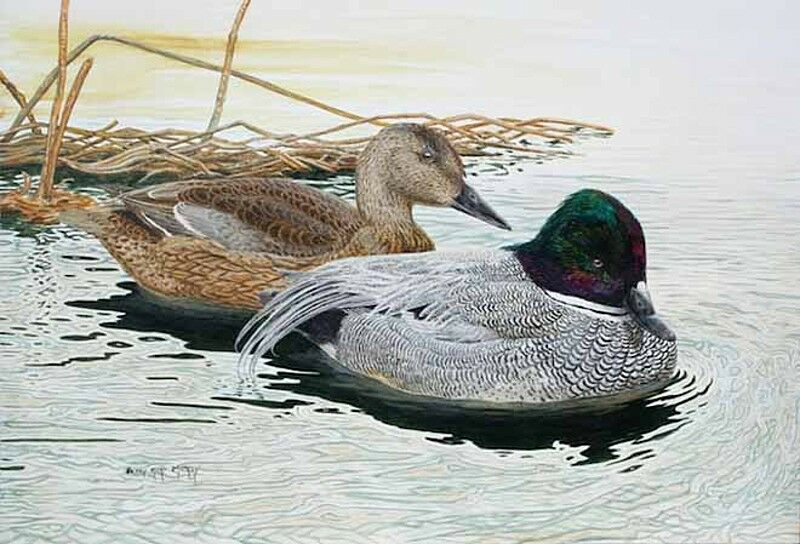
members of the genus, although on the dark side, but the male is quite
spectacularly different from any other ducks, with a significant shaggy
crest, a unique face pattern, and the tightly curved tertials (inner
secondary wing feathers) that give it its name ( falcate means curved or
sickle-shaped ). Those feathers are not only curved as you see, but in
cross section are an acute U shape, and so long that their tips can, as I
have shown in the painting, touch the water in the normal swimming pose.
Reproduction prohibited without prior permission. © Barry Kent Mackay
The species
Classification
Order : Ansériformes
Family : Anatidae
Species : Falcated Duck
Species photos
The photo
O.Net reference : bkma55306
Author :
Barry Kent Mackay
Photo details
Date : 2008
Country : Canada (ca)
Region : Ontario
Location : Markham
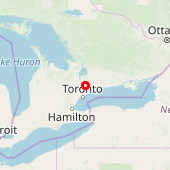
Lat. : 43° 52' 1'' North
Lng. : 79° 16' 1'' West
Exif data [+][-]
Flash : no