Australian Magpie

Birds      PasseriformesCracticidae      Id. Record Geographic rangePictures
Cassican flûteur

Australian Magpie

Gymnorhina tibicen

Order  : Passeriformes

Family : Cracticidae  ;

Biometrics :

Size : 38 à 44 cm
Wingspan : 80 cm
Weight : 360 gr

Longevity : 30 years

IUCN conservation status :

Extinct
Threatened
Least
concern
Extinc
in the Wild
Near
threatened
Not
evaluated

EX EW CR EN VU NT LC NE
Geographic range :

Distribution sumatran.trogon

Synonyms : Черноспинная пе (ru), Urraca Canora (es), Gazza australiana (it), Flötenvogel (al), Zwartrug-fluitvogel (nl), Australian Magpie (en)

Cassican flûteur Physical description :
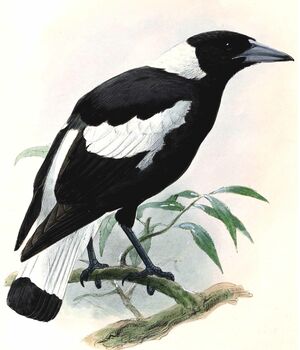
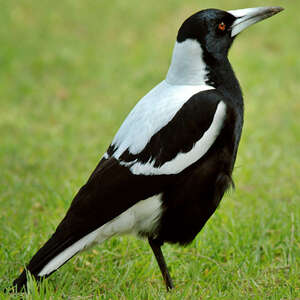
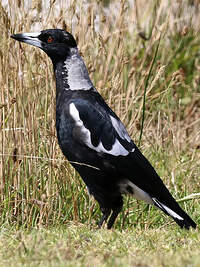
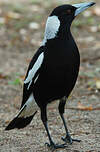
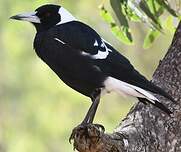
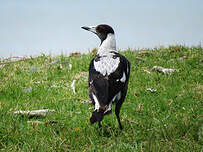
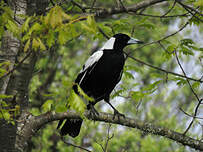
Australian Magpie is a medium-sized bird, with black and white plumage. It is native to Australia and southern New Guinea.
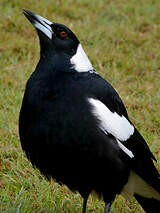
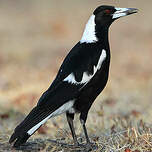
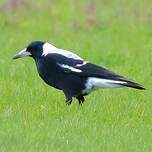
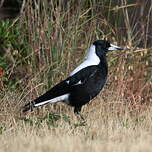
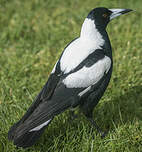
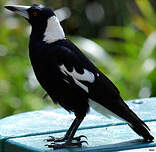
Adult male has white nape, shoulders and upper tail. Rest of body is black.
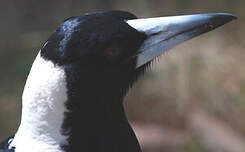
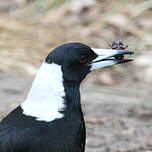
Strong, pointed bill is pale blue with grey tip. Eyes are brown-chestnut. Legs and feet are black.
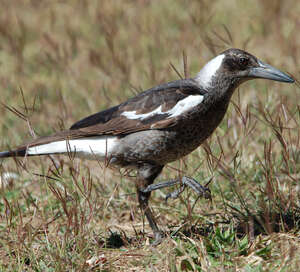
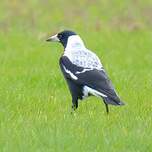
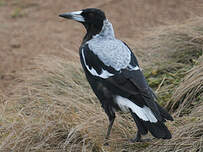
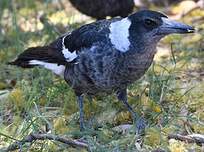
Adult female is similar to male, but white patches are flecked with black, giving her greyer appearance.
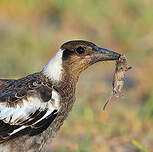
Juvenile resembles female with white parts flecked with lighter greys and browns.
Black colour varies, according to the subspecies. There are eight Magpie subspecies. They differ in size and shape, according to the region and geographical conditions. Colour patterns also differ in tail, wings and back.

Voice : Australian Cassican flûteur Magpie is also called 'Flute-bird', coming from its melodious call. Calls are loud, melodious warblers uttered from high perches at dawn and dusk. Song is an undulating flute-like chorusing, described as 'quardle oodle ardle wardle doodle'. Australian Magpie also mimics the calls of other bird species. Juvenile utters repeated 'squawk'.

Habitat : Australian Magpie lives in open country, in pastures and cultivated land with nearby wooded areas for Cassican flûteur roosting and nesting. It is also found in urban parks and gardens. It avoids too dense forests and arid deserts.
GEOGRAPHIC RANGE: Australian Magpie lives in most parts of Australia and southern New Guinea. This species has been introduced into New Zealand from Australia in the 1860s.

Behaviour : Australian Magpie feeds on the ground, eating small insects and other invertebrates living on or under the surface. It finds its preys by hearing the noises under the Cassican flûteur ground, and then, it extracts the prey with its strong, pointed bill.
Australian Magpie always lives in groups of up to ten birds, which defend their territory. But usually, there is one dominant pair, and males are less numerous than females in the same group.
Young and non-breeding birds form large flocks of several hundreds. They live in areas different from breeding territories, where water and food resources are lacking. These flocks move from place to place, in order to feed and drink. An individual bird which replaces another in a breeding territory will breed and nest in suitable habitat.
Australian Magpie is highly territorial during breeding season, and readily assaults intruders. If the bird is alarmed or threatened while nesting, it will swoop at intruders or predators, snapping its bill in order to drive them away. It usually attacks from behind, without warning. These attacks can be terrifying to children. In urban Cassican flûteur parks, warning signs are post during this period. Magpies can cause injuries to head and eyes of people.

Flight : Australian Magpie is an agile bird, swooping abruptly at intruders when nesting.

Reproduction-nesting : Breeding season can be long, and varies according to the geographic place where birds live. In northern parts, they breed between June and September. In cooler regions, they breed in August or September and until January in some areas.
Female builds the nest high in tall tree, in fork up to 15 metres above the ground, in an exposed place. Nest is a bulky structure, bowl-shaped, made with sticks, grasses and pine-needles. Interior is lined with sheep's wool, fine grass and bark.
Female lays 3 to 5 blue or green eggs with brown markings. Incubation lasts about 20 days, by female, while male defends the nest-site. Young are reared by female, and they fledge about 24 days after hatching.
After fledging, all members of the group help in feeding and protecting the young.
Young birds have to leave the territory within two years, forced by parents. At this moment, they join flocks until they find a territory for breeding.
Numerous young birds die in the first months, by starvation, predators and bad weather conditions.

Food habits : Australian Magpie pecks and probes for crickets, worms and snails. They also take flies, spiders and lizards. They eat grass grubs (that helps farmers), but they also consume seeds, foliage and grain. They take the eggs of other bird species, mice and carrion.

Protection / threats : Australian Magpie is common and widespread in its range.  

Other links :
Iucn
Birdlife


Cassican flûteur

Cassican flûteur

Cassican flûteur

Cassican flûteur

Cassican flûteur

Cassican flûteur


Specification sheet created by Nicole Bouglouan


Qui sommes-nous ? L'association | Mentions légales | Sources | Contacts | Print version
Updated on 2008/05/06 05:36:31 - © 1996-2008 Oiseaux.net

100 Birds and How They Got Their Names

Cassican flûteur

Cassican flûteur

Cassican flûteur

Cassican flûteur

Cassican flûteur

Cassican flûteur

Cassican flûteur

Cassican flûteur

Cassican flûteur

Cassican flûteur

Cassican flûteur

Cassican flûteur

Australian Magpie