Black-winged Stilt

Birds      CharadriiformesRecurvirostridae      Id. Record Geographic rangePictures
Echasse blanche

Black-winged Stilt

Himantopus himantopus

Order  : Charadriiformes

Family : Recurvirostridae  ;

Biometrics :

Size : 35 à 40 cm
Wingspan : 67 à 83 cm
Weight : 160 à 200 g

IUCN conservation status :

Extinct
Threatened
Least
concern
Extinc
in the Wild
Near
threatened
Not
evaluated

EX EW CR EN VU NT LC NE
Geographic range :

Distribution sumatran.trogon

Synonyms : Khodulochnik (ru), Styltlöpare (sv), Ciguëñuela (es), Cavaliere d'Italia (it), Stelzenläufer (al), Steltkluut (nl), Black-winged Stilt (en)

Echasse blanche Physical description :
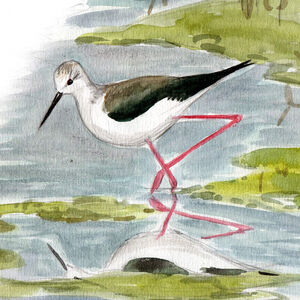
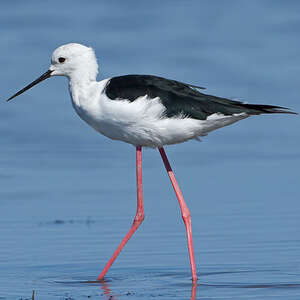
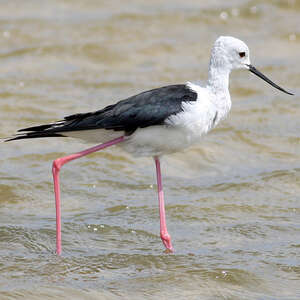
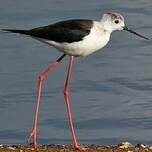
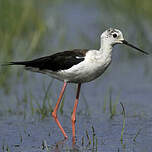
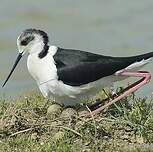
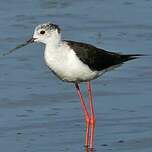
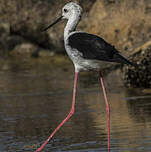
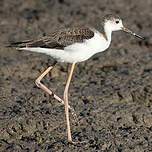
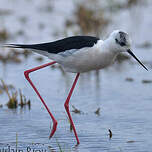
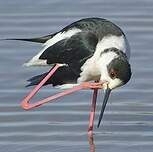
Black-winged Stilt has black and white plumage with all-black wings, upper back and rear neck. Underparts are white, with a white collar contrasting with black back and neck.
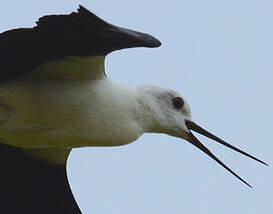
Head has white face and forehead, and black top of the crown. Eyes are red. Long, thin bill is black and straight. Very long legs and feet are reddish-pink.
Both sexes are almost similar, but female is brownish, male is blacker with greenish glossy feathers.
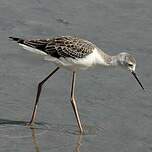
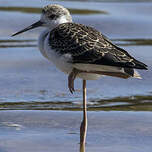
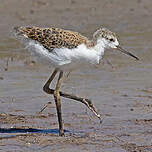
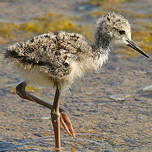
Juvenile is paler than adult, with washed grey crown and rear neck, and brownish above with narrow pale buff fringes, and greyish-pink legs.
We have three subspecies:
Himantopus h. himantopus, lives in Eurasia, India and Africa.
Himantopus h. knudseni lives only in Hawaï. It is very Echasse blanche rare and endangered due to habitat loss.
Himantopus h. mexicanus lives in North America, to northern South America.

Voice :
Sound from CD 'Tous les Oiseaux d'Europe' by Jean C. Roché by courtesy of Sittelle and CEBA.
Black-winged Stilt's calls are a sharp 'kek' and a barking 'ke-yak'. Alarm call is a monotonous 'kik-kik-kik-kik-kik-kik' high pitched. They are noisy on their breeding areas.

Habitat : Black-winged Stilt lives mainly in freshwater and saltwater marshes and mudflats, shallow lakes, coastal lagoons, flooded fields and rice fields.
GEOGRAPHIC RANGE: Black-winged Stilt has a wide range. We can find it in Australia, Central and South America, Africa, Asia, parts of North America, Eurasia, Hawaii and Philippines.

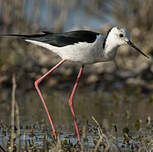
Behaviour : Black-winged Stilt feeds in shallow water, wading and catching preys on or near the surface. But sometimes, it plunges the head under Echasse blanche the surface to capture some aquatic invertebrate. It picks up its food from the sand or water. Its very long legs allow it to walk in deeper water than other waders. They rarely swim for food. Black-winged Stilt is an active forager, and it may employ several methods to catch prey. This species is well adapted to nocturnal vision, which allows them to feed on windy, moonless nights. Stilts Echasse blanche walk quickly, with long strides, wading into water.
Black-winged Stilt is a migratory bird, moving to the ocean coasts in winter. European birds winter in sub-Saharan Africa. They are often seen in flocks of 10 to 20 birds, and also in mixed flocks with other species of shorebirds.
Black-winged Stilt nests in small colonies of 2 to 50 pairs, and mated pairs defend vigorously their nest site and territory. They may nest in mixed groups with avocets. When alarmed near the nest, Echasse blanche it hops and raises with moving legs from side to side. If an intruder approaches when chicks are in the nest, parents perform broken wings display to drive it away from the nest.
They may feed in large flocks of several thousands birds. When alarmed, birds often bob their head.
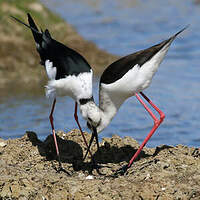
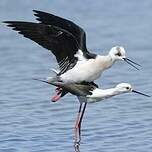
White-winged Stilt becomes very active when mating season starts. Males and females perform numerous bows, with moving wings.
When parents change during incubation, male grasps some bits of grasses from the ground, and toss them backwards onto its shoulders. When male is Echasse blanche very close to the nest, female performs the same display.

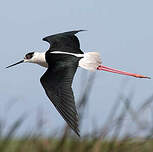
Flight : Black-winged Stilt has rapid direct flight, with rapid wing beats. Legs are projected behind the tail of up to 20 cm, and neck is slightly held. They often fly at low elevation, but in migration, they may fly at very high elevation.

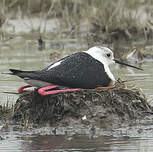
Reproduction-nesting : Black-winged Stilt's nest is a shallow scrape on the ground. It is located on a mound of vegetation, in water on floating water weeds, or near water on the shore.
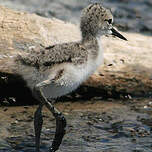
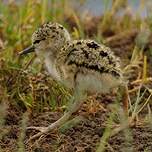
Female lays 4 eggs between mid-May and mid-June. Incubation lasts about 25 days, by both parents. At hatching, chicks are covered with dark down, spotted with grey or brownish black. Underparts are white. Chicks are precocial and leave the nest very soon, remaining hidden in aquatic vegetation. They are fed by both parents. They fledge at about 4 weeks after hatching, and they become independent 2 to 4 weeks later.

Food habits : Black-winged Stilt feeds on aquatic insects, worms, tadpoles, water bugs and beetles and fly larvae, molluscs and spiders.

Protection / threats : Black-winged Stilts are not globally threatened. They depend on predator control and protection of breeding habitats. Populations seem to be stable.
Hawaiian subspecies is endangered.  

Other links :
Iucn
Birdlife


Echasse blanche

Echasse blanche

Echasse blanche

Echasse blanche

Echasse blanche

Echasse blanche


Specification sheet created by Nicole Bouglouan


Qui sommes-nous ? L'association | Mentions légales | Sources | Contacts | Print version
Updated on 2008/05/04 05:30:55 - © 1996-2008 Oiseaux.net

Guide des oiseaux de mer

Echasse blanche

Echasse blanche

Echasse blanche

Echasse blanche

Echasse blanche

Echasse blanche

Echasse blanche

Echasse blanche

Echasse blanche

Echasse blanche

Echasse blanche

Echasse blanche

Echasse blanche

Echasse blanche

Echasse blanche

Black-winged Stilt