
Common Ostrich
Struthio camelus - Autruche d'Afrique
Systematics
-
Order:
Struthioniformes
-
Family:
Struthionidés
-
Genus:
Struthio
-
Species:
camelus
Descriptor
Biometrics
- Size: 175 à 275 cm
- Wingspan: -
- Weight: 90000 à 156000 g
Longevity
40 years
Geographic range

Identification
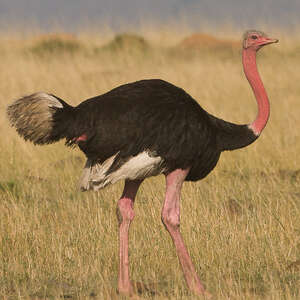
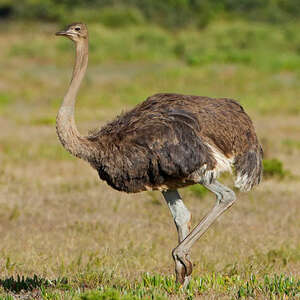
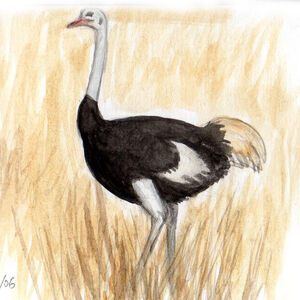
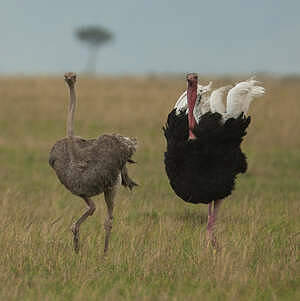
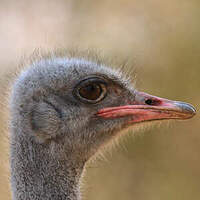
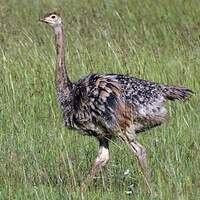
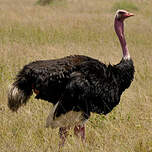
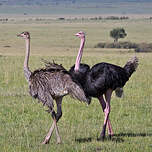
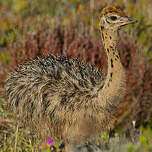
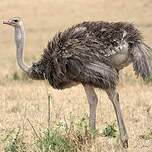
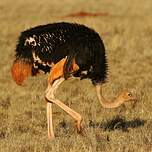
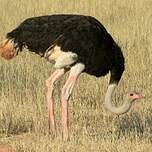
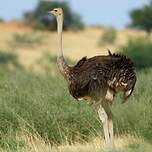
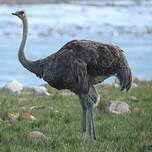
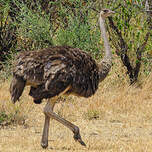
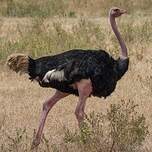
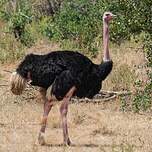
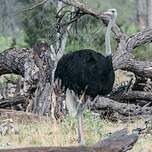
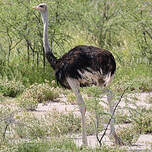
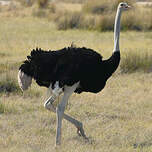
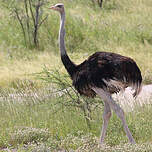
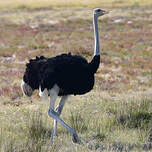
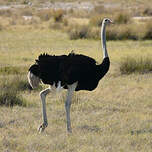
The genus Struthio consists of two species of ostriches: the Common Ostrich and the Somali Ostrich, a subspecies recently raised to the rank of species. The Common Ostrich is the largest of the birds and the one that is immediately recognized by all with its large body, long neck and long, robust legs. It is the only bird to have only two toes on each foot. The inner toe, more developed, serves as support, especially during the race. It is also equipped with a long claw. The head, very small compared to the body, also has the largest eyes in the animal world. They are surrounded by large, black eyelashes. The beak, rounded at the end, is wide and flat. It is the heaviest bird. Its adult weight, which ranges from 90 to 156 kg depending on sex and subspecies, prevents it from flying. Its feathers do not have barbules, which is visually translated into a fluffy and downy plumage. This is primarily a good way to isolate from extreme temperatures, high or low. Sexual dimorphism is clear. The male has black tertiaries and white primary feathers, remiges and rectrices. The naked parts, head, majority of the neck and legs are colored differently depending on the subspecies (pink, gray or gray-blue). The head can be slightly and partially covered with short, brown feathers. The female, smaller than the male, is completely gray-brown. The head, neck and legs are flesh-colored. The chick is fawn with dark brown spots, it grows 25 cm every month in its first year. At the age of one year, the young ostrich weighs 45 kg. The immature is slightly darker than the female. The total development of the bird takes 18 months. Sexual maturity is reached at 3 to 4 years old.
There are four subspecies:C. camelus: West and South of the Sahara, Sahel. The neck is pink with white collar. This subspecies has feathers on the cap.
S. c. massaicus: South of Kenya to Tanzania, Mozambique and Zambia. The neck is pink with white collar. The cap is almost bare.
S. c. australis: South Africa. The neck is grey-pink without a collar. The cap is slightly downy.
S. c. syriacus: formerly present in the deserts of Syria and Arabia, is extinct.
Subspecific information 4 subspecies
- Struthio camelus camelus (s Morocco and Mauritania to s Egypt and n and w Ethiopia, south to Cameroon and n Uganda)
- Struthio camelus syriacus (Syrian and Arabian Deserts)
- Struthio camelus massaicus (s Kenya and c Tanzania)
- Struthio camelus australis (s Africa)
Foreign names
- Autruche d'Afrique,
- Avestruz común,
- avestruz-comum,
- Strauß,
- strucc,
- Struisvogel,
- Struzzo,
- struts,
- Slettestruts,
- pštros dvojprstý,
- pštros dvouprstý,
- Struds,
- strutsi,
- Volstruis,
- estruç comú,
- Strútur,
- struś czerwonoskóry,
- Āfrikas strauss,
- noj,
- Африканский страус,
- ダチョウ,
- 非洲鸵鸟,
- 鴕鳥,
Voice song and cries
Habitat
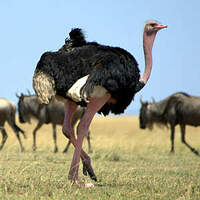
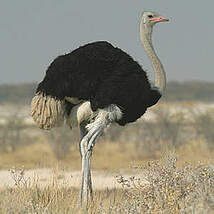
The Common Ostrich lives in open semi-arid grasslands, from desert to dry savanna, as well as in open forests. It can also be found in anthropized areas such as pastures.
Behaviour character trait
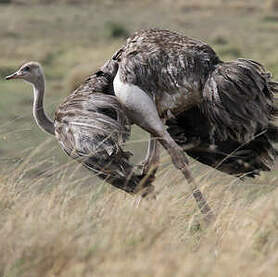
The Common Ostrich, an atypical bird unable to fly, has several other advantages. Standing on its long, sturdy legs, it can look above the vegetation and detect any potential predators.
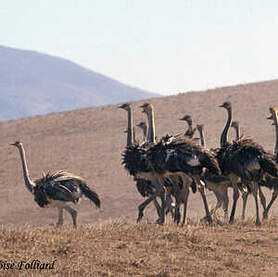
Dietfeeding habits
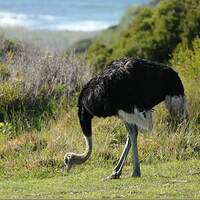
The Common Ostrich is herbivorous even though it sometimes eats some invertebrates. It feeds mainly on grass seeds, bushes, herbs, fruits and flowers. The plants ingested also provide a water intake, which allows it to stay for several days without drinking.
Reproduction nesting
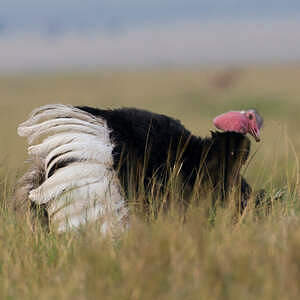
During breeding season, which depends on the geographic region, the male digs a depression in the ground of 30 to 60 cm deep and 3 meters wide. Then he tries to attract the females with a dance. He stands up, with open wings and tail feathers, shakes each wings from right to left, does the same with his head and neck and moves his tail from bottom to top. He then approaches the female as he dances and strikes the ground with his feet. Once the female is courted, the couple will seek some privacy moving away from the group and chasing away any intruder. A second wedding parade can then begin, which will be followed by the mating.
Geographic range

Threats - protection
IUCN conservation status
concern
in the Wild
threatened
evaluated
Although the Common Ostrich is still relatively abundant, its population has significantly decreased in recent years. The feathers and eggs have been used by humans for a long time. The feathers used to adorn the hats of ladies in the 19th century. The collection of eggs and hunting of the bird for its meat in the 20th century nearly caused the species to disappear in Northern and Southern Africa. The destruction of its habitat should not be neglected either, as grazing areas increase in size, replacing the original habitat. Ostrich breeding has helped reduce hunting pressure. The last remaining wild populations are now found in the protected areas of Africa.
Sources of information
- IOC World Bird List (v14.1), Gill, F and D Donsker (Eds). 2024-04-18.
- HBW Alive,
- ARKive, Christopher Parsons
- Wikipedia (English version),
Other sources of interest
 Specification sheet created on
23/07/2023 by Nathalie Santa Maria
Specification sheet created on
23/07/2023 by Nathalie Santa MariaTranslation by AI Oiseaux.net
published: 19-12-2016 - Updated: 04-01-2017
© 1996-2024 Oiseaux.net
- Accipitriformes
- Aegotheliformes
- Anseriformes
- Apodiformes
- Apterygiformes
- Bucerotiformes
- Caprimulgiformes
- Cariamiformes
- Casuariiformes
- Charadriiformes
- Ciconiiformes
- Coliiformes
- Columbiformes
- Coraciiformes
- Cuculiformes
- Eurypygiformes
- Falconiformes
- Galliformes
- Gaviiformes
- Gruiformes
- Leptosomiformes
- Mesitornithiformes
- Musophagiformes
- Nyctibiiformes
- Opisthocomiformes
- Otidiformes
- Passeriformes
- Pelecaniformes
- Phaethontiformes
- Phoenicopteriformes
- Piciformes
- Podargiformes
- Podicipediformes
- Procellariiformes
- Psittaciformes
- Pterocliformes
- Rheiformes
- Sphenisciformes
- Steatornithiformes
- Strigiformes
- Struthioniformes
- Suliformes
- Tinamiformes
- Trogoniformes