Great Green Macaw
Ara ambigua
Order : Psittaciformes
Family :
Biometrics :
Size : 85 à 90 cm
Wingspan :
Weight : 1260 à 1400 gr
Longevity : 60 years
IUCN conservation status :

EX EW CR EN VU NT LC NE
Geographic range :
Synonyms : Guacamayo Ambiguo (es), Ara di Buffon (it), Bechsteinara (al), Buffon-ara (nl), Great Green Macaw (en)
Family description :
Psittacidae is a large family, including several races of parrots of different sizes and colours, but with almost similar behaviour throughout their wide range.
We find two main kinds of birds, the Cockatoos and the Parrots.
The Cockatoos are large to medium-sized, with strong bill and conspicuo... to be continued
Physical description :
Great Green Macaw is a threatened species, classified as Endangered. But today, the most of its remaining habitats is protected by Nature Reserves and conservation programs.
The Loro Parque Fundación has supported conservation activities for this species in the west of Ecuador, in the Cerro Blanco Protected Forest.
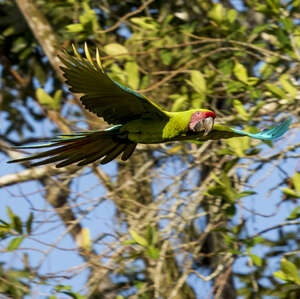
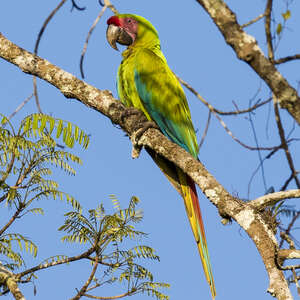
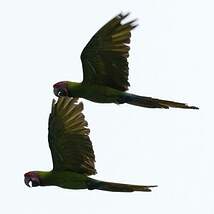
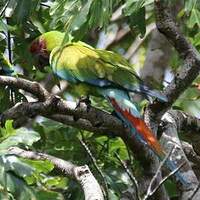
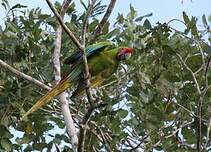
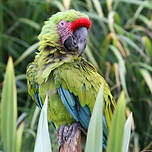
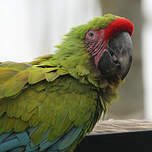
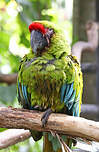
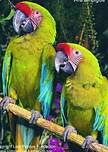
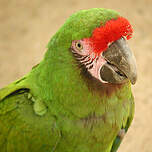
Adult is very similar to Ara militaris, with similar plumage, but Great Green Macaw is larger. It has green plumage, but paler than Military Macaw.
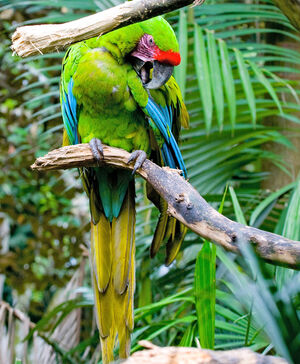
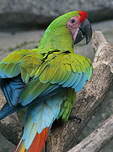
Upperparts are yellowish-green, including the crown and the upperwing coverts. Rump and uppertail coverts are blue, and flight feathers are darker blue. Long, graduated tail is orange-red with blue tips.
On the underparts, the body is yellowish-green, and vent and undertail coverts are blue. Undertail feathers are olive-green. On the underwing, coverts are green whereas flight feathers are olive-green.
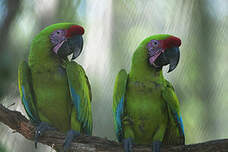
Head is yellowish-green with red forehead. The bare skin of the face is pinkish-white, with fine blackish and reddish feathered lines.
Strong, large bill is blackish, paler at tip. Eyes are pale yellow, with pinkish-white eye-ring. Legs and feet are dark grey.
Both sexes are similar.
Juvenile resembles adults with more olive-green tinge in its plumage.
We find two subspecies:
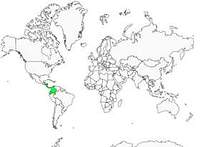
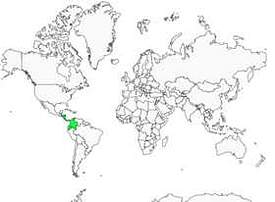
Ara ambigua ambigua, from eastern Honduras and Nicaragua, to Costa Rica and Panama, and to north-western Colombia.
Ara ambigua guayaquilensis, from western Ecuador where two isolated population occur.
Voice : Great Green Macaw utters loud, raucous squawks, and growling 'aowrk' when feeding. It is noisy when in flight.
Habitat : Great Green Macaw lives in humid lowland rainforest, in the tree canopy. When it is feeding, it may be seen in more open areas, but it also frequents foothill forests. It is visible up to 1000 metres of elevation.
GEOGRAPHIC RANGE: Great Green Macaw is found from eastern Honduras, to north-western Colombia and western Ecuador.
Behaviour : Great Green Macaw feeds on seeds and fruits, and also hard-shelled nuts. It is found in pairs or small groups of 10 to 15 birds feeding together.
It is fond of the fruits of the swamp almond tree Dipteryx panamensis. Thanks to its powerful, large bill, it is able to crack open the hard nuts to reach the seed. This food is very important for this species during the breeding season.
Great Green Macaw performs seasonal movements towards the coasts for food, and particularly for the Dipteryx panamensis trees. Then, the macaws move inland for breeding.
Great Green Macaw is an arboreal species often moving into the canopy of tall trees. It moves through the forest, according to availability of fruiting trees.
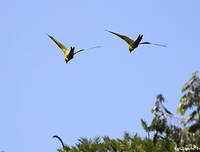
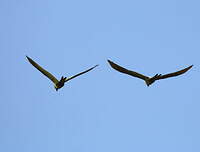
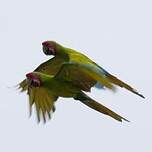
Flight : Great Green Macaw is able to fly long-distances at important height. Through the forest, it flies below the canopy.
It has rapid and direct flight, performed with steady, shallow wing beats.
Reproduction-nesting : Breeding season occurs from December to April, but it may vary according to the locality.
Great Green Macaw nests in cavity, usually a hole in tree, often in Almond tree.
Female lays 2 to 3 white eggs. Incubation lasts about one month, by female.
Young are fed by both adults, and leave the nest about 11 weeks after hatching.
Food habits : Great Green Macaw feeds mainly on seeds and fruits, particularly the nuts of the almond tree Dipteryx panamemsis, and other very hard-shelled fruits.
Protection / threats : Great Green Macaw is a vulnerable species. Its decline is due to habitat loss by heavy deforestation within its range, and to disturbances.
This species depends on intact forest habitat, and it is necessary to maintain a minimum of healthy reproductive population.
Other links :
Iucn
Birdlife
Specification sheet created by Nicole Bouglouan
Qui sommes-nous ?
L'association |
Mentions légales |
Sources |
Contacts |
Print version
Updated on 2008/05/05 05:34:55 - © 1996-2008 Oiseaux.net
Great Green Macaw