
Great Spotted Woodpecker
Dendrocopos major - Pic épeiche
Systematics
-
Order:
Piciformes
-
Family:
Picidés
-
Genus:
Dendrocopos
-
Species:
major
Descriptor
Biometrics
- Size: 24 cm
- Wingspan: 34 à 39 cm.
- Weight: 70 à 98 g
Longevity
11 years
Geographic range

Identification
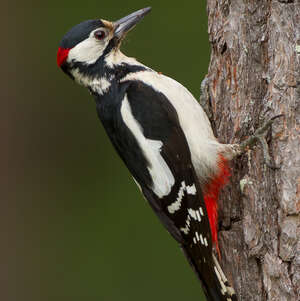
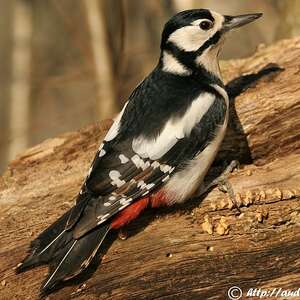
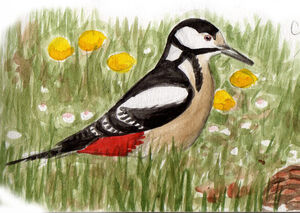
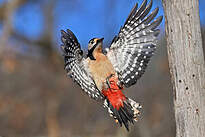
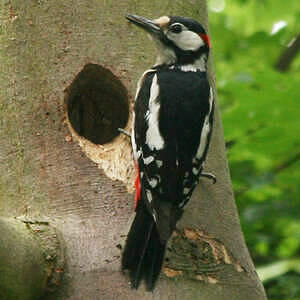
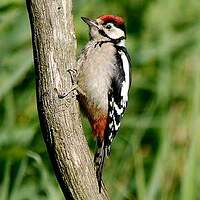
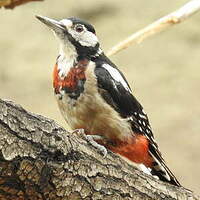
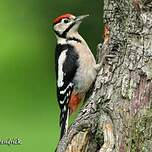
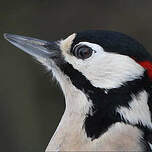
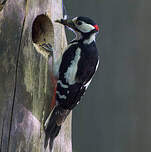
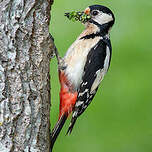
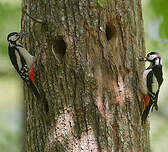
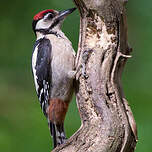
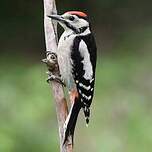
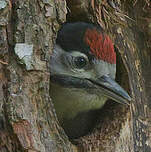
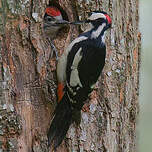
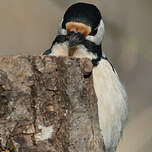
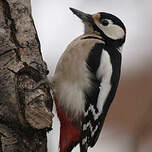
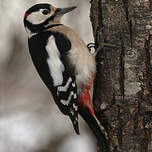
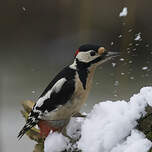
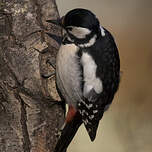
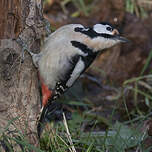
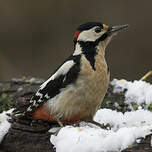
The Great Spotted Woodpecker is the most common and widespread of the so-called colourful woodpeckers, with its colourful fur of black, white and red plumage. Sexual dimorphism is weak. The adult male is distinguished by its crimson red occipital area while it is black in the female. The upper parts (mantle, back, rump and uppertail coverts) are black. The black wings have a large white spot on the shoulders, formed by the external scapulaires and the large and medium internal coverts. All the remiges are black with white spots on their length forming wing bars. The two pairs of central rectrices are black and the three outer pairs increasingly white from inside to outside. The head wears a black cap between the light reddish beige forehead and the red or black back. The sides of the head and neck are white, marked with a black Y whose branches respectively join the beak (in a black moustache), the nape and the chest (the lower branch initiating a pectoral band). A black necklace joins the nape to the mantle, which is also black. The lower parts are white, except for the lower abdomen and the under-tails crimson red. The strong and pointed beak is black. The dark red eyes stand out well in the white auricular zone. The strong clawed legs are grey. The juvenile of the year has a red cap, bordered in black on the sides, the red more extended and vivid in the juvenile male. The black of the plumage is dull, the white spots of the shoulders marked with grey and the red under the tail paler. These characteristics can be confused with the Grey-headed Woodpecker which has an entirely red cap in all plumages and the underside of the tail more pink than red. It is therefore necessary to look carefully at the head pattern (in Grey-headed, the red cap is not bordered in black, the black Y of the neck is smaller and does not join the beak, or the nape).Finally, the chest is finely streaked with dark tones. In the Middle Europe and Minor Asia, however, confusion with the Syrian Woodpecker is a possibility to keep in mind, as the two species look very similar. In the Syrian, the black on the sides of the neck does not meet the black head and the red under the tail is clearly paler than in the Great Spotted Woodpecker. The 24 recognized subspecies are mainly distinguished by the tone of their lower parts which ranges from pure white to a reddish hue more or less pronounced. The most remarkable subspecies is undoubtedly ssp numidus from North Africa which has a large pectoral band completely colored in red and black.
Subspecific information 24 subspecies
- Dendrocopos major major (Scandinavia and ne Poland to w Siberia)
- Dendrocopos major brevirostris (w Siberia to e Siberia, ne China, n Mongolia)
- Dendrocopos major kamtschaticus (Kamchatka Pen.. e Siberia.)
- Dendrocopos major anglicus (Great Britain)
- Dendrocopos major pinetorum (c Europe)
- Dendrocopos major parroti (Corsica)
- Dendrocopos major harterti (Sardinia)
- Dendrocopos major italiae (Italy, Sicily and w Slovenia)
- Dendrocopos major hispanus (Iberian Pen.)
- Dendrocopos major canariensis (Tenerife. Canary Is..)
- Dendrocopos major thanneri (Gran Canaria I.. Canary Is..)
- Dendrocopos major mauritanus (Morocco)
- Dendrocopos major numidus (n Algeria and Tunisia)
- Dendrocopos major candidus (Romania and s Ukraine to Greece)
- Dendrocopos major paphlagoniae (n Turkey)
- Dendrocopos major tenuirostris (Caucasus and Transcaucasia. sw Asia.)
- Dendrocopos major poelzami (se Azerbaijan, n Iran and sw Turkmenistan)
- Dendrocopos major japonicus (se Siberia, ne China, Korea and n and c Japan)
- Dendrocopos major wulashanicus (Inner Mongolia. n China.)
- Dendrocopos major cabanisi (e China)
- Dendrocopos major beicki (c China)
- Dendrocopos major mandarinus (s China and e Myanmar to n Laos and n Vietnam)
- Dendrocopos major stresemanni (ne India, ne Myanmar to se Tibet and sc China. w Sichuan, Yunnan.)
- Dendrocopos major hainanus (Hainan I.. off se China.)
Foreign names
- Pic épeiche,
- Pico picapinos,
- pica-pau-malhado-grande,
- Buntspecht,
- nagy fakopáncs,
- Grote Bonte Specht,
- Picchio rosso maggiore,
- större hackspett,
- Flaggspett,
- ďateľ veľký,
- strakapoud velký,
- Stor Flagspætte,
- käpytikka,
- picot garser gros,
- Barrspæta,
- dzięcioł duży,
- dižraibais dzenis,
- veliki detel,
- Большой пёстрый дятел,
- アカゲラ,
- 大斑啄木鸟,
- 大斑啄木,
Voice song and cries
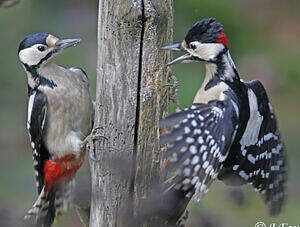
The Great Spotted Woodpecker has its habitual call of a pik or tik sound which can be softened to tek. This is the species' contact call. If the bird is anxious, they produce the same call but much quicker depending on the level of their anxiety. Additionally, particularly during the formation of pairs or when there is territorial conflict between neighbouring pairs or with the Middle Spotted Woodpecker in sympatry, there is a long kekekekekek... which indicates the excitement of the individuals. The juvenile birds at the nest incessantly demand food with a long drawn out and repeated trriiitriiitriiitriii.... The sound territorial manifestation with a singing effect is drumming. Both sexes drum in the spring but the males do it more frequently and constantly. The drumming of the Great Spotted Woodpeckers is typical in the sense that it is brief (1-2 seconds) and that the frequency of the strokes in each series increases slightly. It is a very frequent manifestation in the spring when matching and delimiting territories. It has been calculated that an unmated male can drum up to 600 times per day.
Habitat
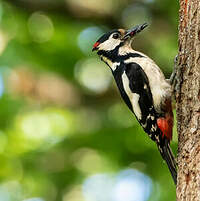
The Great Spotted Woodpecker is a ubiquitous forest species, frequenting all kinds of deciduous, evergreen or mixed woods in its vast distribution area, from sea level up to over 2,000 meters altitude.
Behaviour character trait
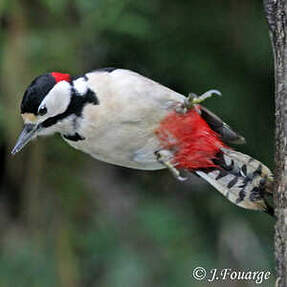
The Great Spotted Woodpecker is an exclusive arboreal bird. It needs trees in all stages of its life - it finds its food there and builds its nest there. Like all woodpeckers, the woodpecker is a solitary and somewhat individualistic bird most of the year. It is only during the breeding season in spring that it searches for and tolerates a partner in order to raise one clutch of young. Afterwards, everyone goes back to their solitude. This species does not show any tendency to congregate. The woodpecker is usually a resident in its forest habitat, meaning it is present all year round, only subject to local movements.
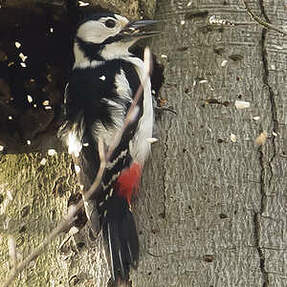
Flight
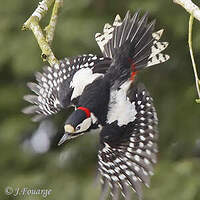
The Great Spotted Woodpecker has a typical picid flight, alternating energetic flapping and pauses with closed wings.
Dietfeeding habits
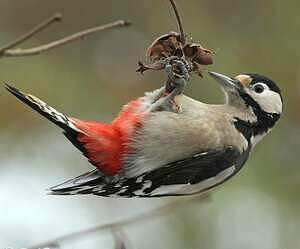
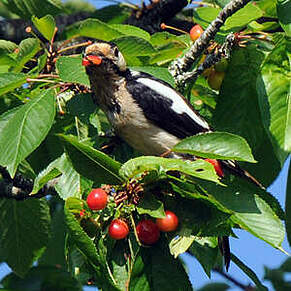
The Great Spotted Woodpecker has a very varied diet. In the summer, the animal part predominates. The bird actively looks for wood-boring larvae of insects such as cerambycids or scolytids that it extracts from the wood with its beak and tongue, working from bottom to top along the trunks and branches. It leaves very typical traces of activity. It attacks the same way ant nests and captures a very large variety of insects and their larvae, even aerial such as moth caterpillars. The young are exclusively fed animal items. It is known to occasionally attack the nests or the nests of other cave dwellers such as tits, including enlarging the access hole with its beak, for example a bird box.
Reproduction nesting
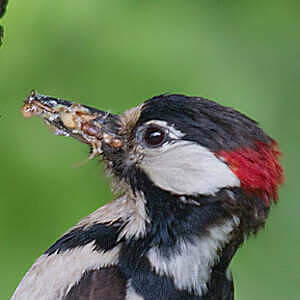
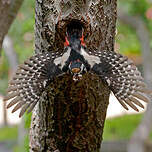
Great Spotted Woodpeckers are able to reproduce from their second civil year. In December, the nuptial displays begin. It must be said that it takes a lot of work to bring together two rather solitary partners in everyday life. This takes time. They will reach their peak in February-March, at least in Central Europe. These displays are expressed through pursuits in underbrush with audible wing beats, numerous vocalizations, a particular gesture (ruffling of the crown feathers indicating excitement, deployment of wings and tail to show the white spots, hide-and-seek around trunks and branches.
Geographic range

The range of the Great Spotted Woodpecker extends across the entire Eurasian continent, from the Atlantic to the Pacific at the average latitude. It forms a continuous band that includes the different forest biomes and skirts the deserts. To the west, it is present in Great Britain but absent from Ireland. To the southwest, two insular subspecies occupy the Canary Islands. At the other end, to the east, the range includes the Japanese archipelago, Sakhalin Island and the Kamchatka Peninsula. To the southeast, it descends into Southern China, Taiwan, and Northern Indochina due to the altitude and climatic and forestry conditions.
Threats - protection
IUCN conservation status
concern
in the Wild
threatened
evaluated
The Great Spotted Woodpecker is common and widely distributed across most of its range. As such, it is not globally threatened. However, it is reportedly rare in South-East Asia. Furthermore, island populations such as those in the Canary Islands are vulnerable due to overexploitation of the pine forests they inhabit.
Sources of information
- IOC World Bird List (v14.1), Gill, F and D Donsker (Eds). 2024-04-18.
- Les passereaux d'Europe, tome 1, P. Géroudet, M. Cuisin
- Avibase, Lepage Denis
- HBW Alive,
- xeno-canto, Sharing bird sounds from around the world,
Other sources of interest
 Specification sheet created on
06/07/2023 by Jean François
Specification sheet created on
06/07/2023 by Jean FrançoisTranslation by AI Oiseaux.net
published: 15-10-2019 - Updated: 29-10-2019
© 1996-2024 Oiseaux.net
- Accipitriformes
- Aegotheliformes
- Anseriformes
- Apodiformes
- Apterygiformes
- Bucerotiformes
- Caprimulgiformes
- Cariamiformes
- Casuariiformes
- Charadriiformes
- Ciconiiformes
- Coliiformes
- Columbiformes
- Coraciiformes
- Cuculiformes
- Eurypygiformes
- Falconiformes
- Galliformes
- Gaviiformes
- Gruiformes
- Leptosomiformes
- Mesitornithiformes
- Musophagiformes
- Nyctibiiformes
- Opisthocomiformes
- Otidiformes
- Passeriformes
- Pelecaniformes
- Phaethontiformes
- Phoenicopteriformes
- Piciformes
- Podargiformes
- Podicipediformes
- Procellariiformes
- Psittaciformes
- Pterocliformes
- Rheiformes
- Sphenisciformes
- Steatornithiformes
- Strigiformes
- Struthioniformes
- Suliformes
- Tinamiformes
- Trogoniformes