
Red-winged Blackbird
Agelaius phoeniceus - Carouge à épaulettes
Systematics
-
Order:
Passeriformes
-
Family:
Ictéridés
-
Genus:
Agelaius
-
Species:
phoeniceus
Descriptor
Biometrics
- Size: 22 cm
- Wingspan: 31 à 40 cm.
- Weight: 32 à 77 g
Longevity
16 years
Geographic range

Identification
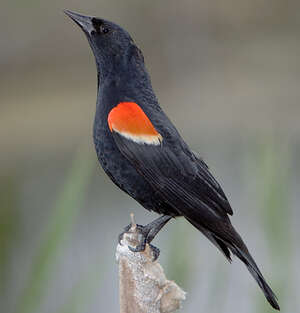
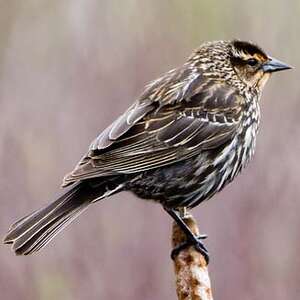
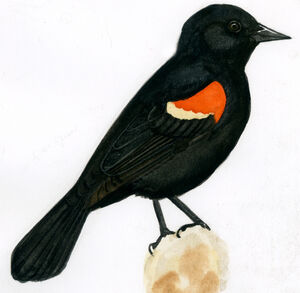
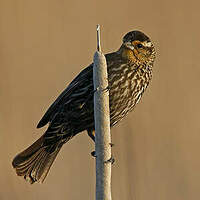
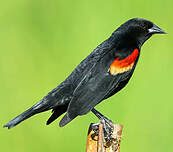
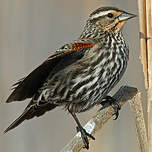
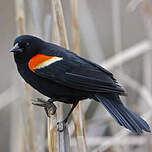
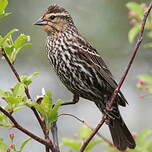
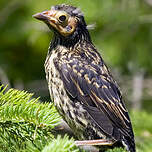
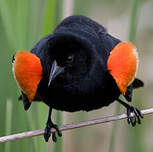
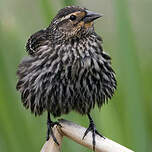
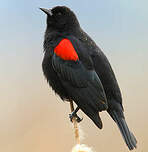
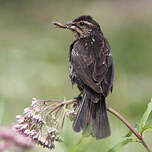
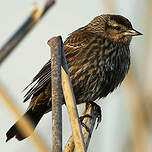
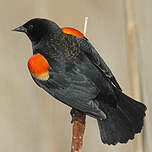
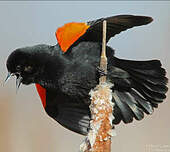
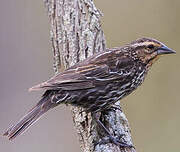
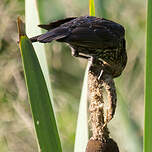
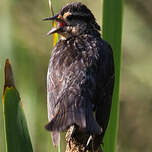
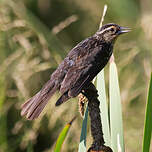
Red-winged Blackbird (Agelaius phoeniceus) is a species of bird in the Icteridae family.
Subspecific information 22 subspecies
- Agelaius phoeniceus phoeniceus (se Canada and e USA)
- Agelaius phoeniceus arctolegus (se Alaska, wc and c Canada and nc USA)
- Agelaius phoeniceus fortis (wc and sc USA)
- Agelaius phoeniceus nevadensis (inland sw Canada and nw and w USA)
- Agelaius phoeniceus caurinus (coastal sw Canada and nw and w USA)
- Agelaius phoeniceus sonoriensis (sw USA and nw Mexico)
- Agelaius phoeniceus nyaritensis (w Mexico to w El Salvador)
- Agelaius phoeniceus grinnelli (El Salvador to nw Costa Rica)
- Agelaius phoeniceus littoralis (coastal se USA from Texas to Florida)
- Agelaius phoeniceus mearnsi (se Georgia to sc Florida. se USA.)
- Agelaius phoeniceus floridanus (s Florida. se USA.)
- Agelaius phoeniceus megapotamus (s Texas. sc USA. to e Mexico)
- Agelaius phoeniceus nelsoni (sc Mexico)
- Agelaius phoeniceus richmondi (se and s Mexico to n Costa Rica)
- Agelaius phoeniceus pallidulus (se Mexico. n Yucatan Pen..)
- Agelaius phoeniceus arthuralleni (n Guatemala)
- Agelaius phoeniceus bryanti (nw Bahamas)
- Agelaius phoeniceus aciculatus (Kern County. s California in sw USA.)
- Agelaius phoeniceus neutralis (s California. sw USA. and nw Mexico)
- Agelaius phoeniceus mailliardorum (coastal c California. w USA.)
- Agelaius phoeniceus californicus (inland c California. w USA.)
- Agelaius phoeniceus gubernator (c Mexico)
Foreign names
- Carouge à épaulettes,
- Sargento alirrojo,
- graúna-de-asa-vermelha,
- Rotflügelstärling,
- pirosvállú csiröge,
- Epauletspreeuw,
- Ittero alirosse,
- rödvingetrupial,
- Rødvingetrupial,
- vlhovec červenokrídly,
- vlhovec červenokřídlý,
- Rødvinget Stærling,
- punaolkaturpiaali,
- sergent ala-roig,
- Blettasóti,
- epoletnik krasnoskrzydły,
- sarkansspārnu strazds,
- rdečeperuti škorčevec,
- Красноплечий чёрный трупиал,
- ハゴロモガラス,
- 红翅黑鹂,
- 紅翅黑鸝,
Habitat
Wetlands (inland) : Bogs, Marshes, Swamps, Fens, Peatlands ; Artificial/Terrestrial : Arable Land, Pastureland

Threats - protection
IUCN conservation status
Extinct
Threatened
Least
concern
concern
Extinc
in the Wild
in the Wild
Near
threatened
threatened
Not
evaluated
evaluated
EX
EW
CR
EN
VU
NT
LC
NE
Sources of information
- All About Birds, Cornell Lab of Ornithology
- Animal Diversity Web, University of Michigan Museum of Zoology
- Audubon,
- Avibase, Lepage Denis
- New World Blackbirds - The Icterids, Alvaro Jaramillo and Peter Burke
- IOC World Bird List (v14.1), Gill, F and D Donsker (Eds). 2024-04-18.
Other sources of interest

- Accipitriformes
- Aegotheliformes
- Anseriformes
- Apodiformes
- Apterygiformes
- Bucerotiformes
- Caprimulgiformes
- Cariamiformes
- Casuariiformes
- Charadriiformes
- Ciconiiformes
- Coliiformes
- Columbiformes
- Coraciiformes
- Cuculiformes
- Eurypygiformes
- Falconiformes
- Galliformes
- Gaviiformes
- Gruiformes
- Leptosomiformes
- Mesitornithiformes
- Musophagiformes
- Nyctibiiformes
- Opisthocomiformes
- Otidiformes
- Passeriformes
- Pelecaniformes
- Phaethontiformes
- Phoenicopteriformes
- Piciformes
- Podargiformes
- Podicipediformes
- Procellariiformes
- Psittaciformes
- Pterocliformes
- Rheiformes
- Sphenisciformes
- Steatornithiformes
- Strigiformes
- Struthioniformes
- Suliformes
- Tinamiformes
- Trogoniformes