
Whooper Swan
Cygnus cygnus - Cygne chanteur
Systematics
-
Order:
Anseriformes
-
Family:
Anatidés
-
Genus:
Cygnus
-
Species:
cygnus
Descriptor
Biometrics
- Size: 165 cm
- Wingspan: 205 à 243 cm.
- Weight: 8000 à 11000 g
Longevity
8 years
Geographic range

Identification
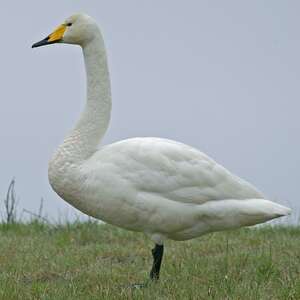
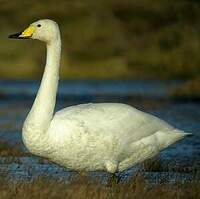
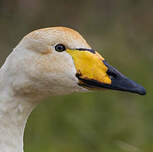
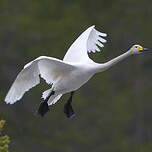
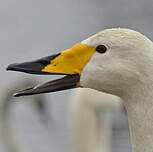
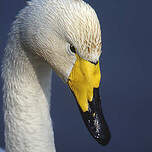
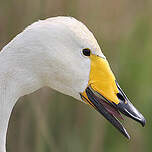
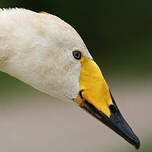
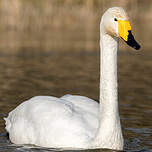
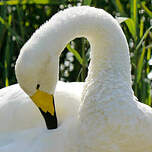
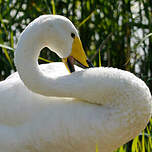
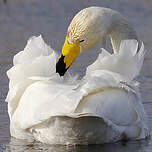
Size is similar to the Mute Swan, but there are noticeable differences. Whooper Swans have a yellow and black beak, a more rigid neck bearing in activiy as well as at rest, and, finally, their wings produce a musical sound when they fly.
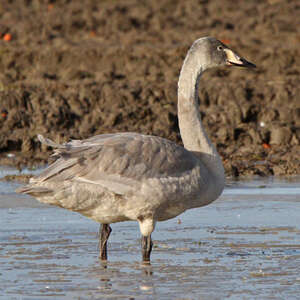
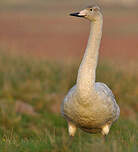
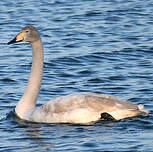
Their feathers are entirely white and their webbed feet are black. Juveniles show a greyish brown plumage. After one year, they get their adult one.
The Whooper Swan can also be mistaken for the Bewick Swan whose he's very close. There are two ways to differentiate them: the Whooper Swan is much bigger, with a longer neck and a more angulous head, and the beak's yellow/black layout is different. While the Whooper's Swan beak looks globally yellow with just a black tip, the Bewick's Swan's one is mainly black with a yellow base, sometimes half yellow, half black.
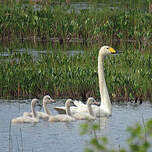
Unlike the Mute Swan, it never raises its wings above its back when it swims and its neck is straighter.
Subspecific information monotypic species
Foreign names
- Cygne chanteur,
- Cisne cantor,
- cisne-bravo,
- Singschwan,
- énekes hattyú,
- Wilde Zwaan,
- Cigno selvatico,
- sångsvan,
- Sangsvane,
- labuť spevavá,
- labuť zpěvná,
- Sangsvane,
- laulujoutsen,
- cigne cantaire,
- Álft,
- łabędź krzykliwy,
- ziemeļu gulbis,
- labod pevec,
- Лебедь-кликун,
- オオハクチョウ,
- 大天鹅,
- 黃嘴天鵝〔大天鵝〕,
Voice song and cries
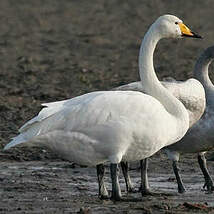
The Whooper Swan emits a loud 'whoop-whoop' call, sounding like a trumpet. It's the most noisy swan and his name has been given because of its singing variations. Their soft and modulated singing resound like the husky sound of a distant bell. Their singing melodies are made of 6 or 7 rising and descending notes.
The swan singing inspired numerous composers and philosophers who often transposed it as a farewell.
Habitat
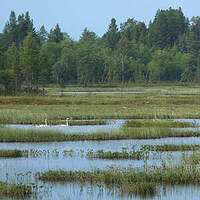
Whooper Swans nest mainly in Eurasian boreal regions. They split in three distinct groups. The most occidental one, with a stable population of about 16 000 individuals, nests in Iceland.
Behaviour character trait
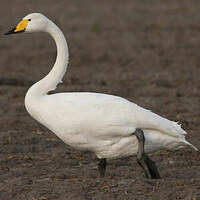
In its nidification aera, it frequents steppe lakes shallow waters, natural reservoirs and tundra ponds. In winter, Whooper Swans can be more often found in agricultural plains, close to the coast or more inside in liable to flooding plains.
Flight
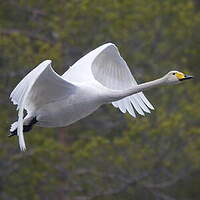
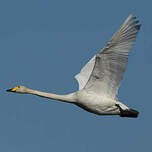
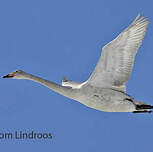
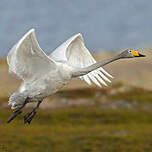
Whooper Swans are less nimble than their cousins when they take flight and they land. They slip longer on the water. They fly off loudly by running on the water. On the contrary, their flight is very silent.
Dietfeeding habits
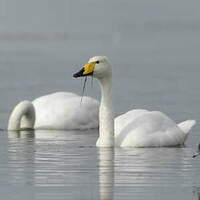
Essentially vegetarian. It eats aquatic plants and uses all parts of it (stems, leaves, roots, shoots). It also graze in prairies, like geese. It may eat small invertebrates, but it's a minor part of their diet.
Reproduction nesting
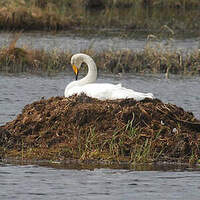
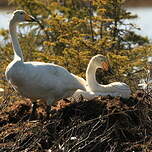
Pairs unite for lifetime. Males are very active in nest building. Their nest is bulky and made essentially with stems and leaves. The bottom is covered with twigs, leaves and feathers. In April-May, the female lays 4 to 7 eggs and sits on for 5 to 6 weeks. Chicks are precocious and are carried on the female's back under the male's aggressive watch and protection. Taking flight occurs 87 to 90 days after hatching.

Threats - protection
IUCN conservation status
concern
in the Wild
threatened
evaluated
They are threatened by trouble, alteration of their habitat, illegal hunting, lead pollution, and agricultural chemicals. High voltage lines don't seem to affect Whooper Swan's populations.
Sources of information
- IOC World Bird List (v14.1), Gill, F and D Donsker (Eds). 2024-04-18.
- Canards, cygnes et oies d'Europe, d'Asie et d'Amérique du Nord, Reeber Sébastien
- Les palmipèdes d'Europe, Géroudet P., MAJ M. Cuisin
- Wildfowl: An identification guide to the ducks geese and swans of the world, Madge, S and Burn, H
- Avibase, Lepage Denis
- Birds of the World, The Cornell Lab of Ornithology
- Liste rouge européenne, LPO
- xeno-canto, Sharing bird sounds from around the world,
Other sources of interest
 Specification sheet created on
18/04/2006 by Didier Collin with help of Daniel Le-Dantec
Specification sheet created on
18/04/2006 by Didier Collin with help of Daniel Le-DantecTranslation text by
published: 02-01-2021 - Updated: 02-01-2021
© 1996-2024 Oiseaux.net
- Accipitriformes
- Aegotheliformes
- Anseriformes
- Apodiformes
- Apterygiformes
- Bucerotiformes
- Caprimulgiformes
- Cariamiformes
- Casuariiformes
- Charadriiformes
- Ciconiiformes
- Coliiformes
- Columbiformes
- Coraciiformes
- Cuculiformes
- Eurypygiformes
- Falconiformes
- Galliformes
- Gaviiformes
- Gruiformes
- Leptosomiformes
- Mesitornithiformes
- Musophagiformes
- Nyctibiiformes
- Opisthocomiformes
- Otidiformes
- Passeriformes
- Pelecaniformes
- Phaethontiformes
- Phoenicopteriformes
- Piciformes
- Podargiformes
- Podicipediformes
- Procellariiformes
- Psittaciformes
- Pterocliformes
- Rheiformes
- Sphenisciformes
- Steatornithiformes
- Strigiformes
- Struthioniformes
- Suliformes
- Tinamiformes
- Trogoniformes