
Lesser White-fronted Goose
Anser erythropus - Oie naine
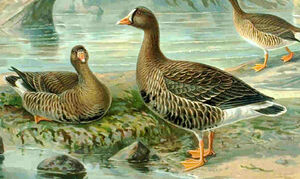
Systematics
-
Order:
Anseriformes
-
Family:
Anatidés
-
Genus:
Anser
-
Species:
erythropus
Descriptor
Biometrics
- Size: 66 cm
- Wingspan: 115 à 135 cm.
- Weight: 1950 à 2300 g
Geographic range

Identification
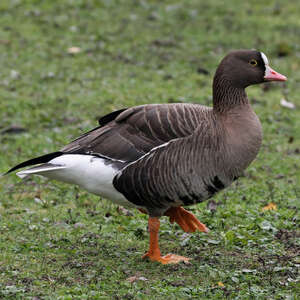
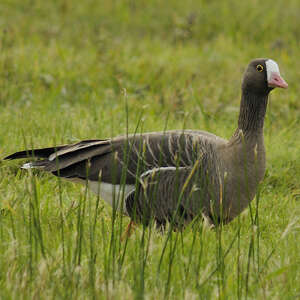
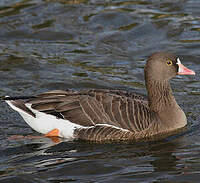
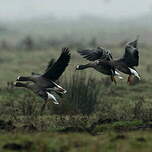
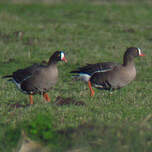
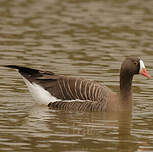
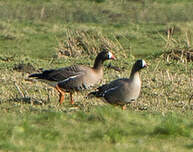
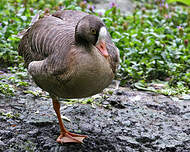
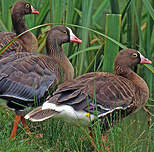
The Lesser White-fronted Goose is part of the grey geese group, along with the Greylag Goose, Red-breasted Goose, Barnacle Goose, Tundra Bean Goose, and Egyptian Goose, a group so named due to the color of the upper plumage which contains more or less grey. It is very similar to the Red-breasted Goose (white face, pink beak, black ventral bars and orange legs) and its identification requires a minimum of attention. This is why the following description will be comparative. As in all grey geese, there is no sexual dimorphism.
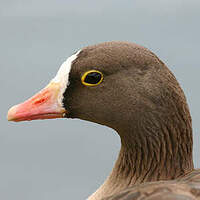
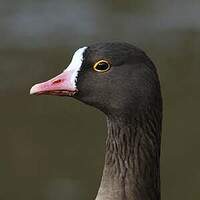
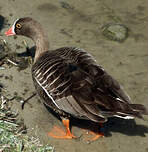
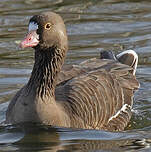
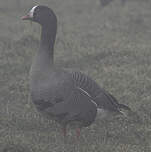
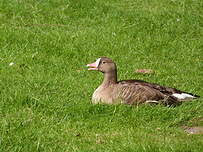
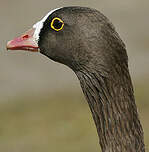
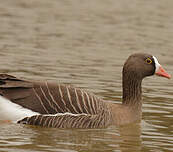
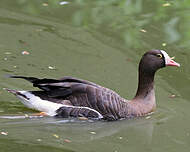
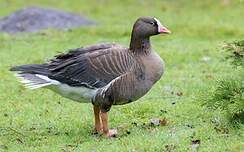
The Lesser White-fronted Goose is monotypic (no subspecies). The adult is slightly smaller than the Red-breasted Goose, with a slightly shorter neck, a rounder head with a bulging white forehead effect, and a shorter beak, but this can be quite subjective. It is absolutely necessary to have a good view of the head. The adult has a white face that extends in a point at the front of the crown (rounded white on the forehead of the Red-breasted Goose), a clear yellow eye ring, even in birds of the first winter (no eye ring or a narrower and much less evident eye ring in the Red-breasted Goose) and a shorter, triangular shaped pink beak in side view.
The juvenile does not have a white face or black ventral bars; these characteristics only develop in the late winter or spring and some birds of the second year acquire them later. The nostrils are dark and the legs have less vivid orange.
Subspecific information monotypic species
Foreign names
Voice song and cries
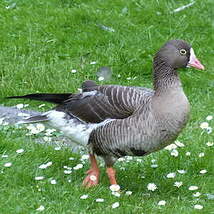
The vocalizations of the Lesser White-fronted Goose are quite varied. The intonation of their voice is higher than the laughter of its relatives, with its notes ringing louder. The most typical call is a kou you you followed by kaya kaya, krep krep krep..., ha ha ha ha and hra hra hra with many variations. Unless one is a specialist of this species, I don't think one can really rely on the voice to identify it.
Habitat
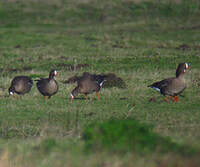
The Lesser White-fronted Goose inhabits open Arctic areas, in particular the shrub-covered tundra of the lower Arctic and the lightly-wooded northern fringe of the upper taiga zone.
Wintering areas lie further south. It mainly winters in western areas of the continent in dry grassland steppes, on semi-arid, short grassland areas, and, of course, on agricultural land. Oriental birds appear to favour wetter habitats, such as the reedbeds at the edge of bodies of water.
Dietfeeding habits
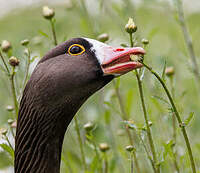
The Lesser White-fronted Goose is a strict vegetarian, carried all year round on two groups of herbaceous plants, the Poaceae (formerly Gramineae) and the Cyperaceae. It can be very dependent on their availability, especially if it specializes in certain ones. This can determine the location of breeding sites and reproductive success as well as the location of wintering areas.
Reproduction nesting
Reproduction is very late, linked to the high latitudes of the sites; it starts at the end of May or in June.
Geographic range

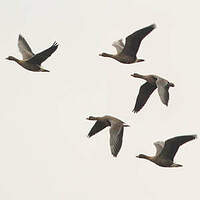
The Lesser White-fronted Goose breeds throughout the Eurasian Arctic, from northern Scandinavia to the extreme eastern Russian region of Anadyr. Its wintering area is divided into two. Birds from the western side of the continent migrate towards Central Europe, especially west of the Black Sea, and south towards the Caspian Sea and Mesopotamia. Eastern birds head east to China, South Korea and Japan.
Threats - protection
IUCN conservation status
concern
in the Wild
threatened
evaluated
The species is classified as 'vulnerable' by BirdLife International. All subpopulations are in decline and the downward trend is continuing. Rapid climate change in the Arctic due to global warming is possibly one of the causes. Wintering in politically unstable regions such as Iraq currently is certainly another. Finally, a low survival rate in the first years of life is another very negative parameter.
Sources of information
- IOC World Bird List (v14.1), Gill, F and D Donsker (Eds). 2024-04-18.
- Canards, cygnes et oies d'Europe, d'Asie et d'Amérique du Nord, Reeber Sébastien
- Ducks, Geese and Swans, Kear, J
- Guide des canards, des oies et des cygnes, Steve Madge
- Les palmipèdes d'Europe, Géroudet P., MAJ M. Cuisin
- Wildfowl: An identification guide to the ducks geese and swans of the world, Madge, S and Burn, H
- Avibase, Lepage Denis
- Birds of the World, The Cornell Lab of Ornithology
- xeno-canto, Sharing bird sounds from around the world,
Other sources of interest
 Specification sheet created on
27/07/2023 by Jean François
Specification sheet created on
27/07/2023 by Jean FrançoisTranslation by AI Oiseaux.net
published: 21-12-2020 - Updated: 24-12-2020
© 1996-2024 Oiseaux.net
- Accipitriformes
- Aegotheliformes
- Anseriformes
- Apodiformes
- Apterygiformes
- Bucerotiformes
- Caprimulgiformes
- Cariamiformes
- Casuariiformes
- Charadriiformes
- Ciconiiformes
- Coliiformes
- Columbiformes
- Coraciiformes
- Cuculiformes
- Eurypygiformes
- Falconiformes
- Galliformes
- Gaviiformes
- Gruiformes
- Leptosomiformes
- Mesitornithiformes
- Musophagiformes
- Nyctibiiformes
- Opisthocomiformes
- Otidiformes
- Passeriformes
- Pelecaniformes
- Phaethontiformes
- Phoenicopteriformes
- Piciformes
- Podargiformes
- Podicipediformes
- Procellariiformes
- Psittaciformes
- Pterocliformes
- Rheiformes
- Sphenisciformes
- Steatornithiformes
- Strigiformes
- Struthioniformes
- Suliformes
- Tinamiformes
- Trogoniformes