Mallard
Anas platyrhynchos - Canard colvert
Systematics
-
Order:
Anseriformes
-
Family:
Anatidés
-
Genus:
Anas
-
Species:
platyrhynchos
Descriptor
Biometrics
- Size: 65 cm
- Wingspan: 75 à 100 cm.
- Weight: 850 à 1400 g
Longevity
29 years
Geographic range

Identification
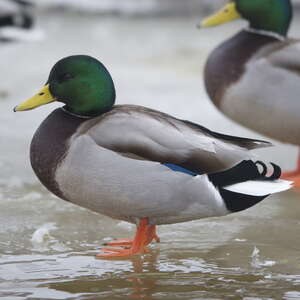
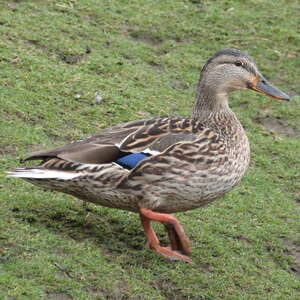
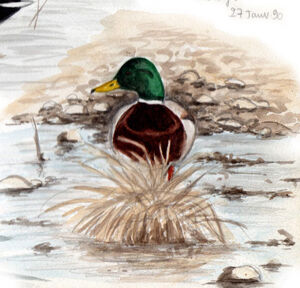
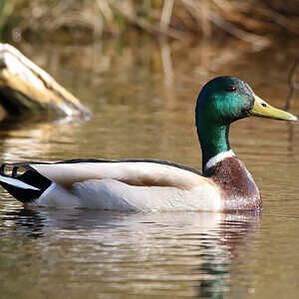
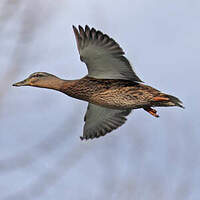
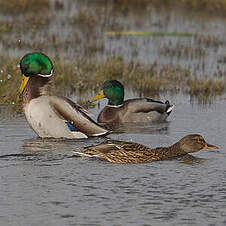
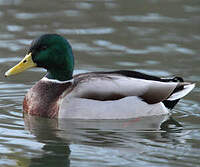
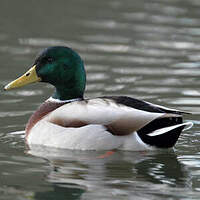
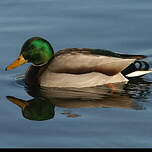
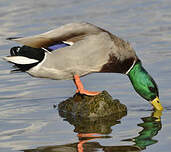
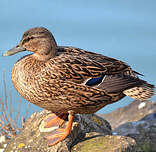
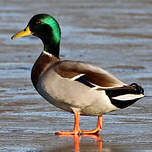
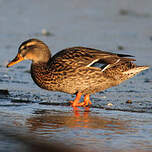
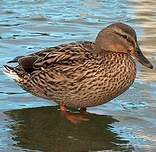
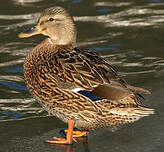
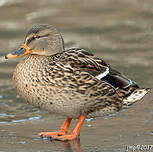
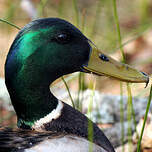
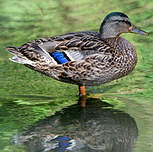
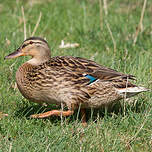
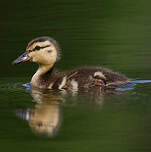
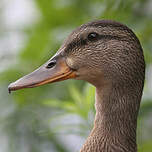
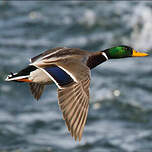
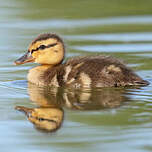
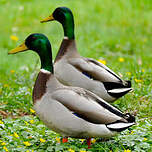
The Mallard is the most common of the so-called surface ducks, meaning those ducks which do not have the ability to dive due to their morphology. It is also the largest of them. Sexual dimorphism is very pronounced. The male in breeding plumage is easily recognizable by its head and its neck of a bright green in bright light. That is what gave it its name. A white collar separates the green of the neck from the dark brown of the chest. The back is light brown, bordered by gray and brown scapulae. The underneath of the body is light gray. Against the black background of the rump and undertail coverts, the white sides of the tail are clearly visible. The central rectrices are black and curved into a staff. The wings are brown above and white below. In the top view, the wing shows a iridescent blue mirror framed by two white lines at the level of the secondaries, a very visible signal when flying. The dark eye does not stand out at all. The beak is lemon-yellow with a black nail. The legs are orange. The female is very different from the male. Its plumage is entirely dead leaves brown, with on each feather an alternation of light rusty-brown and dark brown zones. The bottom parts are just slightly lighter. The head is more uniform, with a dark brown cap and a dark line on the eye. The beak is two-tone, brown-gray with yellow-orange at the margin and at the tip. The white outer rectrices are also well visible. The wing has the same blue mirror as that of the male. The legs are orange. The male in eclipse looks somewhat like the female, but is larger, has a gray head with a very dark cap, but above all keeps the yellow beak. This late summer phase is short. The juvenile looks a lot like the female, but its plumage is overall darker and colder.Its beak is entirely greyish, with at most a hint of yellow.
Subspecific information 2 subspecies
- Anas platyrhynchos platyrhynchos (Europe, Asia, North America)
- Anas platyrhynchos conboschas (Greenland)
Foreign names
- Canard colvert,
- Ánade azulón,
- pato-real,
- Stockente,
- tőkés réce,
- Wilde Eend,
- Germano reale,
- gräsand,
- Stokkand,
- kačica divá,
- kachna divoká,
- Gråand,
- sinisorsa,
- Groenkopeend,
- ànec collverd,
- Stokkönd,
- krzyżówka,
- meža pīle,
- mlakarica,
- Кряква,
- Itik kalung,
- マガモ,
- 绿头鸭,
- เป็ดหัวเขียว,
- 綠頭鴨,
Voice song and cries
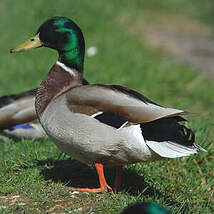
The Mallard is not stingy with his voice. The female at take-off emits a loud ouink, often repeated. She is also the one who emits the well-known quack, made up of the same syllable but faster and decreasing ouink ouink ouink ouink ouink.... The male emits a high-pitched, impure, nasal cry heinh heinh heinh... at flight. On parade, it produces loud whistles. In addition to all this, the birds chatter among themselves and have a varied but unscripted vocabulary. Same within the families in spring.
Habitat
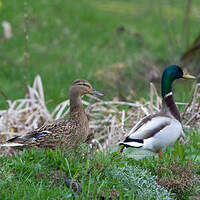
Mallards have low habitat requirements. They frequent all kinds of wetland habitats, both static and flowing, from small seasonal water points to larger bodies of water and from small streams to large rivers.
Behaviour character trait
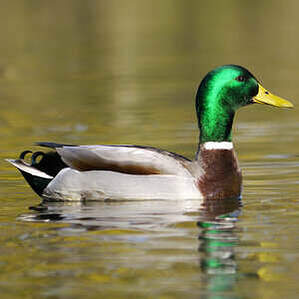
The Mallard is a surface-dwelling "dabbling" duck that feeds in shallow water. It progresses slowly by rocking its body and dipping its head below the surface, while holding its tail vertically. It maintains this position by paddling its feet while its bill digs through the mud or vegetation. It regularly stands up to breathe. At dusk, Mallards leave the water to feed on the surrounding countryside. This is when hunters can be waiting to shoot them, of course on authorised dates. The courtship display sees the male exhibiting its shiny feathers. It swims around the female with its neck stretched out, followed by its head being thrown back onto its back while straightening its body, with a puffed up chest.
Flight
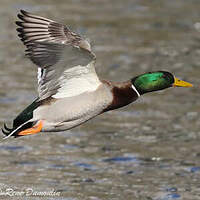
The Mallard, with its large size and weight, has a very energetic flight. It is able to take off from the surface of the water in a single leap, like other surface ducks.
Dietfeeding habits
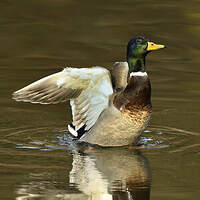
The Mallard is eclectic when it comes to its diet- it is an omnivore. During breeding season, its diet consists mainly of animal food items (snails, slugs, worms, insects and their larvae, small fish, tadpoles...). Its beak is capable of filtering out small aquatic prey. In the interseason, its diet is more clearly vegetarian, consisting of various aquatic and non-aquatic plants and seeds.
Reproduction nesting
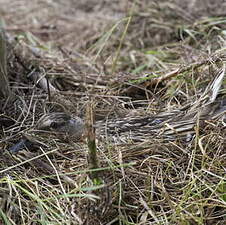
Before breeding, as mentioned above, Mallards tend to nest on the margins of marshes, ponds, and rivers, sheltered from a possible rise in water levels.
Geographic range

The Mallard is a holarctic species present in all of the northern hemisphere (North America, Greenland, Iceland and Eurasia up to the far east, such as Kamchatka and Japan). The northernmost populations (Alaska and Canada, Greenland, Iceland, north of Scandinavia and all of Siberia and Central Asia) are migratory and travel to the south of the nesting area and more to the south (south of the United States and Mexico, Mediterranean, Nile Valley, Mesopotamia and the large alluvial areas in Pakistan, north of India and south of China) in winter.
Threats - protection
IUCN conservation status
concern
in the Wild
threatened
evaluated
The Mallard is not threatened. It is the most numerous species of duck everywhere. This is probably due to its great plasticity and adaptability. That being said, human activities such as hunting or the use of pesticides in agriculture, or early drying of habitats for example, can only have a negative effect on the population, currently partly offset by better winter survival due to climate change and adaptation to very heavily anthropized habitats.
Sources of information
- IOC World Bird List (v14.1), Gill, F and D Donsker (Eds). 2024-04-18.
- Les palmipèdes d'Europe, Géroudet P., MAJ M. Cuisin
- Birds of the World, The Cornell Lab of Ornithology
- xeno-canto, Sharing bird sounds from around the world,
Other sources of interest
 Specification sheet created on
11/07/2023 by Jean François
Specification sheet created on
11/07/2023 by Jean FrançoisTranslation by AI Oiseaux.net
published: 17-10-2020 - Updated: 17-10-2020
© 1996-2024 Oiseaux.net
- Accipitriformes
- Aegotheliformes
- Anseriformes
- Apodiformes
- Apterygiformes
- Bucerotiformes
- Caprimulgiformes
- Cariamiformes
- Casuariiformes
- Charadriiformes
- Ciconiiformes
- Coliiformes
- Columbiformes
- Coraciiformes
- Cuculiformes
- Eurypygiformes
- Falconiformes
- Galliformes
- Gaviiformes
- Gruiformes
- Leptosomiformes
- Mesitornithiformes
- Musophagiformes
- Nyctibiiformes
- Opisthocomiformes
- Otidiformes
- Passeriformes
- Pelecaniformes
- Phaethontiformes
- Phoenicopteriformes
- Piciformes
- Podargiformes
- Podicipediformes
- Procellariiformes
- Psittaciformes
- Pterocliformes
- Rheiformes
- Sphenisciformes
- Steatornithiformes
- Strigiformes
- Struthioniformes
- Suliformes
- Tinamiformes
- Trogoniformes